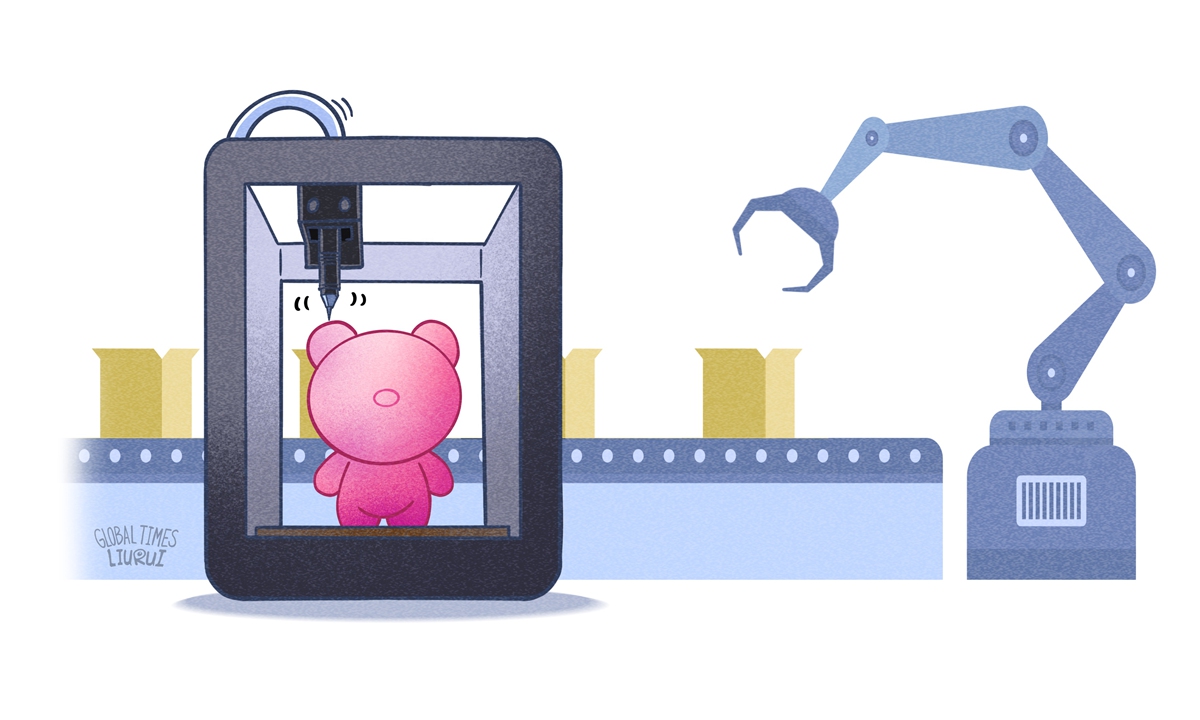
Illustration: Liu Rui/GT
The 15th China International Animation Copyright Fair, held from Friday to Monday in Shipai town, Dongguan city, South China's Guangdong Province, attracted a higher level of international participation and a stronger presence of leading industry players compared with recent editions. More than 600 enterprises and institutions from more than 40 countries and regions showcased more than 2,000 items of intellectual property (IP), according to Guangdong Fabu, the official WeChat account of the Information Office, Peoples's Government of Guangdong Province.This dynamic gathering vividly illustrates the rapid growth and expanding global reach of China's cultural and creative sectors. The event underscored a deeper economic narrative - China's emerging new growth drivers fueled by innovation. A typical illustration of this transformation is Dongguan's art toy industry, a key pillar in the city's economic shift from traditional manufacturing to high value-added innovation.
Once known as an important traditional manufacturing hub, Dongguan is now actively pursuing industrial upgrading and diversification. In this process, the robust industrial strength of the city has not only boosted production efficiency but also propelled the upgrading of the industry chain and the rise in value creation.
In 2023, Dongguan was recognized as China's "Capital of Art Toys" by the China Toy and Juvenile Products Association. The city, which encompasses all segments of the industry chain from design to production, makes 25 percent of the world's anime derivatives and nearly 85 percent of China's art toys, China City News reported in June.
The city's emergence as a new capital of art toys exemplifies China's broader economic transformation - from traditional manufacturing to a knowledge- and creativity-driven model. Companies are increasingly prioritizing product differentiation, brand building, and cultural innovation, moving beyond the conventional "Made in China" label toward "Created in China." This shift highlights the industry's core competitiveness and reflects China's larger ambition to become a global innovation powerhouse.
An example of this transformation is the success of the Nezha IP. Rooted in Chinese mythology, Nezha-related merchandise has become highly popular following the success of the "Ne Zha 2" movie, which was in theaters in the Chinese mainland from January 29 to March 30, and companies in Shipai town secured 100 million yuan ($14 million) in orders in March for related merchandise and toys, local media outlets reported in March.
Similarly, Labubu, an original IP known for its unique design and cultural depth, has sparked a fervent following overseas, establishing itself as a flagship brand for China's art toys on the global stage.
The rising international recognition of these Chinese IP products underscores that the value of China's art toy industry lies as much in its creative cultural content and brand influence as in its manufacturing excellence.
The rise of the art toy industry is closely linked to China's ongoing consumption upgrade, characterized by a shift toward more spiritual and cultural consumption. This trend reflects the evolving preferences of increasingly sophisticated consumers, who seek products that offer emotional connection and cultural expression.
Technology also plays a pivotal role in driving the industry's evolution. Dongguan's art toy enterprises have actively embraced artificial intelligence and other advanced technologies to enhance product interactivity and consumer engagement. For example, this expo showcased innovative experiences of animation and art toys, featuring glasses-free 3D displays, augmented reality interactions, and lifelike humanoid robot engagements.
Furthermore, the industry's growth reflects a strengthened industrial ecosystem, supported by IP development, copyright transactions, and cross-sector collaboration. These efforts have helped create a more mature and sustainable business environment, fostering innovation and protecting creative assets.
This deep integration of technology and culture not only elevates the consumer experience but also accelerates industry upgrading and contributes to China's high-quality economic development. By focusing on high value-added products and upgrading the entire industry chain, China's art toy industry is expected to continue consolidating its position in the global market.
The sector's sustained growth will further drive China's broader economic transformation toward a more creative, innovative, and high-value economy. As Dongguan leads the charge, the art toy industry exemplifies how cultural creativity, industrial strength, and technological innovation combine to shape the future of China's economy.
The author is a reporter with the Global Times. bizopinion@globaltimes.com.cn
RELATED ARTICLES