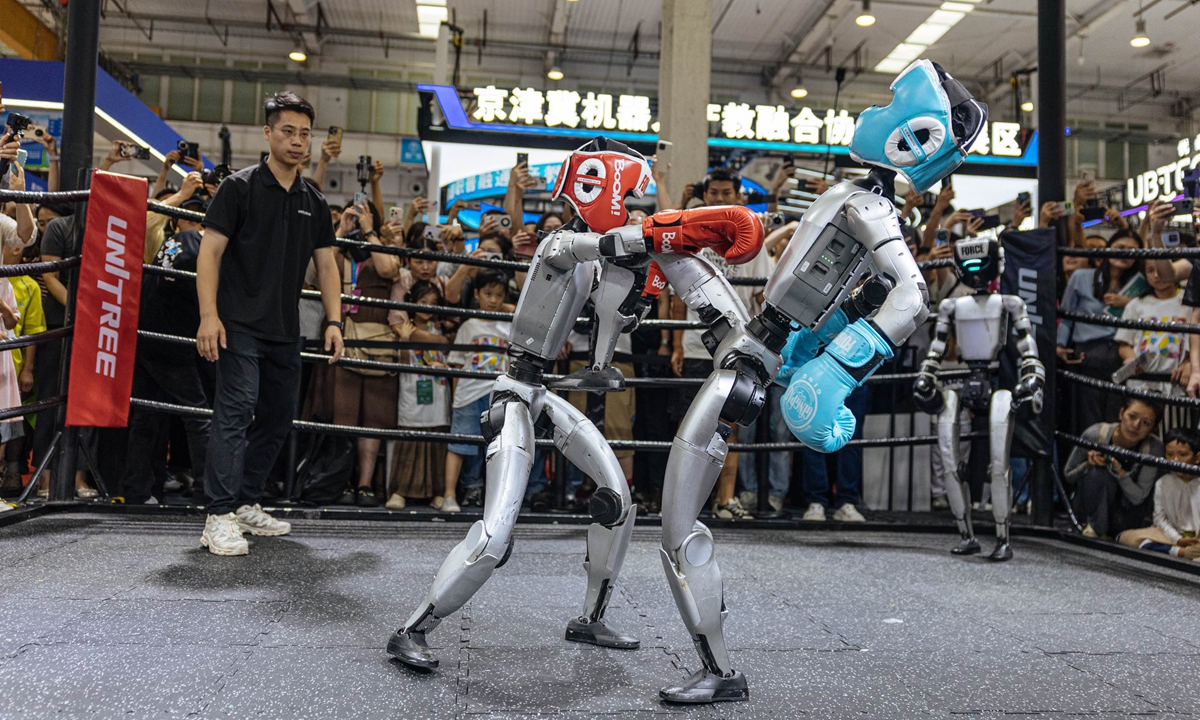
Two humanoid robots engage in a boxing match on August 8, 2025, during the 2025 World Robot Conference in Beijing. The event features over 1,500 cutting-edge products from domestic and international companies, up 25 percent from the previous edition. Photo: Li Hao/GT
This August seemingly marks the arrival of "robotics carnival" in Beijing. The 2025 World Robot Conference (WRC) is being held from Friday to Tuesday in Yizhuang, Beijing. With 1,500 exhibits filling an exhibition hall covering 50,000 square meters, the event has wowed the audience. From August 14 to 17, the 2025 World Humanoid Robot Games will take place in Beijing's National Speed Skating Oval, where 280 teams and over 500 humanoid robots from 16 countries across five continents will compete on the same stage. These two grand events, taking place back-to-back, have not only brought a strong sense of the future, but also showcased the surging momentum of China's new quality productive forces.
The 2025 WRC has set new records in both scale and "concentration" of innovation. A record 50 manufacturers of full-body humanoid robots are participating in the same event. In Addition, more than 100 new products, nearly double that of last year, are making their global debut. The humanoid robot Tien Kung 2.0 hosted the opening ceremony of the conference; Unitree's G1 humanoid robot engaged in a fighting match; UBTECH's Walker S2 robot autonomously swapped its battery in three minutes; and Shenzhen-based Cyborg Robotics' bionic dexterous hand demonstrated its heavy lifting skills - all these performances highlight the rapid progress of China's robotics technology. Another distinctive feature of the conference is embedding "consumption" into the industrial loop. Yizhuang launched the world's first "E-Town Robot Consumption Festival," opening the world's first 4S store dedicated to embodied artificial intelligence (AI) robots and a robot-themed restaurant, upgrading "exhibitions for visit" into "exhibitions for consumption." The prospect of a future where access to robots will be as convenient as buying a car is stimulating two-way vitality between production and consumption.
Judging by the response of international media, the appeal of this innovation-driven event has crossed national borders, igniting global enthusiasm for future productive forces. "World Robot Conference opens in Beijing with devices that dance, hug and shoot hoops," reported Nikkei Asia, noting that China's humanoid robot exhibition is sparking an "investment frenzy." Titled "Shopping for a robot? China's new robot store in photos," an Associated Press article showcases images of various robots on display. A BBC reporter also filmed a robot in the exhibition hall resembling Albert Einstein, highlighting the "wide range of" humanoid robots at the event. Reuters focused on how Chinese robots can now "play roles" such as chess partners or pet dogs, showcasing a wide range of application scenarios. Here, the world is seeing not only dazzling technology, but also a new path for human development led by innovation.
The 2025 WRC not only serves as a platform for showcasing technology but also as a testing ground for exploring commercialization pathways to accelerate the future industries, such as humanoid robots. Wang Xingxing, founder of robotics company Unitree Robotics, said robots are currently still largely in the "performance stage," and the ultimate goal for robots is to "get the work done." He also envisioned that when robots can truly work in large numbers in the future, the state could well require companies to pay a tax on every robot that rolls off the production line. These ideas, however, are not without basis. Currently, China's industrial robots cover 71 major categories of the national economy, and the density of manufacturing robots has jumped to third in the world. In JD's "Asia No.1" warehouse, robots can shelve 20,000 items in just one minute. From industries to households, robots are increasingly integrating into production and daily life in smarter and more compassionate ways.
In Morgan Stanley's "Humanoid 100" list released earlier this year, China has 35 companies recognized as being in the world's "top tier." Chinese enterprises have made remarkable advancements in the field of humanoid robots, benefiting from a mature supply chain, extensive application scenarios, and robust policy support. The Ministry of Industry and Information Technology's "Guiding Opinion on the Innovation and Development of Humanoid Robots" called it a new track for future industries, and many areas in China have implemented supporting policies and allocated special funds to facilitate breakthroughs in key technologies. If the stream of innovation from the private sector has given wings to China's robot industry, then the encouragement and support from policies have provided a clear sky for the industry to soar.
China has consistently embraced the wave of global robot industry development with an open attitude. The theme of the 2025 WRC, "Making Robots Smarter, Making Embodied Agents More Intelligent," reflects a shared vision for the development of the global industry. Since the conference's inception 10 years ago, the number of international supporting organizations and participating international guests has significantly increased. This year, the "Tiangong Ultra" series of robots, which won the championship in the humanoid robot half-marathon, has been open-sourced to the world since last year. The increasingly frequent and well-received "robotics carnival" showcases a certain norm of "innovative China." Each robot that can be touched, purchased, and engaged in a race represents a reflection of China's rising new quality productive forces and serves as the latest public product that China offers for global economic recovery and industrial upgrading.
RELATED ARTICLES