IN-DEPTH / IN-DEPTH
Guardians of Memory: Over 30 trips to Japan in 27 years to gather evidence and seek testimonies: An exclusive interview with Unit 731 military crime exhibition hall director
By in Harbin Published: Aug 11, 2025 11:41 PM Updated: Aug 11, 2025 11:52 PM

Editor's Note:
This year marks the 80th anniversary of the victory of the Chinese People's War of Resistance against Japanese Aggression (1931-1945) and the World Anti-Fascist War. Winning the war is a great victory of the national spirit with patriotism at its core, a great victory achieved with the Communist Party of China (CPC) fighting as the central pillar, a great victory fought by the whole nation through solidarity and bravery, and a great victory for the Chinese people, anti-fascist allies, and people around the world who fought shoulder-to-shoulder.
To commemorate this historic milestone and its lasting impact, the Global Times has launched a themed series revisiting the great significance of the victory through three lenses: The "Guardians of Memory," the "Witnesses of Struggle," and the "Practitioners of Peace." It underscores the importance of "learning from history to build together a brighter future."
This is the sixth installment of the "Guardians of Memory" series, the Global Times exclusively spoke with Jin Chengmin, the director of the Exhibition Hall of Evidences of Crime Committed by Unit 731 of the Japanese Imperial Army in Harbin, listening to the stories behind his cross-border search for evidence. As the first domestic scholar to discover a large number of core evidence of Unit 731's crimes, he was also the first to propose legal notarization for the victims of Unit 731, according to Xinhua.
Unit 731 was the codename for a covert Japanese military medical unit from 1932 to 1945, responsible for bacterial warfare and human experiments that killed over 3,000 Chinese, Korean, Soviet, and Western prisoners of war in brutal tests. The Japanese militarists secretly designated an area of 6.1 square kilometers in the Pingfang district of Harbin city in 1936, establishing the world's largest biological warfare base, according to the Xinhua News Agency.
Decades later, one Chinese man tirelessly crossed oceans to unearth secrets "buried in graves" as ordered by Japan's militarists. At the end of some Unit 731 members' lives, he broke through their fear, evasion, and rejection, eliciting their confessions to crimes, with testimonies filled with guilt and remorse.
The relentless truth seeker is Jin Chengmin, the director of the Exhibition Hall of Evidences of Crime Committed by Unit 731 of the Japanese Imperial Army in Harbin. In 27 years, he made over 30 trips to Japan to extract testimonies from Japanese Unit 731 members, tracked down over 130 survivors and laborers recruited by the Japanese unit across China, and searched for records of this little-known history in the international community that spans more than a decade in multiple countries including the US and Russia.
'If you've forgotten, should we still remember?'
"More than three decades later, I still remember a Chinese-Japanese academic seminar in Beijing where a Japanese expert said softly, 'If you've all forgotten, should we still remember?' The implication was: If the victims have forgotten, must the perpetrators keep remembering?" This remark struck Jin as more of a taunt than a piece of advice.
"With almost no survivors, restoring the truth behind the Unit 731's crimes relies heavily on perpetrators' accounts. But they almost withdrew en masse, deliberately concealing their crimes. We must cross barriers to reach the truth, compelling perpetrators to testify for credible history," Jin told Global Times, referring his work as a "rescue mission" for history.
Since 1998, he has preserved 423 hours of video testimony, now irreplaceable as witnesses pass away.
Jin notes a "right-wing" shift in Japan's government and society regarding Unit 731. "Only four verified veterans remain, the youngest over 90 years old. Their dwindling numbers are what Japan's right-wing desires - without witnesses, they can distort history unchecked. Our memory salvage is a race against time," he said, underscoring the urgency of notarizing victims and gathering cross-border evidence amid Japan's denials.
His discoveries, including the "special transfer" files and frostbite experiment records, provide undeniable proof. Back then, the experimental materials were obtained through a process called "special transfer," a nefarious scheme by Japanese militarists to bypass judicial procedures and send people to the unit for live experimentation.
When asked to characterize Unit 731's crimes, Jin paused solemnly: "Some call it a massacre, but that's imprecise. It was an unprecedented medical crime against humanity, using bacterial weapons - one of the three deadliest weapons alongside chemical and nuclear."
"When Unit 731 retreated, they carried out what they called 'decontamination.' It meant not only annihilating the victims' bodies and erasing their names but also incinerating their corpses in furnaces to leave no trace. All experimental reports were disguised with codenames and aliases to ensure secrecy. In essence, they completely stripped the victims of their fundamental human attributes," explained Jin.
Beyond core military doctors, he interviewed drivers, guards, and youth corps members to refute claims that Unit 731 was the work of a few rogue scientists. "It was a top-down, organized, premeditated, large-scale state crime orchestrated by Japan's government, with no room for evasion."
Cross-border pursuit of Unit 731 members' testimonies aims to prove history can neither be sanitized nor falsified, said Jin.
'We must not let them fade from history'
731 Biochemical Revelations, a war-themed Chinese film, is set for release on September 18, the 94th anniversary of Japan's invasion of China, which foreshadowed WWII in Asia and made China the first to resist fascism. It exposes the crimes of Unit 731 through the tortuous fate of a nonentity. Yet, history includes perpetrators' voices too.
The Exhibition Hall of Evidence of Crimes Committed by Unit 731 of the Japanese Imperial Army unveiled the complete video testimony of former Unit 731 member Masakuni Kurumizawa for the first time on July 7, the 88th anniversary of the July 7 Incident, an event that marked the start of Japan's full-scale invasion of China and China's whole-nation resistance against Japanese invaders.
"I dissected 300 human bodies, about one-third of which were preserved as specimens, while the rest were burned. When we performed the dissection, the bodies were still warm, and blood spurted out," Kurumizawa said in the video.
Jin noted that this "living evidence" reveals the anti-human atrocities of Japanese militarism from the perpetrators' perspective, further exposing the full extent of its crimes.
In Japan, the government has insisted that there are no data showing the details of the activities of the Unit 731. However, it turns out that such documents do exist. Japanese Communist Party lawmaker Yamazoe Taku, at a House of Councilors Budget Committee meeting on March 21, pointed to a public record of the unit's human experimentation and brought to light the government's deception in claiming that there were no such documents, Japanese media outlets reported.
Yamazoe Taku remains in contact with Jin. Jin acknowledges that such truth-facing Japanese politicians are a rare, isolated minority in today's political and social landscape. Yet, over a period of 27 years, repentance from some Unit 731 members and support from some Japanese social organizations on post-war issues have sustained him. One example is Shimizu Hideo.
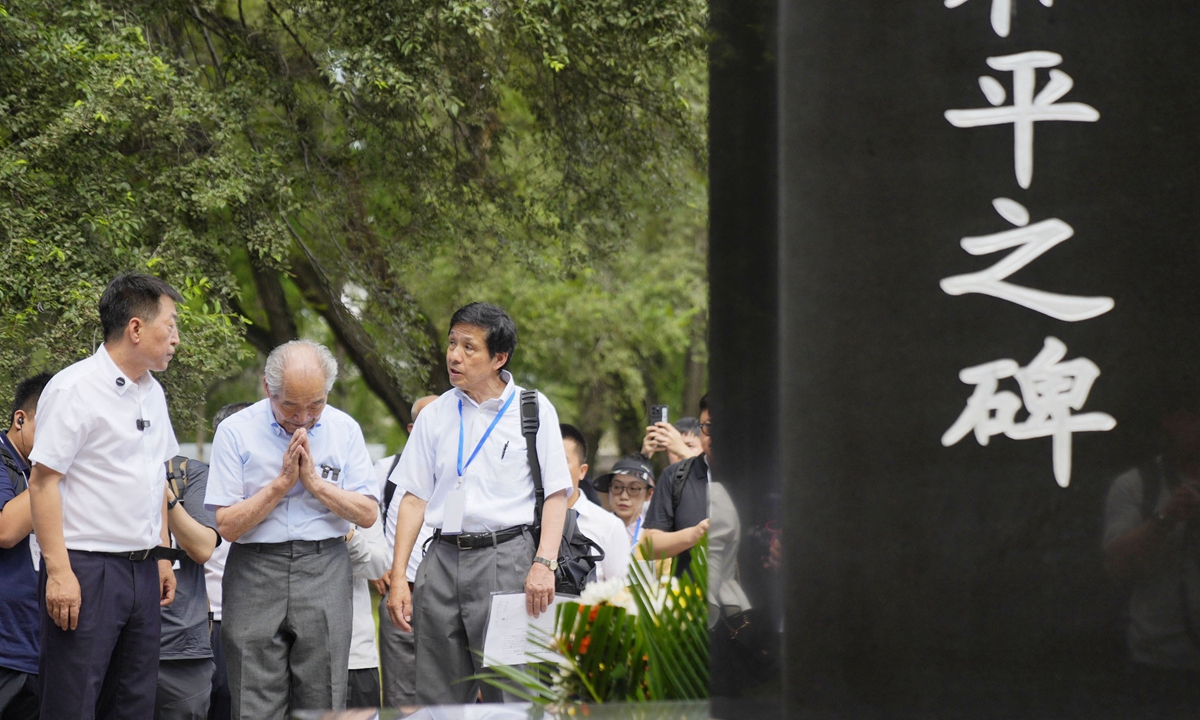
On August 13, 2024, Jin accompanied the 94-year-old to Unit 731's former site in Harbin, where he repented before the "Peace and Non-War Monument." Drafted at 14 in March 1945, Shimizu served at Unit 731's headquarters, Japan's bacterial warfare hub. His visit solidified the crime's evidence chain.
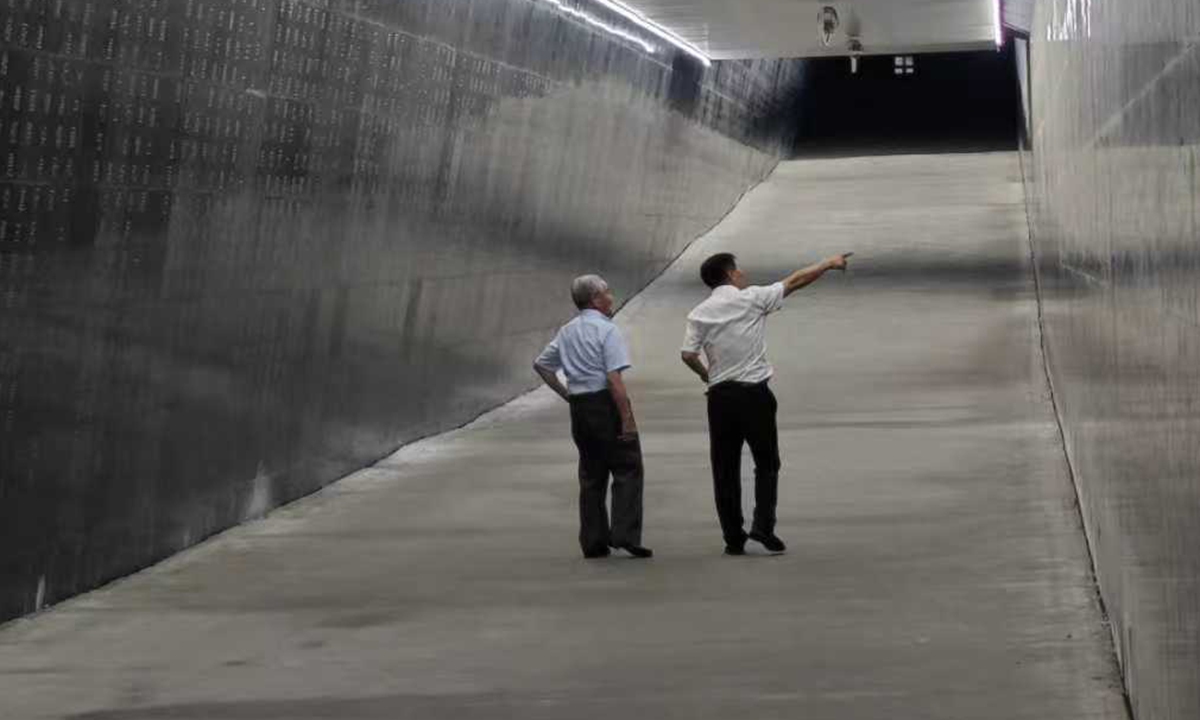
At the exit of the crime evidences exhibition hall, a 76-meter-long tunnel connects the new museum to the original Unit 731 site. The "testimony wall" along the tunnel lining both sides is etched with confessions from former Unit 731 members and victims' oral accounts. A photograph captures Jin and Shimizu Hideo walking side by side through the "testimony wall" corridor. The wall, like a string of silent notes, evokes a dialogue spanning decades - a conversation across time between a repentant perpetrator and a guardian of memory.
"After repenting in China, Shimizu fell ill but persevered to face historical truth, despite family opposition and community ostracism. Right-wing attacks labeled him a 'Japanese enemy,' even calling for his death. Some face threats while some pay with their lives. We must not let them fade from history," Jin said.
He also told the Global Times that there are many other China-friendly figures in Japan. Besieged by right-wingers-with smoke bombs thrown into homes, some needing bulletproof vests to work, and labeled "traitors" by fellow citizens-they insist they are true patriots. Their perseverance aims to make Japan remember history and stop from repeating past errors, yet their stories are rarely reported.
'Speaking out' is liberation for them
Of the Unit 731 members Jin approached, fewer than 30 provided testimony. Some refused meetings; some met but stayed silent; some spoke only to other Japanese people; some opened up only on their deathbeds. "In Japan, we met low-ranking Unit 731 military personnel who hid their identities post-war, tormented by their past," Jin said.
Jin found out that many senior Unit 731 officers returned to Japan under new names, taking posts in universities, research institutes or major firms - some even becoming presidents, directors or professors. This disparity spurred some low-ranking members to expose truths. "Psychologically, they bore the burden of concealment, but with nothing to lose in old age, confessing was liberation, freeing them from guilt. Suzuki Shizuo, haunted by experiments performed on a Soviet mother and daughter, found relief after confessing," Jin said.
Jin recalled visiting one Unit 731 member more than three times. Polite but evasive, he skirted Unit 731 topics, interrupted by family or falling silent. On the final visit, Jin nearly lost hope. As a parting shot, he dismissed his family, took Jin to a tavern, and said, "I know why you're here. I won't let you leave empty-handed. I'll tell you what I did."
Few dare to open this 'black box'
The Exhibition Hall of Evidences of Crime Committed by Unit 731 of the Japanese Imperial Army now stands east of Unit 731's original site, a rectangular black-gray building.
Jin told Global Times that its design draws inspiration from an airplane's black box. The hidden data and secret history of Unit 731 are preserved within its walls. "To uncover the truth, visit the black box," Jin said. "Its half-buried design reflects Unit 731's collapse, like a fallen aircraft."
The Unit 731 site is the world's largest, best-preserved bacterial warfare relic. In 2022, for the ninth national memorial ceremony for the Nanjing Massacre victims, the renovated museum unveiled over 20,000 artifacts, documents, and records, providing new proof of Unit 731's experiments and warfare. It also depicts the post-war US-Japan deal, through which the US monopolized Unit 731's brutal "medical results" for strategic gain, excluding the interests of victim countries including China and the Soviet Union. "Japan destroyed evidence and evades history, abetting the cover-up, as shown in our exhibits. Few dare face this black box," Jin said.
Jin's greatest aspiration is to secure UNESCO World Heritage status for the site, recognized globally for its significance. "Preserving dozens of Unit 731 relics is a major contribution to humanity. It deserves to be a patriotic and anti-fascist education base," he said.
Despite dwindling evidence, Jin persists in cross-border truth-seeking, advocating for objective, neutral narration.
"I see the crime evidences exhibition hall as a 'bastion of peace,' not merely cherishing or advocating peace - I cannot stop wars, but I will walk the path of defending peace. Those who join us are comrades in this mission."
This year marks the 80th anniversary of the victory of the Chinese People's War of Resistance against Japanese Aggression (1931-1945) and the World Anti-Fascist War. Winning the war is a great victory of the national spirit with patriotism at its core, a great victory achieved with the Communist Party of China (CPC) fighting as the central pillar, a great victory fought by the whole nation through solidarity and bravery, and a great victory for the Chinese people, anti-fascist allies, and people around the world who fought shoulder-to-shoulder.
To commemorate this historic milestone and its lasting impact, the Global Times has launched a themed series revisiting the great significance of the victory through three lenses: The "Guardians of Memory," the "Witnesses of Struggle," and the "Practitioners of Peace." It underscores the importance of "learning from history to build together a brighter future."
This is the sixth installment of the "Guardians of Memory" series, the Global Times exclusively spoke with Jin Chengmin, the director of the Exhibition Hall of Evidences of Crime Committed by Unit 731 of the Japanese Imperial Army in Harbin, listening to the stories behind his cross-border search for evidence. As the first domestic scholar to discover a large number of core evidence of Unit 731's crimes, he was also the first to propose legal notarization for the victims of Unit 731, according to Xinhua.
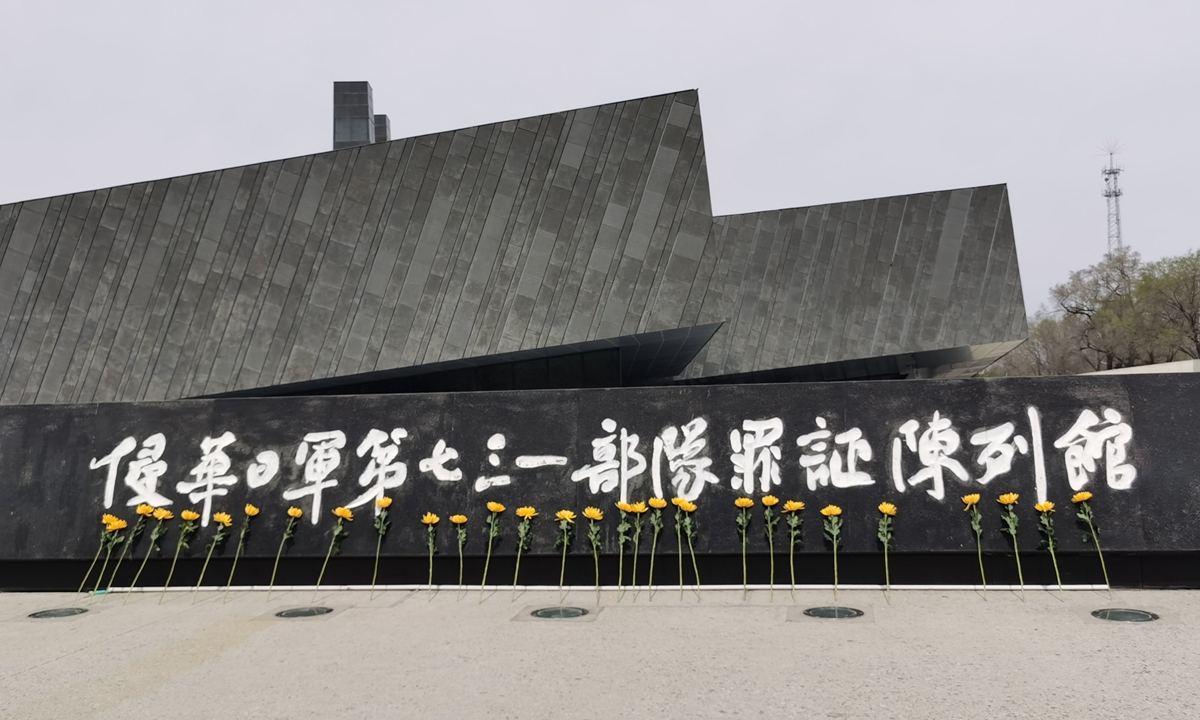
The Exhibition Hall of Evidences of Crime Committed by Unit 731 of the Japanese Imperial Army in Harbin, capital of Northeast China's Heilongjiang Province Photo: Hu Yuwei/GT
More than 90 years ago, Unit 731, a notorious Japanese germ-warfare unit created during World War II (WWII), left an indelible stain on the soil of Harbin, the capital of Northeast China's Heilongjiang Province.Unit 731 was the codename for a covert Japanese military medical unit from 1932 to 1945, responsible for bacterial warfare and human experiments that killed over 3,000 Chinese, Korean, Soviet, and Western prisoners of war in brutal tests. The Japanese militarists secretly designated an area of 6.1 square kilometers in the Pingfang district of Harbin city in 1936, establishing the world's largest biological warfare base, according to the Xinhua News Agency.
Decades later, one Chinese man tirelessly crossed oceans to unearth secrets "buried in graves" as ordered by Japan's militarists. At the end of some Unit 731 members' lives, he broke through their fear, evasion, and rejection, eliciting their confessions to crimes, with testimonies filled with guilt and remorse.
The relentless truth seeker is Jin Chengmin, the director of the Exhibition Hall of Evidences of Crime Committed by Unit 731 of the Japanese Imperial Army in Harbin. In 27 years, he made over 30 trips to Japan to extract testimonies from Japanese Unit 731 members, tracked down over 130 survivors and laborers recruited by the Japanese unit across China, and searched for records of this little-known history in the international community that spans more than a decade in multiple countries including the US and Russia.
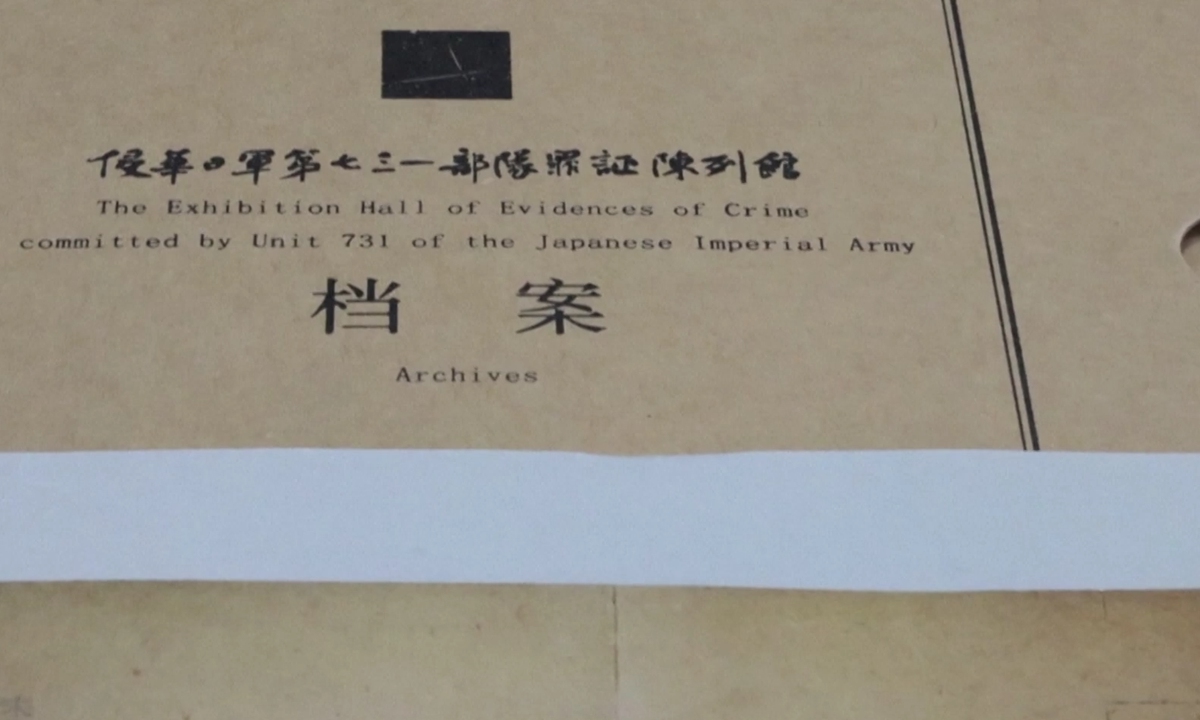
The archives of evidences of crime committed by Japanese Unit 731 Photo: VCG
'If you've forgotten, should we still remember?'
"More than three decades later, I still remember a Chinese-Japanese academic seminar in Beijing where a Japanese expert said softly, 'If you've all forgotten, should we still remember?' The implication was: If the victims have forgotten, must the perpetrators keep remembering?" This remark struck Jin as more of a taunt than a piece of advice.
"With almost no survivors, restoring the truth behind the Unit 731's crimes relies heavily on perpetrators' accounts. But they almost withdrew en masse, deliberately concealing their crimes. We must cross barriers to reach the truth, compelling perpetrators to testify for credible history," Jin told Global Times, referring his work as a "rescue mission" for history.
Since 1998, he has preserved 423 hours of video testimony, now irreplaceable as witnesses pass away.
Jin notes a "right-wing" shift in Japan's government and society regarding Unit 731. "Only four verified veterans remain, the youngest over 90 years old. Their dwindling numbers are what Japan's right-wing desires - without witnesses, they can distort history unchecked. Our memory salvage is a race against time," he said, underscoring the urgency of notarizing victims and gathering cross-border evidence amid Japan's denials.
His discoveries, including the "special transfer" files and frostbite experiment records, provide undeniable proof. Back then, the experimental materials were obtained through a process called "special transfer," a nefarious scheme by Japanese militarists to bypass judicial procedures and send people to the unit for live experimentation.
When asked to characterize Unit 731's crimes, Jin paused solemnly: "Some call it a massacre, but that's imprecise. It was an unprecedented medical crime against humanity, using bacterial weapons - one of the three deadliest weapons alongside chemical and nuclear."
"When Unit 731 retreated, they carried out what they called 'decontamination.' It meant not only annihilating the victims' bodies and erasing their names but also incinerating their corpses in furnaces to leave no trace. All experimental reports were disguised with codenames and aliases to ensure secrecy. In essence, they completely stripped the victims of their fundamental human attributes," explained Jin.
Beyond core military doctors, he interviewed drivers, guards, and youth corps members to refute claims that Unit 731 was the work of a few rogue scientists. "It was a top-down, organized, premeditated, large-scale state crime orchestrated by Japan's government, with no room for evasion."
Cross-border pursuit of Unit 731 members' testimonies aims to prove history can neither be sanitized nor falsified, said Jin.
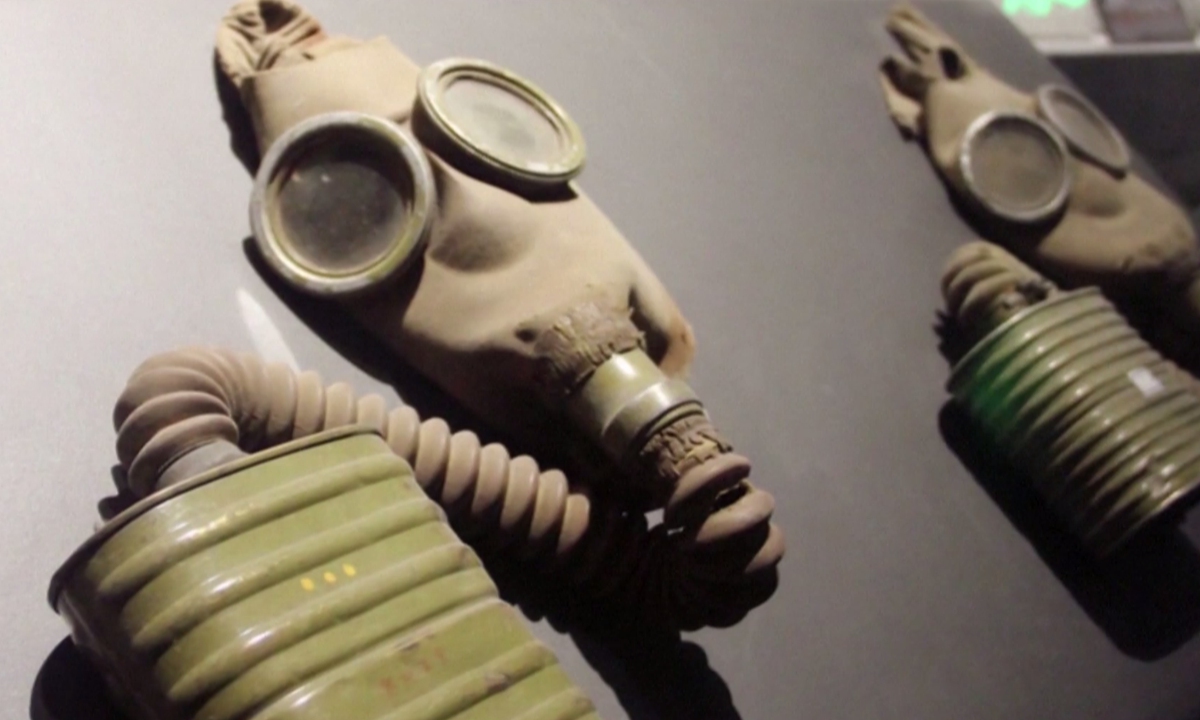
Protective gear used by Japan's Unit 731 in its germ warfare crimes Photo: VCG
'We must not let them fade from history'
731 Biochemical Revelations, a war-themed Chinese film, is set for release on September 18, the 94th anniversary of Japan's invasion of China, which foreshadowed WWII in Asia and made China the first to resist fascism. It exposes the crimes of Unit 731 through the tortuous fate of a nonentity. Yet, history includes perpetrators' voices too.
The Exhibition Hall of Evidence of Crimes Committed by Unit 731 of the Japanese Imperial Army unveiled the complete video testimony of former Unit 731 member Masakuni Kurumizawa for the first time on July 7, the 88th anniversary of the July 7 Incident, an event that marked the start of Japan's full-scale invasion of China and China's whole-nation resistance against Japanese invaders.
"I dissected 300 human bodies, about one-third of which were preserved as specimens, while the rest were burned. When we performed the dissection, the bodies were still warm, and blood spurted out," Kurumizawa said in the video.
Jin noted that this "living evidence" reveals the anti-human atrocities of Japanese militarism from the perpetrators' perspective, further exposing the full extent of its crimes.
In Japan, the government has insisted that there are no data showing the details of the activities of the Unit 731. However, it turns out that such documents do exist. Japanese Communist Party lawmaker Yamazoe Taku, at a House of Councilors Budget Committee meeting on March 21, pointed to a public record of the unit's human experimentation and brought to light the government's deception in claiming that there were no such documents, Japanese media outlets reported.
Yamazoe Taku remains in contact with Jin. Jin acknowledges that such truth-facing Japanese politicians are a rare, isolated minority in today's political and social landscape. Yet, over a period of 27 years, repentance from some Unit 731 members and support from some Japanese social organizations on post-war issues have sustained him. One example is Shimizu Hideo.
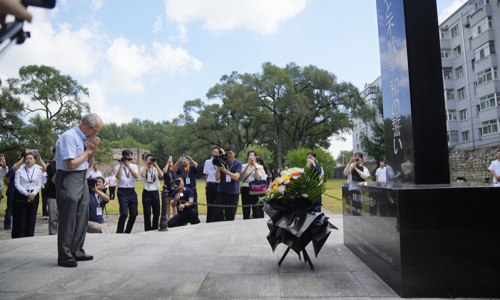
On August 13, 2024, Jin accompanied the 94-year-old to Unit 731's former site in Harbin, where he repented before the "Peace and Non-War Monument." Drafted at 14 in March 1945, Shimizu served at Unit 731's headquarters, Japan's bacterial warfare hub. His visit solidified the crime's evidence chain.
At the exit of the crime evidences exhibition hall, a 76-meter-long tunnel connects the new museum to the original Unit 731 site. The "testimony wall" along the tunnel lining both sides is etched with confessions from former Unit 731 members and victims' oral accounts. A photograph captures Jin and Shimizu Hideo walking side by side through the "testimony wall" corridor. The wall, like a string of silent notes, evokes a dialogue spanning decades - a conversation across time between a repentant perpetrator and a guardian of memory.
"After repenting in China, Shimizu fell ill but persevered to face historical truth, despite family opposition and community ostracism. Right-wing attacks labeled him a 'Japanese enemy,' even calling for his death. Some face threats while some pay with their lives. We must not let them fade from history," Jin said.
He also told the Global Times that there are many other China-friendly figures in Japan. Besieged by right-wingers-with smoke bombs thrown into homes, some needing bulletproof vests to work, and labeled "traitors" by fellow citizens-they insist they are true patriots. Their perseverance aims to make Japan remember history and stop from repeating past errors, yet their stories are rarely reported.
Jin Chengmin (right) and Shimizu Hideo walk past the "testimony wall" etched with confessions from former Unit 731 members and victims' oral accounts at the Unit 731's former site in Harbin on March 13, 2024.
'Speaking out' is liberation for them
Of the Unit 731 members Jin approached, fewer than 30 provided testimony. Some refused meetings; some met but stayed silent; some spoke only to other Japanese people; some opened up only on their deathbeds. "In Japan, we met low-ranking Unit 731 military personnel who hid their identities post-war, tormented by their past," Jin said.
Jin found out that many senior Unit 731 officers returned to Japan under new names, taking posts in universities, research institutes or major firms - some even becoming presidents, directors or professors. This disparity spurred some low-ranking members to expose truths. "Psychologically, they bore the burden of concealment, but with nothing to lose in old age, confessing was liberation, freeing them from guilt. Suzuki Shizuo, haunted by experiments performed on a Soviet mother and daughter, found relief after confessing," Jin said.
Jin recalled visiting one Unit 731 member more than three times. Polite but evasive, he skirted Unit 731 topics, interrupted by family or falling silent. On the final visit, Jin nearly lost hope. As a parting shot, he dismissed his family, took Jin to a tavern, and said, "I know why you're here. I won't let you leave empty-handed. I'll tell you what I did."
Jin Chengmin (left) and Shimizu Hideo (center) stand in front of the "Peace and Non-War Monument" at Unit 731's former site in Harbin, on August 13, 2024. Photo: VCG
Few dare to open this 'black box'
The Exhibition Hall of Evidences of Crime Committed by Unit 731 of the Japanese Imperial Army now stands east of Unit 731's original site, a rectangular black-gray building.
Jin told Global Times that its design draws inspiration from an airplane's black box. The hidden data and secret history of Unit 731 are preserved within its walls. "To uncover the truth, visit the black box," Jin said. "Its half-buried design reflects Unit 731's collapse, like a fallen aircraft."
The Unit 731 site is the world's largest, best-preserved bacterial warfare relic. In 2022, for the ninth national memorial ceremony for the Nanjing Massacre victims, the renovated museum unveiled over 20,000 artifacts, documents, and records, providing new proof of Unit 731's experiments and warfare. It also depicts the post-war US-Japan deal, through which the US monopolized Unit 731's brutal "medical results" for strategic gain, excluding the interests of victim countries including China and the Soviet Union. "Japan destroyed evidence and evades history, abetting the cover-up, as shown in our exhibits. Few dare face this black box," Jin said.
Jin's greatest aspiration is to secure UNESCO World Heritage status for the site, recognized globally for its significance. "Preserving dozens of Unit 731 relics is a major contribution to humanity. It deserves to be a patriotic and anti-fascist education base," he said.
Despite dwindling evidence, Jin persists in cross-border truth-seeking, advocating for objective, neutral narration.
"I see the crime evidences exhibition hall as a 'bastion of peace,' not merely cherishing or advocating peace - I cannot stop wars, but I will walk the path of defending peace. Those who join us are comrades in this mission."
RELATED ARTICLES