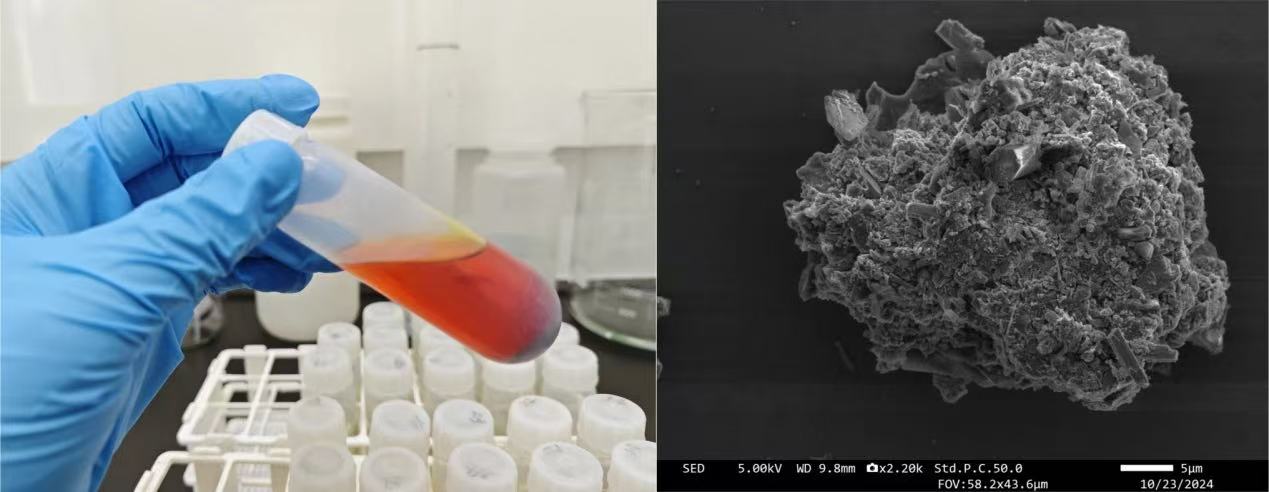
Extraction of black carbon and electron microscope images of black carbon. Picture: Institute of Oceanology of Chinese Academy of Science
By using black carbon records from marine sediments; integrating fire records from other continents and global archaeological site big data, Chinese researchers from Chinese Academy of Sciences found that large-scale human use of fire began around 50,000 years ago, marking a new breakthrough in the study of human-environment interactions.Fire is a pivotal aspect of human involvement in the carbon cycle. However, the precise timing of the large-scale human fire use remains uncertain.
Using black carbon records from sediments in northeastern East China Sea, researchers from Institute of Oceanology of Chinese Academy of Science and other institutes reconstructed the history of fire activity in northern East Asia over the past 300,000 years. They found that between 300,000 and 50,000 years ago, fires were more frequent during weaker monsoon periods and less frequent when monsoon rains were strong, highlighting the monsoon's role in driving fire activity.
However, since about 50,000 years ago, fire intensity has risen sharply and become less tied to monsoon patterns, coinciding with a period of rapid population growth in East Asia — suggesting that human expansion significantly influenced fire use.
Moreover, this pattern is consistent with fire histories in Europe, Southeast Asia and Papua New Guinea-Australia regions.
Around 50,000 years ago, regions including Europe, Southeast Asia, and the Papua New Guinea-Australia area all saw a sharp rise in fire activity.
During this Ice Age period, lower sea levels exposed large continental shelves in the Indo-Pacific Warm Pool, creating new land, while drier conditions weakened rainforest barriers, enabling humans to spread rapidly across East Asia, Southeast Asia and Australia in less than 10,000 years.
This large-scale migration led to rapid population growth, greatly increasing the need for fire — especially in a cold climate with limited food resources. Together, these factors marked a key turning point when humans began using fire on a large scale, possibly already leaving an impact on the global carbon cycle during the last Ice Age.
Global Times
RELATED ARTICLES