Extensive subsidies found in Canada’s agricultural sector as China announces anti-dumping measures against Canadian imported rapeseeds, rubber
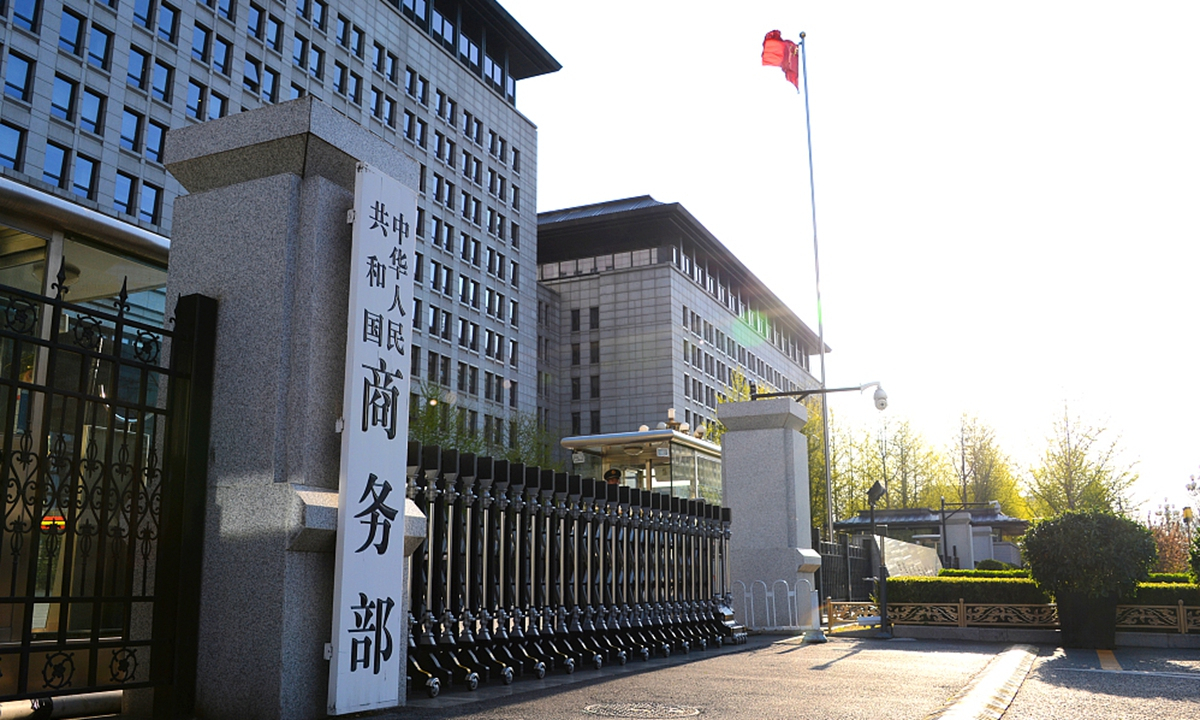
The Ministry of Commerce (MOFCOM) Photo: VCG
China's Ministry of Commerce (MOFCOM) on Tuesday announced preliminary anti-dumping determinations on imported rape or colza seeds and halogenated butyl rubber originating from Canada, citing that the investigation found preliminary evidence indicating the imported products were dumped, causing substantial injury to the related domestic industry. MOFCOM stressed that the determination comply with both Chinese law and WTO rules.
Preliminary evidence indicates that the imported products were dumped to the Chinese market, causing material injury to domestic industries, with a clear causal link between the dumping and the injury, according to the MOFCOM official statement.
Determination from the rapeseed investigation revealed extensive government subsidies and preferential policies in Canada's agricultural sector, particularly for rapeseed , which have distorted market supply and demand and led to severe overcapacity, resulting that in a preliminary determination such imports are subject to "particular market situations," according to MOFCOM.
MOFCOM has decided to implement provisional anti-dumping measures in the form of a deposit. Starting from August 14, 2025, importers of the investigated products shall provide the corresponding deposit to the China Customs based on the deposit rates determined for each company in this preliminary determination. The deposit rate imposed on all Canadian companies is 75.8%.
Responding to media inquiry for comment on MOFCOM's move to issue preliminary anti-dumping determinations, MOFCOM spokesperson said on Tuesday that MOFCOM initiated a self-initiated anti-dumping investigation into imports of rapeseeds originating from Canada on September 9, 2024. Subsequently, on September 14, 2024, upon application from domestic industries, MOFCOM launched an anti-dumping investigation into imports of halogenated butyl rubber originating from Canada and several other countries.
Following the initiation of these cases, MOFCOM conducted the investigations in strict accordance with Chinese laws and regulations as well as WTO rules, upholding the principles of fairness, impartiality, openness, and transparency, the spokesperson said, noting that preliminary evidence indicated the existence of dumping of the investigated products, substantial injury to the related domestic industries, and a causal link between the two.
According to the provisions of China's Anti-Dumping Regulations, MOFCOM issued preliminary determinations for both cases on Tuesday, deciding to implement provisional anti-dumping measures, the spokesperson said, noting that the dumping margin was set at 75.8 percent for Canadian rapeseed exporters, and between 26.2 and 40.5 percent for Canadian exporters of halogenated butyl rubber.
Anti-dumping investigations are legitimate trade actions that comply with WTO rules to protect domestic industries, and there is a fundamental difference between the probes and Canada's discriminatory measures that violate WTO rules, according to analysts.
On September 9, 2024, MOFCOM launched an anti-dumping investigation, on its own initiative, into imports of rape or colza seeds from Canada worth $3.47 billion. After that, MOFCOM, upon requests from domestic industries, initiated anti-dumping probes into imports of halogenated butyl rubber from Canada, Japan, and India.
China is the largest export market for Canadian rapeseed. In recent years, the volume of Canadian rapeseed exports to China has been increasing significantly , with prices consistently undercutting domestic Chinese prices, severely harming local producers and causing sustained losses in the industry.
According to data from China's General Administration of Customs, imports of Canadian rapeseed in 2023 rose 170.37% from 2022.
Rapeseed is China's largest oil crop, involving nearly 100 million farmers, and serving as a pillar industry in many regions as well as a key livelihood sector in the country's central and western areas.
Also on Tuesday, MOFCOM initiated an anti-dumping investigation on pea starch imported from Canada. The dumping investigation period is January 1 to December 31, 2024, while the injury investigation period covers the period from January 1, 2021, to December 31, 2024, MOFCOM said in an announcement.
Rubber probe
Tuesday's announcement also confirmed dumping exists in halogenated butyl rubber imports from Canada and Japan, with provisional anti-dumping measures to be imposed accordingly. However, the probe into Indian imports had been terminated in accordance with the law, due to negligible import volumes, MOFCOM said.
The rubber probe initiated after MOFCOM received a formal application from domestic industry on July 17, 2024, requesting an anti-dumping investigation into halogenated butyl rubber imports from the three countries.
The application last year alleged that Canadian halogenated butyl rubber was dumped into the Chinese market at a margin of 40.5 percent, with material injury to domestic industry worsening over the investigation period, resulting in severe operational declines and heavy financial losses.
Halogenated butyl rubber is a high-end synthetic material mainly used in products such as tubeless air-tight layers, heat-resistant inner tubes, and pharmaceutical bottle stoppers. China is the world's largest consumer of halogenated butyl rubber.
Canada's protectionist measures
Since last year, Canada has followed the US in rolling out a series of trade protectionist and restrictive measures against China — drawing strong dissatisfaction and firm opposition from China.
The latest measure is announced by Canada's Department of Finance announced in July 2025 that, in response to US tariffs on steel and global overcapacity in the sector, it would expand tariff rate quotas on a wider range of imports and tighten existing quotas starting August 1, with surtaxes applied to imports exceeding the quota. A 25% surtax would also be imposed on imports from all countries except the US that contain steel melted and poured in China.
Chinese experts criticized Canada's steel tariffs targeting China as a unilateral move, saying it "violates WTO rules, disrupts the international order, lacks justification in both reason and law, and is a typical act of unilateralism and protectionism."
Last October, Canada raised tariffs on Chinese-made electric vehicles (EVs) from 6.1 percent to 106.1 percent, while steel and aluminum tariffs climbed to 25 percent starting October 15.
MOFCOM spokesperson warned that the move will destabilize global industrial and supply chains, seriously undermine the global economic system and economic and trade rules, and severely impact China-Canada economic and trade relations.
RELATED ARTICLES