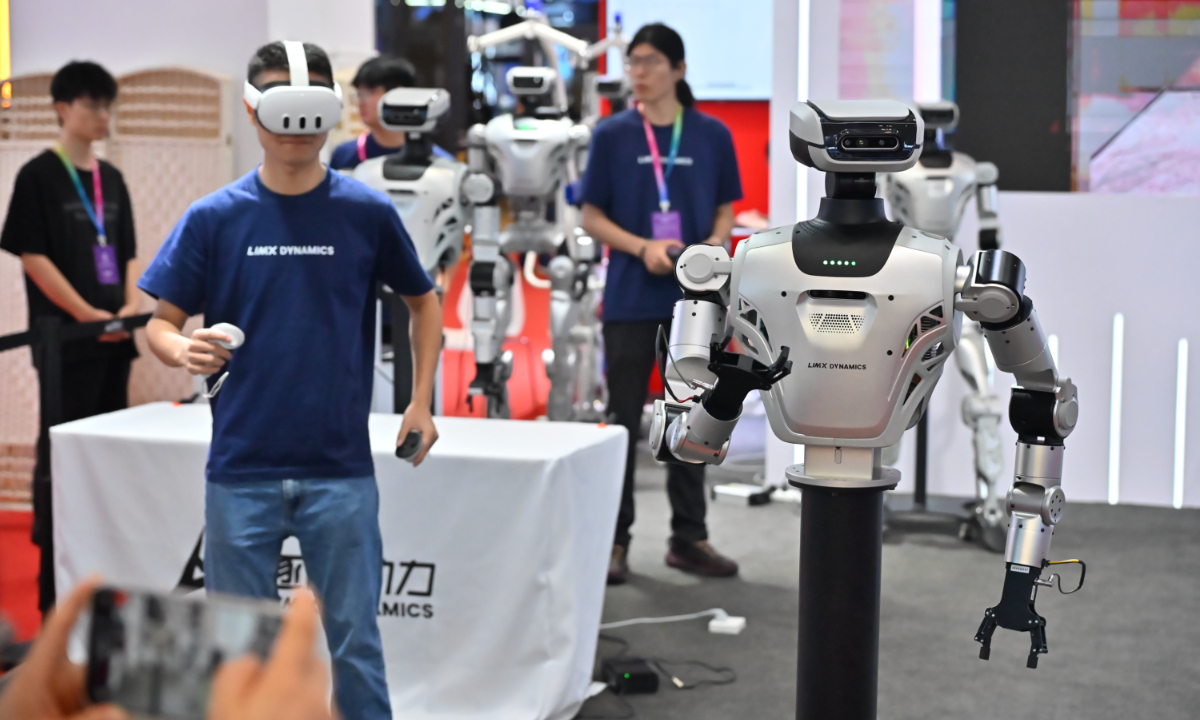
A staff showcases the remote control function of a robot at the 2025 World Robot Conference on August 8, 2025. Photo: Tao Mingyang/GT
This month, numerous robotics-related conferences and competitions are taking place in China. Following the 2025 World Robot Conference (WRC), held in Beijing from August 8 to 12, the world's first humanoid robot sports event - the 2025 World Humanoid Robot Games - will also be held in the Chinese capital from August 14 to 17. This robotics wave showcases the new heights of China's intelligent manufacturing.The flourishing intelligent industry, led by robotic technology, has become a hallmark of technological innovation in the past decade. China is a front-runner in robotic production, accounting for more than 50 percent of the world's installed robots with over half of those robots manufactured domestically.
National initiatives like "Made in China 2025" and current and future Five-Year Plans offer strong policy backing. Top companies such as UBTECH, ECOVACS and Pudu Robotics lead the fast-growing service robot market, fuelled by solid manufacturing and quick consumer uptake.
Wang Xingxing, CEO of Unitree Robotics, predicted a breakthrough moment akin to the AI revolution: "The 'ChatGPT moment' for robots could arrive within the next two to three years."
This "ChatGPT moment" means robotics will rapidly become more capable, accessible and transformative as AI has done, changing the industry and how people interact with robots.
For this to happen, fast progress is needed in key robotics areas like perception, autonomy and adaptability. There needs to be open collaboration across companies and countries, as seen when China's AI companies released a wave of low-cost and open-source models, outperforming the status quo and sparking global innovation. Robotics will have to be integrated into daily life to boost productivity and quality of life, and strong policy support coupled with public and private investment will be needed to speed up R&D and market adoption.
While the development of robotics is often a competitive race between nations, the WRC frames it as a journey shared by all humans. Innovation happening anywhere in the world benefits the whole planet. The spirit of rivalry is giving way to a global commitment to collective progress, shared knowledge, and collaboration - marking a new phase in robotics development.
The focus should also be on integrating AI to advance technological innovation, foster international cooperation and promote practical, real-world applications - especially by humanising robots to reduce the "FUD Factor" (fear, uncertainty and doubt) - through greater public engagement and understanding.
Jeff Burnstein, president of the US-based Association for Advancing Automation, spoke on humanoid robots' growing role: "More humanoid robots will appear due to investments driving innovation… The robots do the dull, dirty, dangerous jobs, which help people do higher-paying, safer, better jobs."
This comment highlights a crucial tension in today's workplace: While robotics brings efficiency and growth, it is essential for us to encourage community-level involvement to balance this progress. Embracing automation should not come at the cost of meaningful human interaction or fulfilling employment. Instead, we need thoughtful approaches that integrate robots to enhance productivity while preserving jobs and nurturing the social fabric of work. Only by involving communities can we ensure technology serves people, not replaces them.
The questions about balancing between technology and humanity are not new; their origins can be traced back thousands of years. In the fourth century BC, the Liezi described Yan Shi, a master craftsman, presenting a life-size mechanical figure to King Mu, the leader of China's Zhou Dynasty. The figure walked, bowed and even sang with such realism that the king initially believed it was a living man. This ancient account highlights China's early fascination with automation and craftsmanship, and is often considered one of the world's earliest descriptions of a robot-like creation.
King Mu, upon seeing the first mechanical man, ordered its destruction, fearing it might rival human beings. Only when the inventor demonstrated that the figure was built through human skill and knowledge did the emperor relent. Today, the WRC, with its atmosphere of shared knowledge and global awareness, ensures that progress continues to be guided by human values and purposeful collaboration.
China's history of innovation and invention is deep and influential. Early examples include mechanical machines and automated clocks developed centuries ago, showing an early mastery of streamlining automation.
These innovations grew from a collective culture grounded in Confucian values - teamwork, social harmony and respect for family and society. Inventions whose purpose is to benefit the community and preserve social order.
As a world leader in robotics, China carries a great responsibility to excel not only in technology but also in ethical development and global cooperation. Success will depend on how well China and the international community work together to solve shared challenges and ensure robotics benefits all humanity.
The author is an Australian sinologist and vice president of the publishing company Weldon's. opinion@globaltimes.com.cn
RELATED ARTICLES