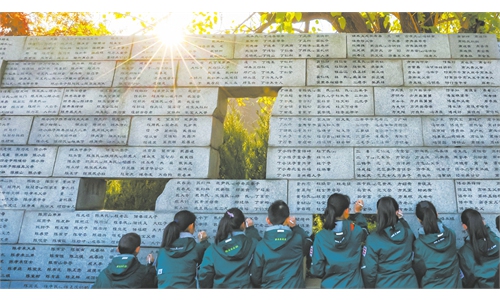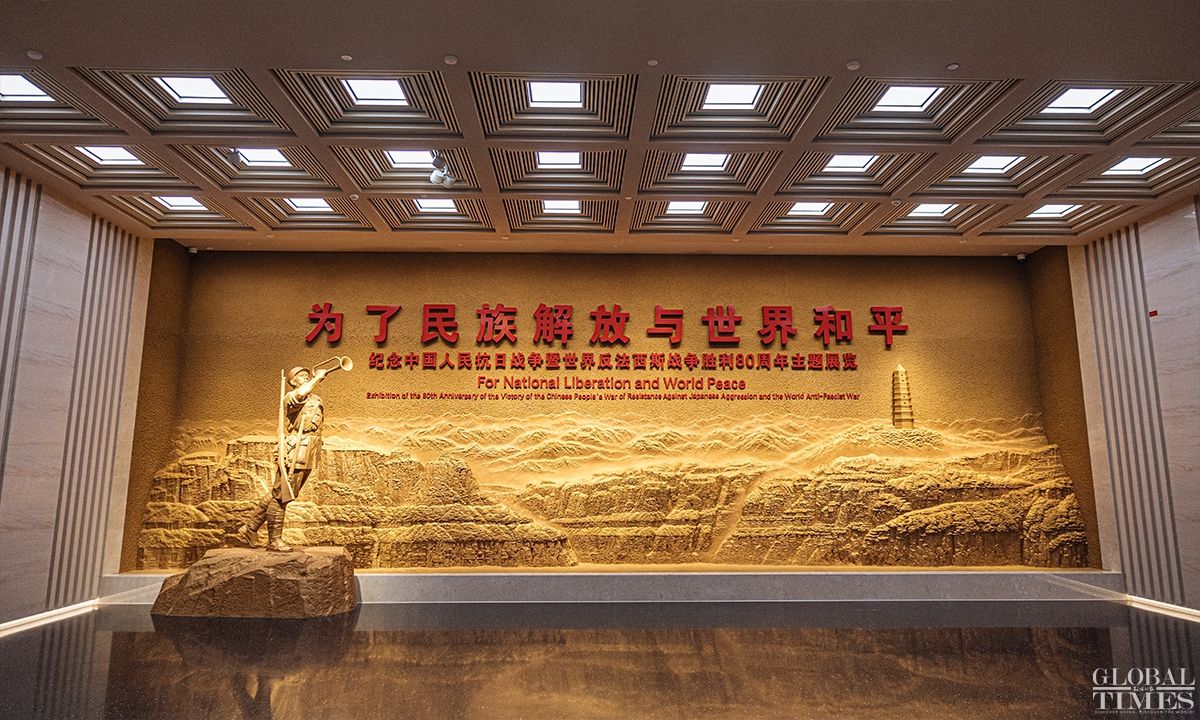
exhibition themed "For National Liberation and World Peace" is launched on July 8 in Beijing to commemorate the 80th anniversary of the victory in the Chinese People's War of Resistance Against Japanese Aggression and the World Anti-Fascist War. Photo: Li Hao/GT
As the 80th anniversary of the victory in the Chinese People's War of Resistance against Japanese Aggression and the World Anti-Fascist War draws near, the story of World War II is being retold - not in footnotes, but in fresh headlines. Declassified archives and joint film projects are revealing one clear message: The victory over fascism was a team effort, stitched together by ordinary people across continents.
In October 1942, a Japanese freighter ship, the Lisbon Maru, carrying over 1,800 British prisoners of war, was torpedoed off China's Zhoushan coast. As the ship tilted toward the sea, Japanese guards sealed the hatches before abandoning ship, trapping the prisoners below deck. Desperate cries echoed from the holds until some prisoners managed to break free - only to be met with gunfire from Japanese guards. At this critical moment came the sound of oars: Zhoushan fishermen courageously rowed their small boats straight into the line of fire, rescuing 384 British soldiers from the treacherous waters. Their courage is the subject of a documentary film The Sinking of the Lisbon Maru.
Acts of solidarity ran all along China's front line. Canadian doctor Norman Bethune and Indian physician Dwarkanath Kotnis sacrificed their lives tending to Chinese soldiers and civilians; the American "Flying Tigers" fought alongside the Chinese Air Force against Japanese aggression. Over the Himalayas, US and Chinese crews flew the "Hump" route - the world's most dangerous airlift - dropping food, fuel and hope, turning it into a lifeline for wartime supplies. Over 3,200 overseas Chinese drivers and mechanics from Southeast Asia volunteered to transport strategic materials along the Yunnan-Myanmar Road. Different passports, same mission: stop fascism cold.
The humanitarian spirit and solidarity demonstrated in these stories are no less remarkable than events like the Dunkirk evacuation in the European theater, yet they remain largely overlooked outside the nations directly involved. The truth is, the battles in the Eastern theater played a critical role in determining the outcome of World War II.
As the principal theater in the East, China's resistance provided indispensable strategic support to the global anti-fascist effort. The Chinese People's War of Resistance Against Japanese Aggression was not merely a struggle for national sovereignty but a pivotal chapter in the worldwide fight against fascism.
China was the first to confront fascist aggression in 1931 and endured 14 years of relentless warfare. The human cost was staggering: over 35 million military and civilian casualties and direct economic losses exceeding $100 billion. By pinning down the bulk of Japan's military forces, China thwarted Tokyo's expansionist ambitions and enabled Allied counteroffensives elsewhere. As British historian Rana Mitter underscores in Forgotten Ally, "Without the 'China Quagmire' - a quagmire caused by the refusal of the Chinese to stop fighting - Japan's imperial ambitions would have been much easier to fulfill."
The war's greatest legacy is not a monument, but a habit: working together when the stakes are high. It reshaped the international system profoundly. The spirit of collaboration, forged in the crucible of shared struggle against fascism, became the cornerstone of the postwar order, driving transformative changes across political, economic and security spheres, enabling unprecedented growth, and laying the groundwork for over eight decades of global stability.
The United Nations, the World Health Organization and the World Trade Organization all grew from seeds planted in wartime allied cooperation. Now, 80 years on, their mission - keep talking, keep trading, keep the peace - remains just as urgent. From pandemics to climate change, the lesson is the same: No nation wins alone.
On September 3, 2025, China will commemorate the 80th anniversary of the victory in the Chinese People's War of Resistance against Japanese Aggression and the World Anti-Fascist War. This observance is not merely retrospective but a clarion call. Eight decades after the guns fell silent, the world stands at another crossroads. At a time when some tout a "clash of civilizations," revisiting history reminds us that people of all ethnicities, cultures and faiths can, and should, unite for common ideals.
The waves that swallowed the Lisbon Maru, Bethune's bloodstained scalpel, the rumble of trucks on the Yunnan-Myanmar Road - all whisper the same truth: Only by confronting history with honesty can humanity glean the wisdom to move forward. In an era of fraying globalization, history must not be relegated to museums but serve as a torch for the future, pointing the way forward for all of us.
The author is a Beijing-based analyst of international affairs. opinion@globaltimes.com.cn
RELATED ARTICLES