Essential for China, South Korea to cherish memory of joint resistance against Japanese invasions
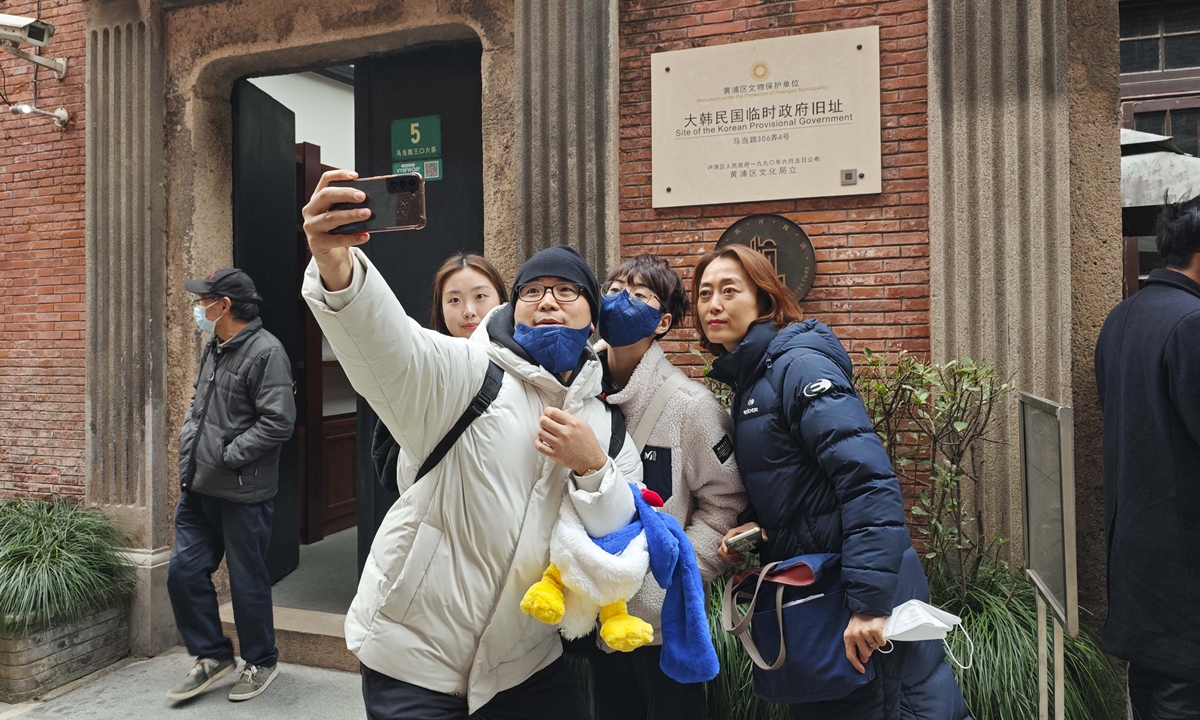
South Korean tourists take photos at the Site of the Korean Provisional Government in Shanghai on January 11, 2025. Photo: VCG
This year marks the 80th anniversary of Liberation Day and the victory in the Chinese People's War of Resistance Against Japanese Aggression. Recently, I accompanied a group of South Korean friends on visits to historical sites related to the Korean independence movement, including the Site of the Korean Provisional Government in Shanghai and the former refuge of Kim Gu in Jiaxing, East China's Zhejiang Province. Walking through these spaces steeped in history, we felt as if we had traveled back to those war-torn years.On Chinese soil, the Korean independence movement sprouted and grew strong. On the battlefield resisting Japanese aggression, Chinese and Korean soldiers shed blood and fell side by side - together they safeguarded the dignity and freedom of East Asian peoples with their lives. This history is a shared memory written deep into the veins of the peoples of both nations.
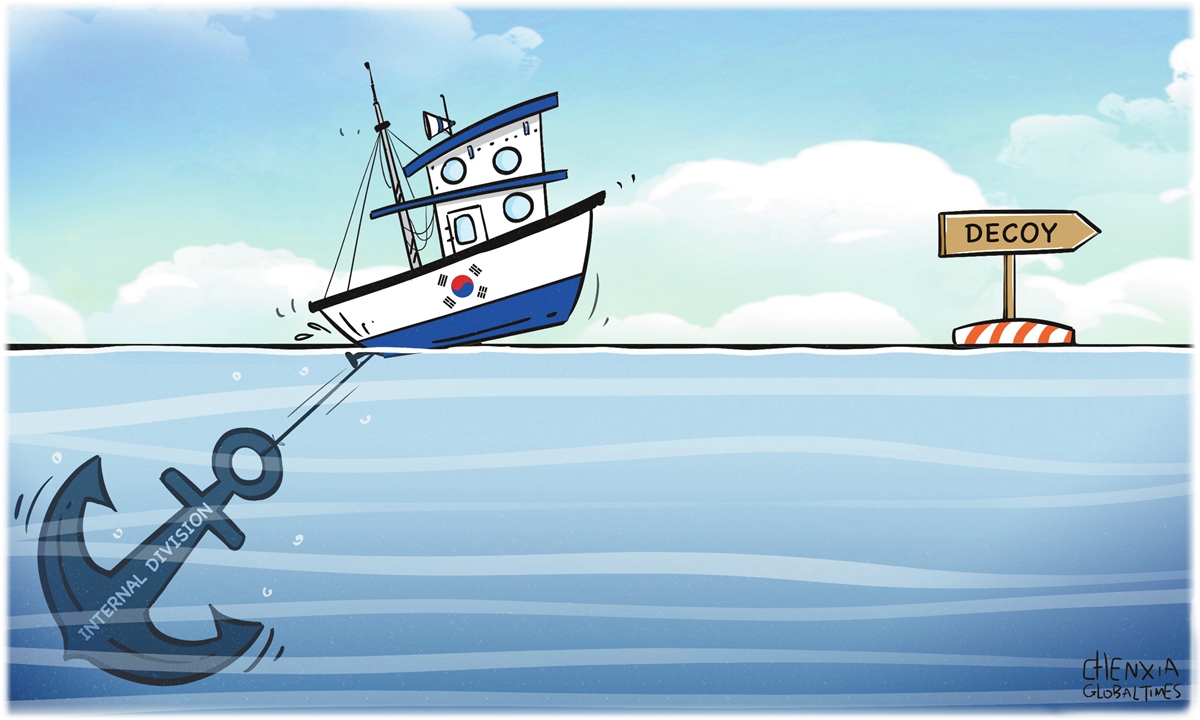
Unfortunately, what is regrettable is that South Korea's official public speeches commemorating Liberation Day barely mention this shared history. Instead, in recent years, Liberation Day addresses have placed more emphasis on "future-oriented cooperation" with Japan - and even pledged to bolster trilateral US-Japan-South Korea military coordination, casting China as a potential security challenge. This contrast with the shared struggle of 80 years ago gives the impression of "forgetting," or even "abandoning," that history.
For South Korea, Liberation Day is a commemoration of its emancipation from colonial shackles and the restoration of national independence. Without China's long-lasting resistance that drained Japan's strength, and without the strategic depth and international backing that China provided to the independence movement, South Korea's path to liberation would likely have been much harder and far more protracted. The chain of causation in history is not fictional - it is forged through innumerable facts and sacrifices. To ignore this chapter of history is not only to forget the predecessors, but also to distort our contemporary understanding of the region.
In today's Northeast Asia, new security dilemmas and economic challenges are unfolding. Japan refuses to reckon with its historical issues, its security policy is tilting ever more to the right, and its military strategy is accelerating beyond post-war constraints. At the same time, the US is pursuing a strategy of bloc confrontation, pushing for a militarized US-Japan-South Korea alliance that brings fresh tension and instability to the region. Against this backdrop, if South Korea relies entirely on Japan and the US for its strategic security, it risks losing diplomatic autonomy - and may well become a pawn in great-power rivalry should a crisis erupt.
In contrast, China and South Korea, as close neighbors separated by only a narrow strip of water, have historically stood together in resisting Japanese invasions. Furthermore, they share deep cultural roots and possess highly complementary economies with deeply intertwined industrial chains. In the face of global challenges such as anti-globalization, supply chain restructuring and climate change, the two countries are well-positioned to lead in strengthening cooperation. They can jointly encourage Japan to confront and reflect on its history of aggression, and promote mutual trust-building and regional economic integration among China, Japan and South Korea.
To achieve this, it is essential to confront and cherish the shared historical memory of resistance against Japanese aggression in China and South Korea. Regardless of shifting political stances, historical facts cannot be erased, and the spirit of history should not be forgotten. Both China and South Korea should employ various methods, such as historical research, preservation of historical sites and joint commemorations, to help the younger generation understand the truth of how the two nations stood side by side during the most challenging times.
Eighty years ago, the righteous Chinese and Korean fighters fought side by side for national independence, with their actions rooted in a shared sense of destiny and mutual recognition of values. Today, in the face of new geopolitical challenges and global risks, China and South Korea once again need this awareness of a community with a shared future. When South Korea commemorates Liberation Day, it should not forget China; looking ahead, it should allow the tree of China-South Korea cooperation to flourish, making the memory of their joint resistance a solid bond, promoting peace and cooperation in Northeast Asia.
The author is the director and professor of the Center for Korean Peninsula Studies at the Shanghai University of International Business and Economics. opinion@globaltimes.com.cn
RELATED ARTICLES