File Photo: VCG
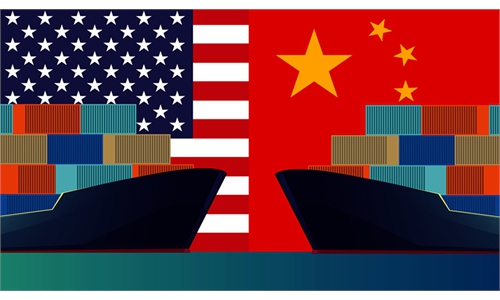
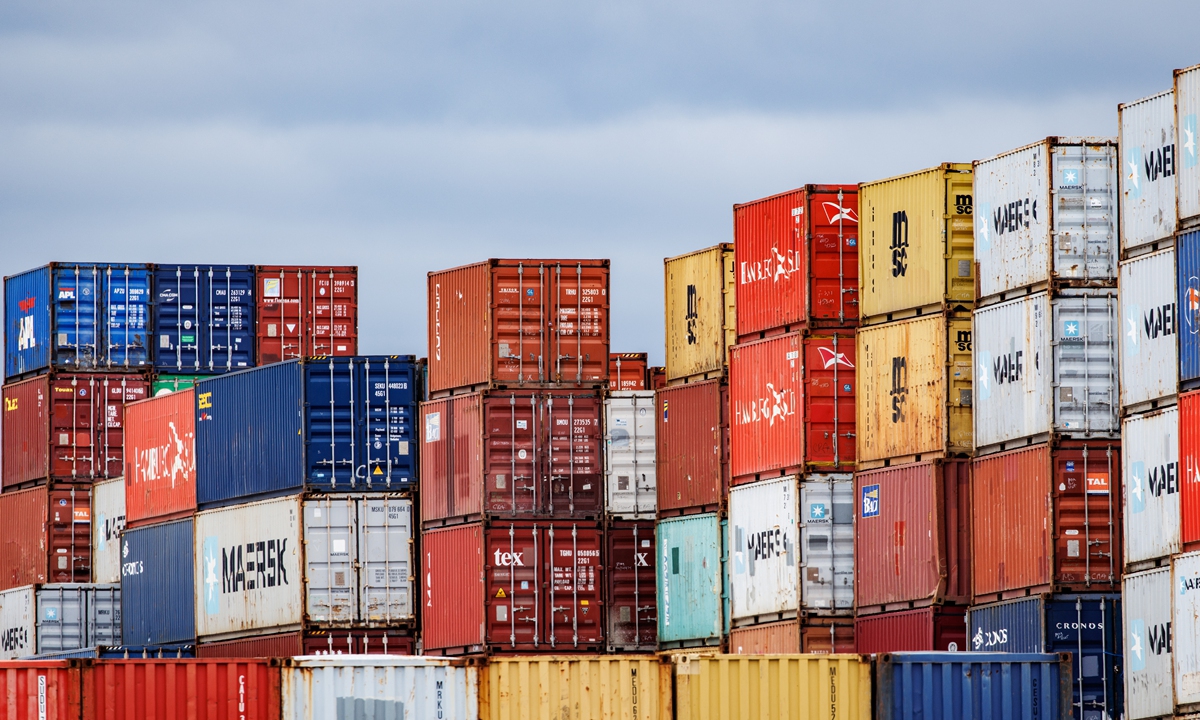
The record-breaking container imports from China at America's busiest gateways for Chinese goods not only demonstrate the resilience of bilateral trade but also underscore the importance of promoting a more predictable trading environment to sustain mutual benefits.The US ports of Los Angeles and Long Beach set a record in July, handling the equivalent of more than 1 million import containers for the first time, The Wall Street Journal reported on Thursday.
The spike in port activity has been driven by companies racing to secure imported goods before potential tariff policy changes. The phenomenon lays bare the real and sustained demand for Chinese goods in the US while also exposing concerns among businesses grappling with trade policy uncertainty.
While the economic complementarity between China and the US and the resilience of their bilateral trade relationship remain unshaken, this fundamental dynamic offers no justification for letting trade relations linger in the shadows of uncertainty created by the US side. The record-breaking container volumes flowing through America's busiest ports could serve as a stark reminder that bilateral trade, no matter how resilient, cannot reach its full potential when buffeted by uncertainty.
On Tuesday, China and the US each announced that they would extend the suspension of reciprocal 24 percent tariffs for an additional period of 90 days, while retaining the remaining additional ad valorem rate of 10 percent on those articles.
Politico, meanwhile, cited Sean Stein, president of the US-China Business Council, as saying that US industry welcomes the pause, and international markets also responded positively. These reactions underscore the importance of certainty in China-US economic relations, which is not merely a bilateral concern but also vital for the global economy as a whole. Both sides possess the conditions and opportunities to enhance trade certainty, which would be mutually beneficial for China and the US as well.
Looking back at the development of China-US trade, it is evident that the economic structures of both nations have long demonstrated a high degree of complementarity. China boasts a comprehensive industrial chain, a vast pool of labor resources, and a highly competitive manufacturing sector, while the US excels in high-tech industries and advanced services sectors. This complementarity has facilitated a substantial scale of trade between the two countries while fostering a profound integration of their economies. However, in recent years, the US has introduced uncertainty in its trade policies, frequently raising tariffs and implementing restrictions. These actions have disrupted the previously stable trade order, creating an environment of unpredictability that poses challenges for businesses on both sides.
Many of the problems in bilateral trade stem directly from such uncertainties created by the US side. Some in the US may think that wielding erratic trade policies may provide them with leverage to dictate terms, extract concessions, and ultimately secure lopsided gains. This strategy, rooted in the belief that unpredictability strengthens negotiating positions, overlooks the fundamental reality that trade thrives on stability, not volatility.
In practice, such tactics have repeatedly proven counterproductive. When trade policies are full of uncertainties, companies can only take short-term response measures. In order to complete imports before potential tariff changes, American companies have to pay higher freight and storage fees, pushing up logistics costs and exacerbating port congestion. This kind of market fluctuation caused by policy uncertainty will eventually be transmitted to all links of the industrial chain.
Meanwhile, the long-term uncertainty has prompted countries such as China to accelerate their adjustments. China has accelerated efforts to diversify its economic partnerships, deepening trade ties with ASEAN, the EU, Africa, and Latin America. As this diversification drive grows, the US approach of leveraging uncertainty to gain an "initiative" may lose efficacy, also undermining American interests as China becomes less dependent on the US market.
In this context, enhancing the certainty of China-US trade requires concrete actions by the US to reduce volatility. China has always adhered to the basic national policy of opening up to the outside world, and its policy toward the US has always maintained continuity and stability, being committed to creating a fair, transparent and predictable trade environment for companies in both countries. It is hoped that the US side could face up to the complementarity of the two economies and the mutually beneficial nature of trade cooperation, and abandon practices that create uncertainty.
RELATED ARTICLES