Xinjiang’s water projects transform life and land
‘Smart irrigation’ system brings steady incomes, greater risk resilience for farmers
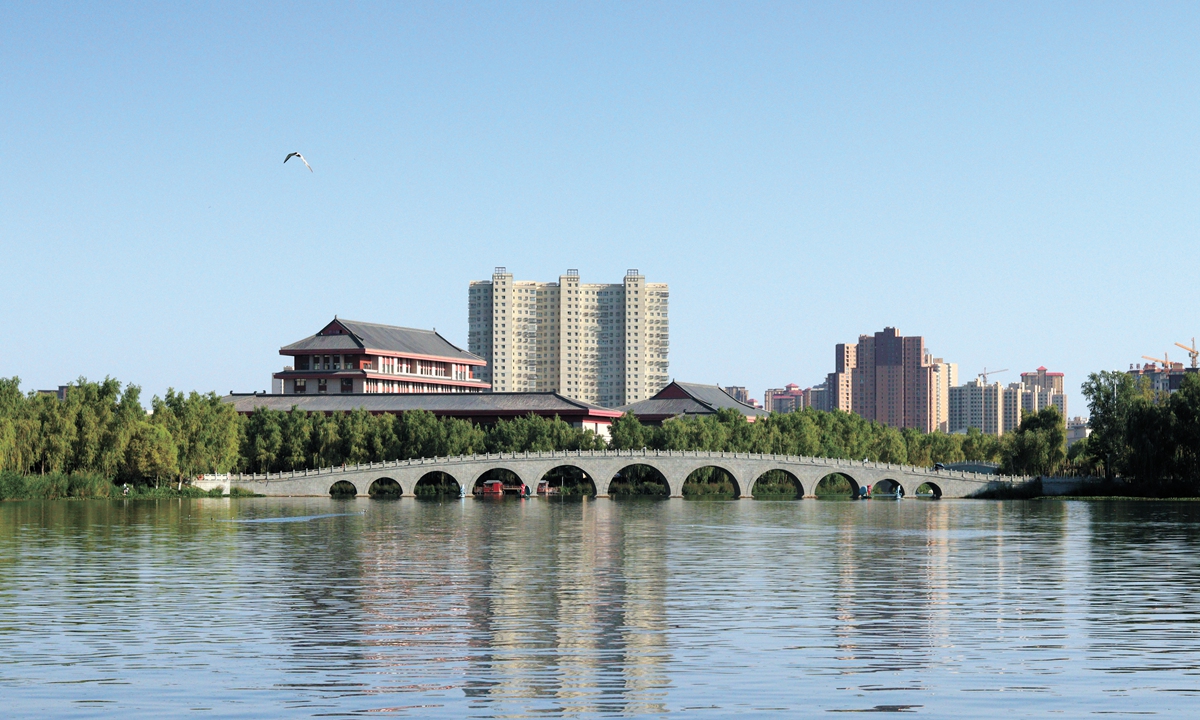
The view of Duolang River Park in Aksu City, Xinjiang Uygur Autonomous Region. Photo: Su Yaxuan/GT
In Northwest China's Xinjiang Uygur Autonomous Region, water is not merely a gift of nature, but an "invisible artery" silently nourishing farmlands, villages and cities. With water resources unevenly distributed in time and space, droughts and floods were once frequent events. How this fragile and scarce resource is mobilized, allocated and utilized directly impacts Xinjiang's grain yields, villagers' livelihoods and even social stability.
In early August, the sun beat down relentlessly and the air shimmered with heat, yet villages and towns along the route in Bortala Mongolian Autonomous Prefecture, painted a different picture: lush fields and glistening rivers. Children chased one another along waterfront paths, while the senior citizens sat chatting in the shade, occasionally glancing at the flowing water - not merely a part of their daily lives, but a testament to how life has improved.
A Global Times reporter, following the "Water Management and Development in Xinjiang" tour, observed that local water conservancy projects have quietly transformed residents' lives: farmers no longer have to toil under the blazing sun to irrigate their fields, villagers have left behind the days of brackish water and frequent supply shortages, and urban and rural communities have gained new waterfront parks and greenways. Water, in the most tangible and gentle way, is reshaping production and lifestyles across this land.
Enhancing the 'hardware'
Currently, in north Xinjiang's Bortala Mongolian Autonomous Prefecture, the cotton fields of Xiaretuore Village in Daheyanzi Town are now in the critical fruit-setting stage — a sea of green dotted with white. Farmer Ding Hongshan walks through waist-high plants, his face lit with joy: "The watering is timely and sufficient; the cotton is thriving - this year will be a bumper harvest!"
In Daheyanzi Town, the Jiufenzha project serves as the local irrigation dispatch center. Since being included in Xinjiang's modernization and supporting-facilities project and the Ministry of Water Resources' first pilot project for digital twin irrigation districts in 2022, the medium-sized irrigation district in Daheyanzi Town has undergone upgrades such as replacing canals with pipelines. These improvements have benefited 224,900 mu (approximately 15,000 hectares) of farmland in the irrigation area.
The Jiufenzha connects the main canal with several branch canals. Its digital twin platform functions as a "smart brain," allowing farmers to control end-point valves directly via a mobile app.
"In the past, watering meant going to the field - wherever the water was, you had to be there. Each round took at least four to five hours. Now I just tap on an app to water, fertilize, or spray pesticides - can even do it while drinking tea at home," Ding told the Global Times.
Xinjiang's efficient "smart irrigation" system translates into more stable incomes and greater risk resilience for farmers. Among the beneficiaries is Xuan Baolin, whose farmland falls within the Jiufenzha irrigation project area. "Managing 300 mu of cotton fields alone used to be exhausting," said Xuan. "But this year, farming 300 mu is just normal. Many households are planting more cotton than before." He added, "The water quality has also improved, leading to better crop growth and higher yields."
If irrigation is the lifeblood of agriculture, then water supply is the foundation of daily life. According to local water authorities, since 2016, Jinghe County has invested 470 million yuan ($65.4 million) in constructing water plants and implementing east-west trunk pipelines, laying 180 kilometers of main supply lines that serve 144,000 people across more than 60,000 households. Both tap-water coverage and water quality compliance in the county have reached 100 percent.
In Xiaonai Village, Mangding Township, Jinghe County, 60-year-old villager Tursunjan Kurbanjan still remembers the hardship of well water. "In the past, we drank well water containing sand and gravel, which required settling before each use." Now, with the urban-rural integration project, clean tap water flows directly into every household. Tursunjan Kurbanjan turned on the faucet with a smile, washing freshly picked grapes under clear running water. "Now we just turn on the tap - clean water anytime, no more shortages," he said. He did the math, for his family of five, monthly water costs for drinking and household use come to about 50 yuan.
"We're so grateful to the government for this project," his words echo those of thousands across Xinjiang. According to data from the Department of Water Resources, Xinjiang Uygur Autonomous Region, by the end of 2024, rural tap water coverage in the region had reached 98.5 percent - well above the national average of 90 percent. This highlights the narrowing urban-rural living standard gap.
Water as the 'software' of daily life
At the Xingfu river-lake central park by the Jirgalang River in Yining County, Ili Kazak Autonomous Prefecture, water plays a role more like the backdrop of life and a bond of emotions. "Jirgalang" happens to mean "happiness" in the Uygur language. As evening falls, senior residents stroll along the park's waterfront walkway, young couples push strollers with their babies and groups of children lean over the railings to fish…
"The riverbanks used to be completely flat wetlands - whenever floods came, the entire road would be submerged," said Parhat Mahmut, a resident of Yining County, pointing to the newly reinforced riverbanks before him. "Now both sides have been strengthened and upgraded. The environment is better, the water quality has improved and every morning people come here to exercise. The surrounding area is fully equipped with a hospital, bank and government service centers, as well as other facilities."
At Aksu's Duolang River Park, the sound of a guitar and powerful singing could be heard from a distance. The singer was Anwar Hasan, a local resident who lives near the park. On leisurely afternoons, he and his wife often spend the day outside and have a traditional Uygur-style picnic. They laid out all different fruits, and they sing Uygur folk songs. As a native of Aksu, he proudly declared, "Look how beautiful our city has become!"
The meaning of water projects in Xinjiang is undergoing a quiet transformation - shifting from "access to water" to "water quality," and even "harmony between people and water." This evolution reflects the outcomes of Xinjiang's sustained efforts in digital water governance, precision irrigation and integrated urban-rural water supply systems in recent years.
Xinjiang's water story has no end. It flows like an eternal river, from snow-capped glaciers to oasis villages, nourishing this vast and diverse land while leaving clear and warm imprints in the lives of every resident.
This year marks the 70th anniversary of the establishment of the Xinjiang Uygur Autonomous Region. These tangible advancements in water projects stand as vivid testimony to Xinjiang's development in the new era.
RELATED ARTICLES