'It's ridiculous!' Ex-US commerce chief Raimondo blasts 'anti-China euphoria' in US
By Li Yawei and Published: Aug 16, 2025 12:37 AM

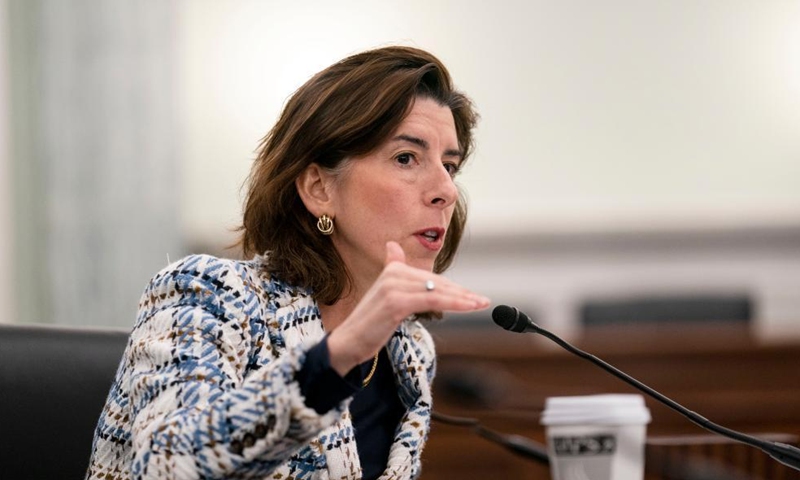
The former Commerce Secretary Gina Raimondo attends a hearing of US Senate Committee on Commerce, Science, and Transportation titled "Department of Commerce Fiscal Year 2023 Budget Priorities" on Capitol Hill in Washington, D.C., the United States, on April 27, 2022. (Xinhua/Liu Jie)
Former US Secretary of Commerce Gina Raimondo recently said there is an anti-China euphoria in the US, questioning why she was criticized for being weak on China by visiting the country. She added that she understands the Republicans view China as "the greatest threat," but warned that decoupling totally will lead to escalation, which she thinks "is dangerous."
Raimondo's remarks came at the 2025 KPMG Tech and Innovation Symposium on August 12. Raimondo visited China in August 2023, becoming the first US Commerce Secretary to do so in sevenyears at that time, according to media reports. However, upon her return to the US, she became the target of criticism from many Republican lawmakers.
During an interview at the KPMG event, Raimondo said she was criticized by many Republicans on Capitol Hill for being "soft on China" because she went to Shanghai Disneyland and talked with its CEO.
To refute such criticism, Raimondo said at the KPMG Symposium that "an amusement park hurts our national security. It's ridiculous."
Raimondo said that people saying that "I was soft on China." "The fact that I had a lot of meetings with CEOs. I was a commerce secretary. I thought it was my job to meet with CEOs," she added.
The constant criticism between US politicians of the two parties of being "soft toward China" reflects a highly unhealthy phenomenon in the US' understanding of the country, Li Haidong, a professor at China Foreign Affairs University, told the Global Times on Friday.
Under the current state of China-US relations, the China policy adopted by the ruling party, whether it is Democrats or Republicans, tends to be hardline, Li said, adding that the opposition always seeks to pressure the ruling side into adopting an even more hardline stance, aiming to undermine its China policy and related initiatives. This is driven by an intention to ridicule the other party and revel in its setbacks.
The current political problem in the US is that everything is subservient to elections, power and positions, rather than confronting real issues and addressing them objectively, truthfully and effectively, Li added.
This has resulted in inconsistencies, incoherence and acute internal friction in the US approach to issues concerning China and other major matters, the expert said.
During the KPMG Symposium, Raimondo said that "trying to hold back China is a fool's errand," adding that one way to keep winning is by training harder and running faster.
When asked if the US is ahead in the AI race against China, Raimondo said "yes, but just barely." She said that she is for trading with China and for constant communication. "There is a dangerous level of lack of communication, and lack of back channels, which I think can only lead to escalation, risk of miscalculation," she added.
Undoubtedly, Raimondo's perspectives are relatively balanced and rationally sound compared with some China hawks, unshackled by the grip of the domestic political climate, Li said.
Although Raimondo was seen as a US politician who favored cooperation with China when she was in office, Li pointed out a phenomenon under Washington's political atmosphere: politicians' remarks tend to be in line with the "anti-China political correctness" when they are in office, while speaking and acting more rationally when they leave their positions.
RELATED ARTICLES