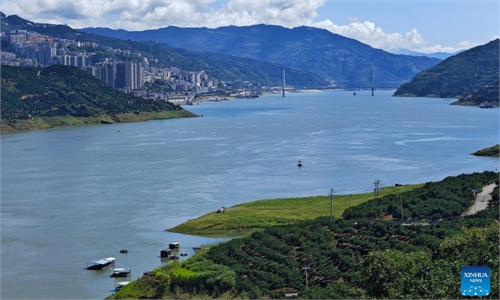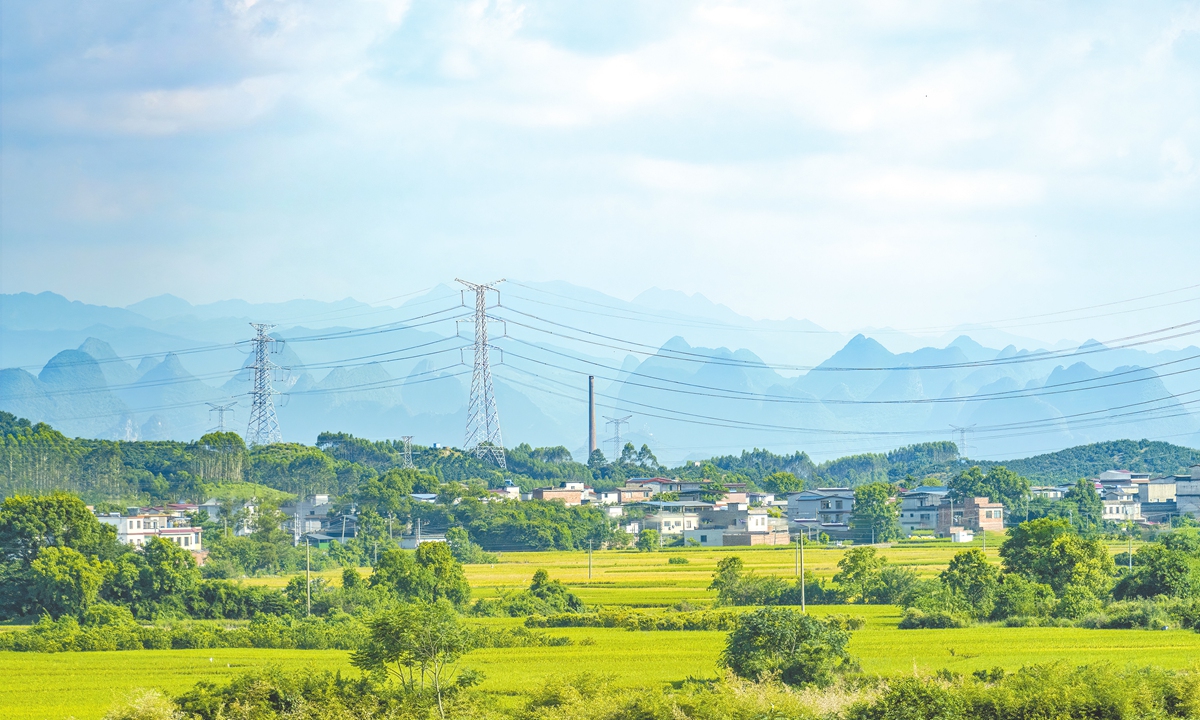
A view of Guilin, South China's Guangxi Zhuang Autonomous Region Photo: VCG
Editor's Note:
This year marks the 20th anniversary of the concept that "lucid waters and lush mountains are invaluable assets," also known as the "two mountains" concept. From China's constant push for green transformation and ecological civilization to its growing influence in global climate governance, the concept has increasingly gained international attention and resonance. In a recent interview with Global Times (GT) reporter Xia Wenxin, Clifford Cobb (Cobb), a renowned US scholar on sustainable development, noted that China's rapid progress in green development stems from the strong commitment of the Party and the government, offering a model for global environmental governance. He also discussed the deeper meaning of the concept of "ecological civilization" and the challenges for the US to engage in its green agenda.
GT: In 2005, President Xi Jinping put forward the concept that "lucid waters and lush mountains are invaluable assets" in East China's Zhejiang Province. How do you understand this concept?
Cobb: Originally, this concept was introduced to offset the single-minded pursuit of economic growth, which was China's path for about 30 years. I think it can now be understood more broadly to mean that nations should pursue harmonious development that balances many different interests and that monetary values are not necessarily supreme. Thus, we are sometimes able to achieve two goals that seem to be in opposition, such as economic development and a clean environment. We should always try to find new perspectives that go beyond fixed choices.
GT: Why has China's green development progressed so fast in recent years? What are its contributions to global environmental governance?
Cobb: China's progress in green development has clearly resulted from a strong commitment to this goal by the Party and the government. That commitment gives China credibility in the eyes of other nations by demonstrating that dedication to the environment can be combined with the need to lift rural areas out of poverty. Every nation faces the challenge of continuing along a development path while also leaving clean water and healthy soils for the next generation. China's environmental initiatives prove that this balance is possible.
GT: You once commented in an interview that China has influenced the world by adopting terms like "ecological civilization," which you believe is a Chinese idea. In your opinion, what are the connotations of "ecological civilization"? How should the international community convert this idea into practice?
Cobb: From the beginning, around 5,000 years ago, civilization has developed by exercising control over the rest of nature. Humans dammed rivers, built cities and roads, plowed fields to grow crops, cut down forests, and sailed across oceans. Since humans are a part of nature that uses tools, many of these changes could be considered "natural." Humans adapted to environments and also modified those environments for human use. As long as there was a balance between adaptation to nature and modification of nature, civilization retained an ecological quality. However, industrialization created an imbalance. The scale of modification changed, particularly with the development of chemistry in the 19th century and the rapid growth of human populations. In my view, the term "ecological civilization" means restoring the balance between adaptation and modification.
GT: You also noted in the same interview that strong leadership in climate change governance is absent at the national level in the US. What led to this lack of leadership? Do you expect it to change in the short term?
Cobb: At one time, the US was in a position of leadership on climate change governance because American scientists, including those from oil companies, conducted the original research that revealed the threat from large-scale carbon combustion. By 1990, both major parties in the US took climate change seriously and might have led the world to take action, but oil companies began a campaign to create doubt, and both parties lost the will to act.
In addition, many Americans think that climate change is a purely technical problem that can be solved with a few innovations. The idea that nature should be forced to accommodate whatever humans want is deeply ingrained in the American ethos. Instead of humans adapting to nature, many Americans expect nature to adapt to humans, as if the American Congress or American engineers could overturn the law of gravity. Thus, the loss of American leadership on climate issues is tied to deep cultural forces and not merely to the shifting sands of American politics.
GT: What could the US learn from China's green development?
Cobb: The US and other countries can learn from the technical advances made in China in the development of green energy production. The US may also learn from efforts in China to slow or reverse the effects of desertification and to develop better methods of water management.
GT: What, in your opinion, is the current approach in US politics to climate change governance?
Cobb: In general, most cultures have viewed the environment as a secondary concern, unless the situation becomes extreme. Military and economic issues always seem urgent; environmental issues are normally treated as future problems that can be ignored. There is always some basis for negotiations over minor environmental issues, but when an environmental issue rises to the primary level, as has happened in the case of climate change, diplomatic conditions change.
In the US, the Republicans believe that actions to limit climate change will damage the economy. Even when the Democrats were in power, they were afraid to take bold action because it would have been unpopular with voters. For 25 years, both parties have avoided taking climate change seriously. Even though the Democrats engaged in international diplomacy with bold rhetoric, they took little action. Meanwhile, China has become the global leader on climate change by promoting the rapid development of renewable energy expected to replace coal. China now sets the global standard for climate action.
GT: How do you see the prospects of China-US climate cooperation, including climate talks, under the current Donald Trump administration?
Cobb: The Trump administration will not address climate change issues because its supporters believe climate change is a hoax. Since the US now repudiates any measures taken to limit the use of fossil fuels, the US has removed itself from international cooperation. At this stage, American companies are more committed than the US government to reducing carbon emissions, so progress will not stop in the US. However, the official policies of the government control diplomacy, and the Trump administration seems to be dedicated to weakening the soft power of the US, while it also undermines the military capacity of the US by financing expensive defense systems without a strategic plan.
Ultimately, negotiations on every issue are controlled by changing diplomatic conditions, and those are dictated by the balance of power in the world. As the US is losing its power and status in the world by inflicting damage on its own economy and by mismanaging alliances, the so-called American Century is over, and that will affect diplomacy among all nations as a new polycentric world order emerges. However, having said that, I am unclear how there can be any discussion between the US and any other nation about climate cooperation for the next few years.
RELATED ARTICLES