Photo: VCG
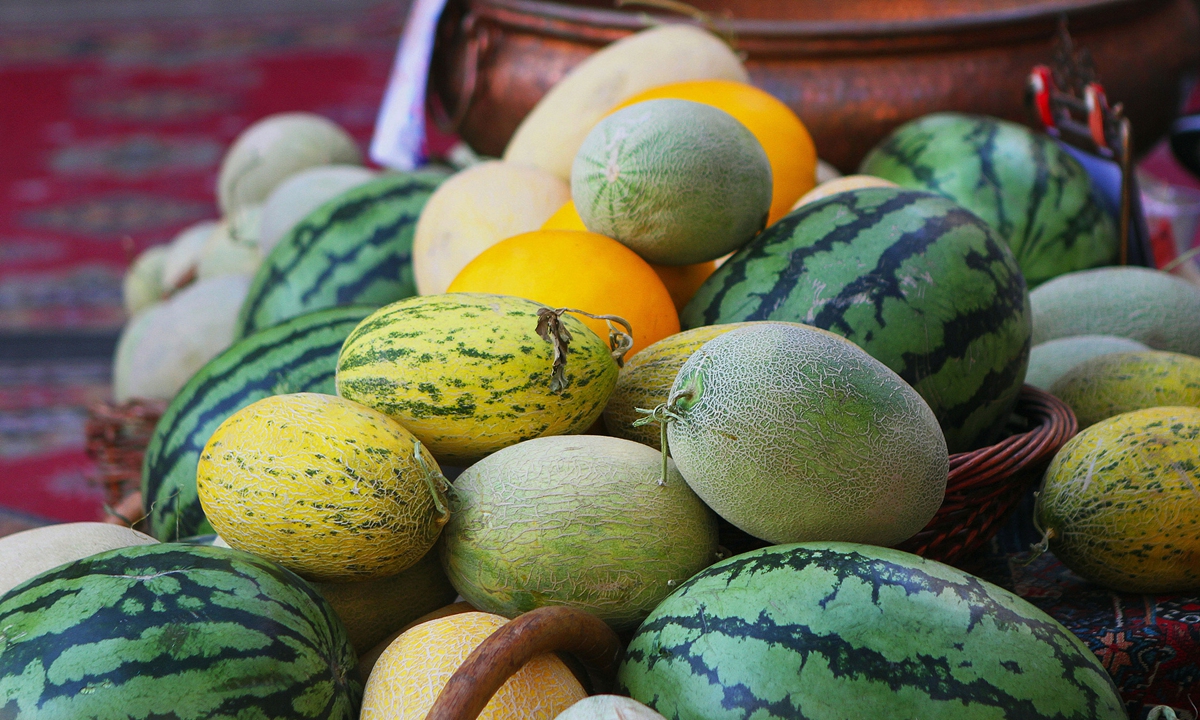
If you visit Northwest China's Xinjiang Uygur Autonomous Region in August, the peak season for melons and other fruits, the words you're likely to hear most often are the warm invitations of locals: "Come and have some melons! They're homegrown and so sweet!" This is no exaggeration - Xinjiang's sweet melons consistently win over the taste buds of visitors with their juiciness and rich aroma. As the centerpiece of traditional hospitality, the "melon" is not only a symbol of Xinjiang's warm and welcoming culture but also a thread connecting a story about locality and globalization.
The sweetness of Xinjiang's fruits is no accident. Geography and climate have endowed them with unique advantages.
Statistics show that Xinjiang enjoys an average of 2,500 to 3,500 hours of sunshine each year. The long daylight hours provide extended periods for photosynthesis, while cooler nights - with temperatures dropping by 10 to 20 degrees Celsius - reduce plant respiration, allowing more sugar to naturally accumulate in the fruits. The fact that Xinjiang's large temperature differences between day and night contribute to the sweetness of its fruits is something almost every Chinese student learns in geography class.
Xinjiang's melon cultivation area and variety are equally remarkable. According to the Xinhua News Agency, in 2025, Turpan City in Xinjiang alone had 68,000 mu (about 4,533 hectares) of Hami melons, encompassing more than 20 high-quality varieties, with an expected total output of around 136,000 tons.
Specialty melons, such as cantaloupes and sweet melons, form a local agricultural industry chain centered on "melons," with both their output and quality serving as hallmarks of the sector. In terms of both yield and quality, Xinjiang's melons have become a signature symbol of the region's agriculture.
With the deepening of the China-proposed Belt and Road Initiative (BRI), Xinjiang's melons and other fruits are increasingly expanding in the international markets.
According to data from Wuchang Customs, since the beginning of this year, Turpan City has exported over 4,476.28 tons of Hami melons, worth 27.41 million yuan - a year-on-year increase of 11.8 times in value. At present, fresh Hami melons, grapes and other agricultural products from Turpan have already sold well in more than 20 countries and regions worldwide.
The BRI has created significant opportunities for Xinjiang's fruit to go global. Take the Horgos Port as an example: In January and February this year, Horgos exported 110,000 tons of fruits and vegetables, up 46.2 percent year-on-year. This would not have been possible without the opportunities brought by the BRI and the efficient operation of the ports. The fresh produce can even enter the Kazakh market within just a few hours. A small fruit has become a microcosm of global agricultural exchange.
Beyond imports and exports, China also strengthens agricultural cooperation with other countries through technology transfer. In October 2020, the Shanghai Cooperation Organization established the Demonstration Base for Agricultural Technology Exchange and Training in Shaanxi Province. The initiative not only boosts local agricultural capacity, but also shares Chinese agricultural products and technology with the world.
Amid the tide of globalization, Xinjiang's fruit serves not only a symbol of the region but also as a vital link between China and the rest of the world. The success of Xinjiang's melon is a direct result of free trade, characterized by smooth logistics, low tariffs and mutual access to technology. China has consistently opposed protectionism, advocating for global agricultural stability through technology sharing, green channels and trade liberalization.
This stance and experience are particularly valuable in light of rising global uncertainties, as the cross-border flow of agricultural products is facing challenges such as high tariffs, unilateral sanctions and geopolitical conflicts imposed by certain Western countries.
Journeying from Chinese farms to international supermarket shelves, Xinjiang's melons serve not only as Xinjiang's calling card but also as a testament to global agricultural exchange and cooperation. In this story of globalization, we see not only sweetness, but also trust and partnerships that transcend borders. In a world undergoing profound changes, perhaps this kind of sweetness needs to travel further.
The author is a reporter with the Global Times. suyaxuan@globaltimes.com.cn
RELATED ARTICLES