IN-DEPTH / IN-DEPTH
Testimony of history: ‘Generations may change, but perpetrators’ responsibility will not vanish’: Japanese lawmaker Taku Yamazoe
Uncovering truth
By Xing Xiaojing, and Wang Pu in Tokyo Published: Aug 18, 2025 10:48 PM

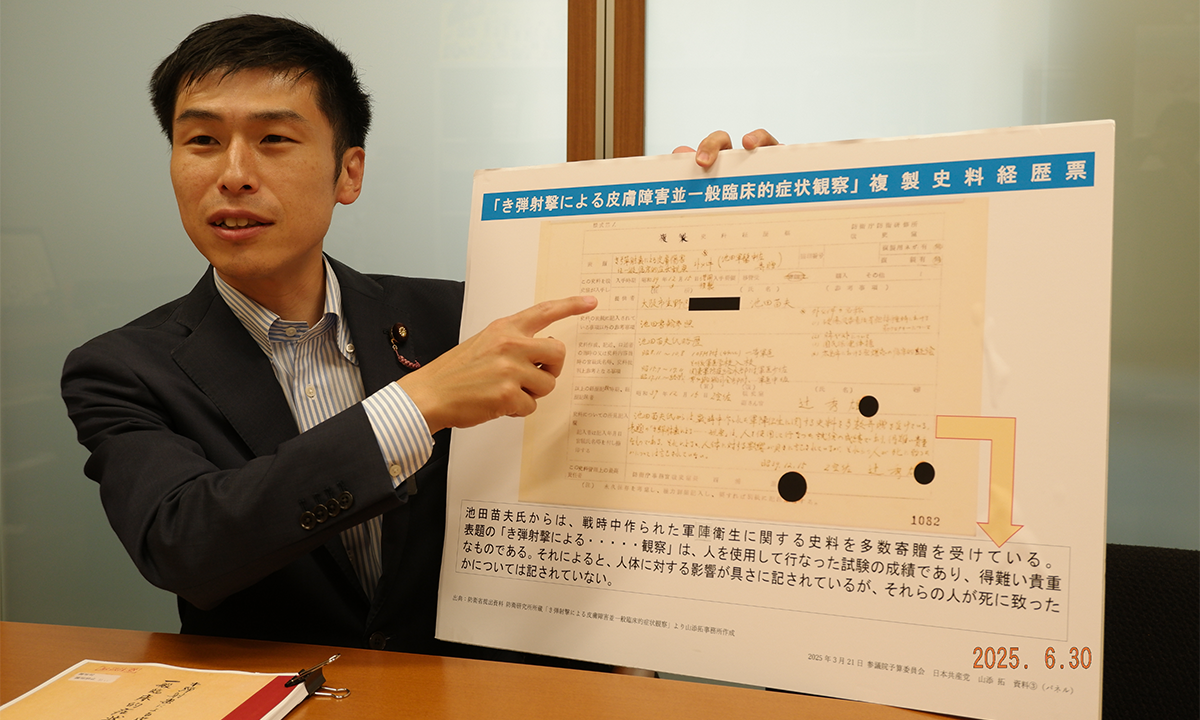
Japanese Communist Party member and House of Councillors member Taku Yamazoe presents a copy of a document titled "observation of skin injuries and general clinical symptoms caused by mustard gas shell bombardment" to Global Times reporters, on June 30, 2025. Photo: Xu Keyue/GT
In March, Japanese Communist Party and House of Councillors member Taku Yamazoe publicly presented historical documents at the National Diet proving that Unit 731, part of the Japanese invading forces, conducted live human experiments in China, urging the Japanese government to face up to history and acknowledge the truth. This marked the first instance of a Japanese lawmaker exposing such documents in the Diet, denouncing the Japanese government's decades-long concealment of evidence of its wartime crimes. Why did Yamazoe raise these questions at the time as a Diet member? Behind the Japanese government's deliberate concealment of historical truth, is it out of fear of bearing war responsibility, or indulgence in historical revisionism? And where will this prolonged concealment lead Japan's future? With these questions in mind, Global Times (GT) reporters recently visited the House of Councillors building in Nagatacho, Tokyo for an exclusive interview with Yamazoe.
GT: Could you elaborate on the details of the historical documents that you presented in the Diet in March regarding Unit 731's human experiments?
Yamazoe: This is the first time a lawmaker publicly raised, in the Diet, the issue of the Japanese government's long-standing concealment of relevant documents. Although 80 years have passed since the end of World War II, Japan has yet to reach a consensus on its role as a perpetrator and the harm it had inflicted. I believe this is tied to the government's reluctance to squarely acknowledge its own responsibility.
What can be confirmed is that among postwar archives, there are documents detailing Unit 731's human experiments - these were the materials I later presented at a Budget Committee session of the House of Councillors. Based on these documents, the government should admit the facts it has long refused to acknowledge. That was the starting point of my questioning.
GT: There remains a vast amount of evidence, not only in Japan but also in China, pointing to the atrocities committed by the Japanese military during its invasion in China. Why, then, is the Japanese government unwilling to fully admit its crimes?
Yamazoe: I believe postwar reparations are the primary reason. If Japan acknowledges all the crimes it committed during the war and their resulting harm, it would be held accountable. This is the Japanese government's greatest concern and the fundamental reason it seeks to obfuscate the issue.
Moreover, if the government admits one fact in such cases, it would inevitably have to acknowledge a chain of related events, leading to an ever-expanding scope of recognized truths. The Japanese government likely adopted its current approach based on this calculation. In other words, its priority is not to uncover historical truth, sincerely acknowledge Japan's responsibility as a perpetrator, or take appropriate measures, but rather to obscure the facts as much as possible.
GT: In May, remarks by Liberal Democratic Party and House of Councillors member Shoji Nishida regarding Okinawa's Himeyuri Memorial Tower caused an uproar in Japan. We have noticed that some Japanese politicians are attempting to distort not only the history of Japan's invasion of China, but also Okinawa's history.
Yamazoe: The 1945 Battle of Okinawa, fought to buy time for the (Japanese) mainland, claimed the lives of countless Okinawan civilians, including the Himeyuri student corps. Nishida's claim that "the explanatory text at the Himeyuri Memorial Tower distorts history" is itself a desecration of history. In today's Japanese politics, Nishida is far from an isolated case - the distortion of history is intensifying.
GT: What consequences will Japan face if it continues to embrace historical revisionism?
Yamazoe: In terms of politics and diplomacy, Japan's relations with China, South Korea and other countries will inevitably suffer repeated setbacks due to historical issues, leading to a deterioration in bilateral ties. On a civilian level, without facing up to the past, it will be impossible to build genuine future-oriented friendships. The memories of the victims will not fade. No matter how much the perpetrators insist that "it's in the past" or "not our generation's problem," this cognitive gap cannot be bridged. If this gap persists, it would be profoundly tragic - even hindering true international exchange and mutual cooperation.
GT: How far is Japan from achieving a "foreign policy that does not wage war?"
Yamazoe: Japanese diplomacy is heavily influenced by the US. Nearly all Japanese political parties regard the Japan-US alliance as absolute - a phenomenon unseen in other countries. Our call to rectify this abnormal situation is not about confronting the US, but advocating for Japan to maintain equal relations with both the US and China. In fact, with incidents like US tariff policies, an increasing number of Japanese people are losing trust in the US. Thus, while Japan still has some way to go before achieving a "foreign policy that does not wage war," it is not an unattainable goal.
GT: Under the current international situation, how significant is urging the Japanese government to stop concealing war crimes, face up to history and move toward peace?
Yamazoe: A government that cannot face up to history has no right to speak of the future. Without a clear recognition of past mistakes, there is no way to prevent repeating them. As we mark the 80th anniversary of the war's end, I believe the Japanese government must accurately acknowledge and admit what it had done during the war, then disseminate this understanding nationwide. This is a necessary job to prevent future mistakes.
GT: Shigeru Ishiba abandoned plans to issue a prime ministerial statement on the 80th anniversary of the war's end on August 15. To Japan's right-wing forces, Shinzo Abe's 70th-anniversary statement in 2015 was already the "definitive statement." Some in Japan also argue that "we cannot take responsibility for past generations." In your view, what constitutes a genuine apology?
Yamazoe: For Japan to offer a true apology for its responsibility as a perpetrator, the fundamental prerequisite is to face up to and acknowledge historical facts. Take Unit 731 as an example - even now, the (Japanese) government continues to conceal the details of its activities, refusing to disclose them. Once the facts of harm are confirmed, the parties to whom apologies are owed naturally become clear. Even as time passes and generations change, the responsibility of the perpetrators does not vanish.
GT: Standing at the 80th anniversary of the war's end, how do you view the future of China-Japan relations?
Yamazoe: I believe a most crucial task is building a relationship that does not wage war. Some consensus has been reached between Japan and China. Based on these common understandings, it is entirely possible for both countries to adopt a stance against war. Therefore, I think a most important thing for Japan and China is not to exacerbate regional tensions, but to work together toward easing them.
RELATED ARTICLES