IN-DEPTH / IN-DEPTH
US’ disdain for international rules risks global trust in its rationality: Former Indian PM advisor
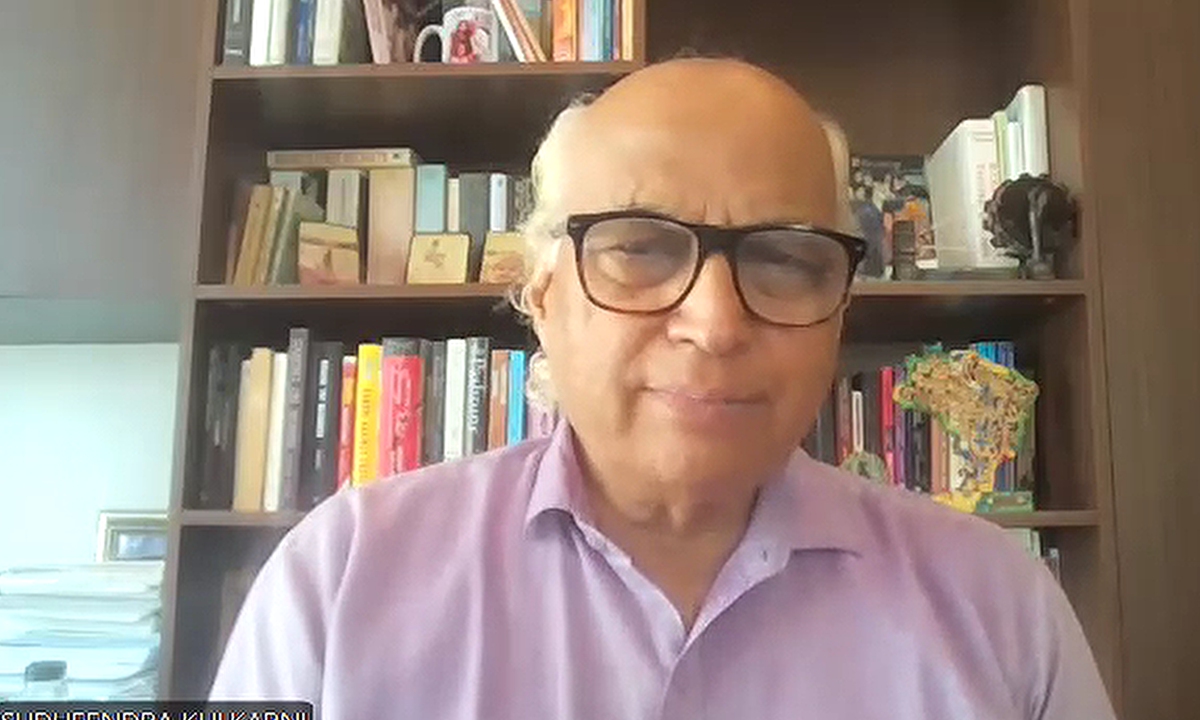
Indian scholar Sudheendra Kulkarni Photo: Bai Yunyi/GT
Editor's Note:Shortly after the start of US President Donald Trump's second term, Indian Prime Minister Narendra Modi became one of the first foreign leaders to visit Washington. At the time, the two referred to each other as "good friends," and both countries set an ambitious goal of increasing bilateral trade to $500 billion by 2030. However, less than six months later, US-India relations took a sharp downturn: The US announced a total of 50 percent tariffs on Indian imports and threatened to impose an additional 10 percent tariff due to India's membership in the BRICS group. Furthermore, the US repeatedly challenged India's "red lines" on issues such as purchasing Russian oil and matters related to Pakistan. This marks "a stunning reversal" in the relationship between the two countries, commented the BBC on August 6. Following this, how New Delhi responds will determine the future trajectory of India-US relations. According to Indian media reports, Modi is expected to meet with Trump in the US at the end of September to discuss trade and tariff issues.
Are India-US relations at a "crossroads?" Will the escalation of tensions between the two countries make it more difficult for Washington to enlist New Delhi in its plans to contain China? Regarding these questions, the Global Times (GT) recently conducted an exclusive interview with Indian scholar Sudheendra Kulkarni (Kulkarni), a close aide to former Indian prime minister Atal Bihari Vajpayee and the founder of the Forum for a New South Asia.
GT: We have noticed that there has been a recent escalation of tensions in relations between India and the US primarily due to tariff issues. Based on your understanding, how do the Indian people view US pressure tactics and the current state of India-US relations?
Kulkarni: The mood in India toward the US is turning very negative and even bitter, because what the US is doing is against the principles of friendship between India and the US.
For nearly a decade, Prime Modi had invested so much in building India-US relations. Some people were even expecting India to become a US ally. There were forces within the US that wanted India to become a close partner in containing China. Against this backdrop, the recent actions by the Trump administration have both come as a surprise and also a matter of deep concern. He has chosen to make tariffs a weapon of his country's economic policy, as well as international relations. This goes against the tenets of international relations.
I must say, Indians, including those who admire the US, are deeply disillusioned and also embittered.
GT: Some comments suggest that current India-US relations are at their lowest point in nearly three decades. What's your take on this view?
Kulkarni: I agree with this view. It is not because of what India has done that pushed these relations to rock bottom. The US is an important country, which no country in the world can ignore. We wanted to have good relations with the US, but how the US government is behaving frustrated this goal.
GT: The US has long sought to draw India into a joint effort to contain China. Given the current situation, will Washington's plan be even more difficult to implement? Will India consider readjusting its relations with the US, Russia and China?
Kulkarni: The strategy to establish a relationship between the US and India to counter China was an unworkable strategy, even before the recent deterioration of India-US relations. There were some people in India who believed in this strategy, and became supporters of the so-called Quad (the quadrilateral partnership among the US, Japan, Australia and India). We are now seeing that the US doesn't care for its so-called friends. So who can trust the US?
Second, there are some issues between India and China. Many of these problems between India and China are inherited from the past. I think that if we make sincere efforts on both sides, these problems can be resolved through negotiations and dialogue. If some problems cannot be resolved at once, we can let some problems remain in the background and continue to cooperate for mutual benefit.
In any bilateral issue, we should never bring in a third party who may have their own vested interests. We are both ancient nations. For thousands of years, we have interacted with and respected each other. Why should we allow the US to interfere in relations between India and China?
Russia, on the other hand, has been a traditional friend. Why should the US dictate to us who we should buy oil from? Russia has been meeting a very critical need of ours at a reasonable price. We buy things to our advantage. What's wrong in that? The US' attitude that other countries should accept their dictates is a wrong attitude. I think the US should learn to live in a democratic world and not in a world that it thinks it can command forever.
GT: How do you view the long-term prospects of the "Quad?"
Kulkarni: The current trade tensions will make the "Quad" cooperation more difficult. There is also a question mark as to whether Donald Trump will attend the Quad Leaders' Summit this year.
The "Quad" has no future. While the ocean may be named the Indian Ocean, that does not mean it exclusively belongs to India. It is an ocean that belongs to all the countries in the vicinity, just as the Pacific Ocean does not belong to any one nation.
If we want a rule-based maritime order in this region, the right thing would be to include all the countries in the region. Why not include China as part of the "security dialogue," expanding its membership to include countries like Indonesia and others? Together, in a consultative manner, we can reestablish the norms for maritime activity, ensuring maritime security for all nations.
Therefore, the "Quad" is a small clique. It doesn't work. It has no future.
GT: Do you think the extreme pressure from the US could possibly make the Indian government give in?
Kulkarni: I don't think so. We are an independent nation, we are a sovereign nation, we are proud of our freedom, and we are proud of our whole heritage. We have fought a long battle for freedom from imperialism. So if anyone thinks that India will bow down to the pressures of the US, they are mistaken.
GT: How do you view the contradiction between "India First" and "America First"?
Kulkarni: The US government is taking an easy part out of a major economic crisis that the US finds itself in. Ultimately, it is going to hurt the US itself. What the US government did is to use tariffs as a weapon to force other countries in the world to accept whatever it dictates. There is no scope for a mutually trusting dialogue on the question of tariffs, and others are imposed to follow. This goes against the tenets of what the US has been preaching to the rest of the world, that there should be "a rule-based world order." Now, is what the US government doing? Absolutely no respect for rules; contempt for rules actually. So this has made a lot of people around the world to question the wisdom or even the basic intelligence of American leadership.
There are some discussions regarding "India first." But in a globalized world, in an increasingly interdependent, interconnected world, if any country says that we "come first" and our priorities are the utmost, it goes against the interests of the international community. I would say not "India first," or "America first," but "humanity first." The interests of all the countries in the world should come first. And then the interests of individual nations.
Countries around the world will have a very bleak future if one country begins to act as a "global hegemony." India, China, Brazil and other countries including the EU, we should have a common dialogue, because we all are victims of this hegemonic pressure. And we should then set the rules for a fair, democratic and global trade order.
RELATED ARTICLES