China-based giant toy maker Pop Mart posts over 360% rise in profit in H1 Guochao trend accelerates global expansion
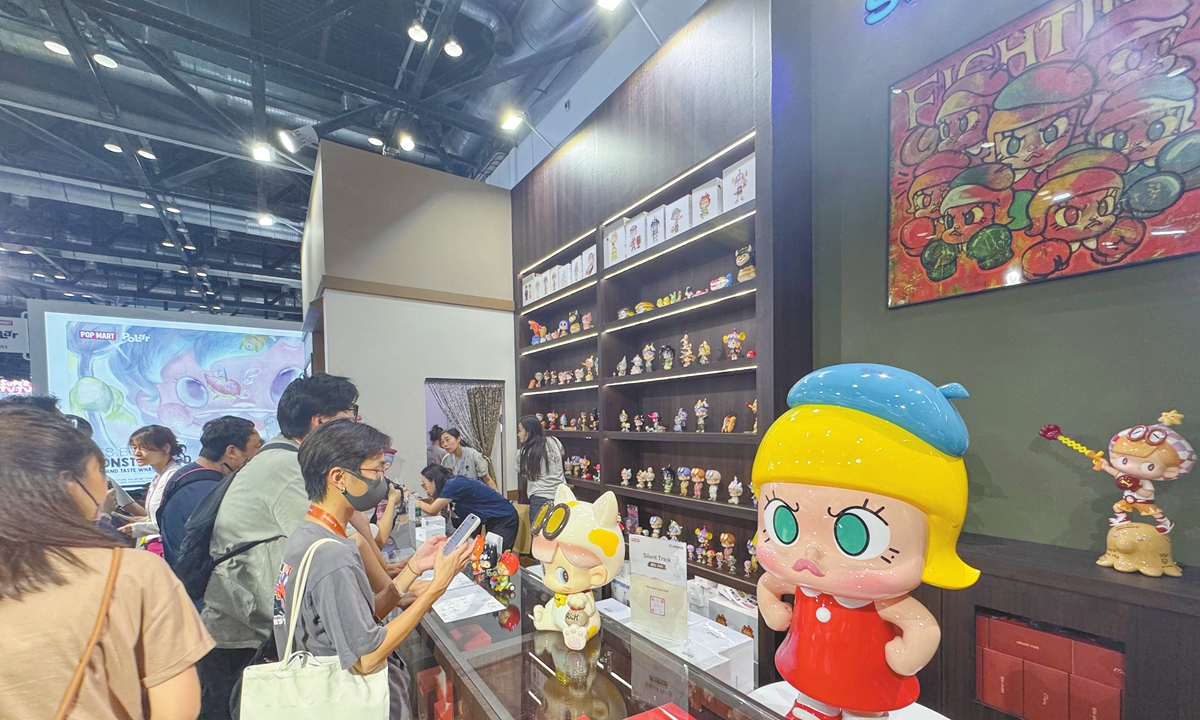
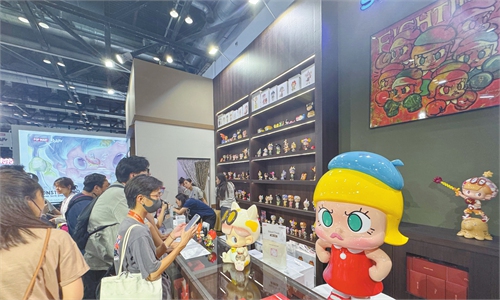
Visitors shop at a store during a pop toy show organized by Pop Mart in Beijing on August 2, 2025. Photo: Chen Qingrui/GT
China's giant toy producer Pop Mart on Monday released its financial results for the first half of 2025, reporting revenue of 13.88 billion yuan ($1.91 billion), up 204.4 percent year-on-year, extending the strong momentum from the previous two quarters.
Adjusted net profit reached 4.71 billion yuan, up 362.8 percent year-on-year.
Experts said the performance is a testament to the rise of China's Guochao trend and its intellectual property IP incubation capacity.
This is Pop Mart's first financial report following its global organizational restructuring, and also the first time the company has disclosed results across its four major regions — China, Asia-Pacific (excluding China but covering other Asian and Oceania markets), the Americas, and Europe and other regions.
Revenue from China stood at 8.28 billion yuan, up 135.2 percent; Asia-Pacific revenue was 2.85 billion yuan, rising 257.8 percent; revenue from the Americas surged to 2.26 billion yuan, up 1,142.3 percent; and revenue from Europe and other regions rose 729.2 percent to 480 million yuan.
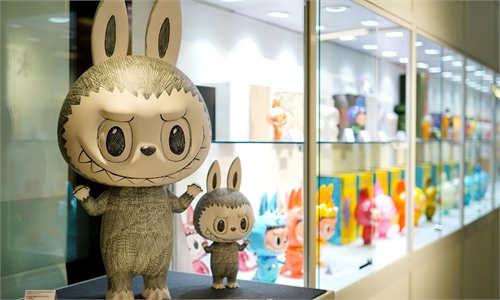
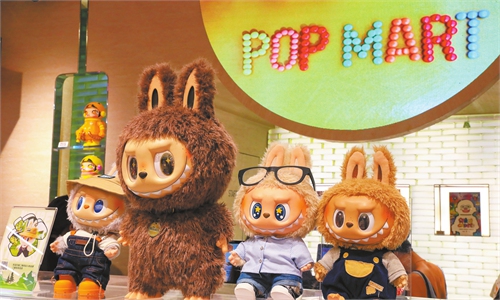
The company, best known for creating the global sensation LABUBU, has also seen explosive sales growth across other in-house products with intellectual property (IP) rights.
In the first half of 2025, 13 artist IPs each generated more than 100 million yuan in revenue. Among them, The Monsteres, Molly, Skullpanda, Crybaby, and Dimoo (should be upper/lower case such as The Monsters ete) recorded revenues of 4.814 billion yuan, 1.357 billion yuan, 1.220 billion yuan, 1.218 billion yuan, and 1.105 billion yuan, respectively, according to the company's financial report.
LABUBU, a member of The Monsters family, was one of the world's most popular IPs in the first half of 2025, thanks to its distinctive appeal and unique style.
The company told the Global Times that as of June 30, the Chinese mainland membership base had expanded to 59.12 million from 46.08 million at the end of 2024.
Members accounted for 91.2 percent of sales in the first half, with a repurchase rate of 50.8 percent.
Previously, Pop Mart founder Wang Ning emphasized in an interview that the company's rise has been powered by both Chinese culture and Chinese manufacturing.
"We want to be an enterprise like a tree, with its roots deeply planted. China's inclusive culture, strong manufacturing capacity, and broad market... all provide the soil for rooting. It is precisely Chinese manufacturing and Chinese culture that have made us what we are," said Pop Mar's founder Wang Ning in an exclusive interview with the People's Daily.
He said that in 2025, the company's overseas sales are likely to exceed domestic sales, and the growth rate is much faster than expected. "When we went initial public offering (IPO), total sales were less than 2 billion yuan. In 2024, we achieved a revenue of 13 billion yuan. In this way, we have built many Pop Marts. This year, the sales of Pop Mart in North America are likely to exceed those in Southeast Asia, as the overseas market is constantly expanding," according to Wang Ning.
As one of the leading representatives of China's rising pop toy industry, Pop Mart established four regional headquarters in April for the first time, underscoring its deepening globalization strategy. The company attributed its growing market presence to continuous improvements in operational effectiveness and business efficiency in China.
In the first half of 2025, Pop Mart opened its first stores in landmark locations such as Cambridge in the UK and Bali in Indonesia, continuing its push into iconic global destinations.
As of June 30, the company was operating 571 stores across 18 countries, including 40 new physical outlets and 105 new Robo Shops, the company told the Global Times on Tuesday.
China's IP incubation market has already proven its efficiency. Its rapid feedback mechanism enables timely strategy adjustments, helping companies and creators avoid blind global investments and shorten the IP success cycle, said Wang Peng, an associate research fellow at the Beijing Academy of Social Sciences.
Wang added that China's core opportunity lies in the synergy between "industrial efficiency upgrades" and "cultural creativity." "Young consumers are not only fueling market growth but also advancing both the localization and globalization of IPs. For international creators, China's industrial chain provides a springboard from regional success to global influence."
RELATED ARTICLES