Illustration: Xia Qing/GT
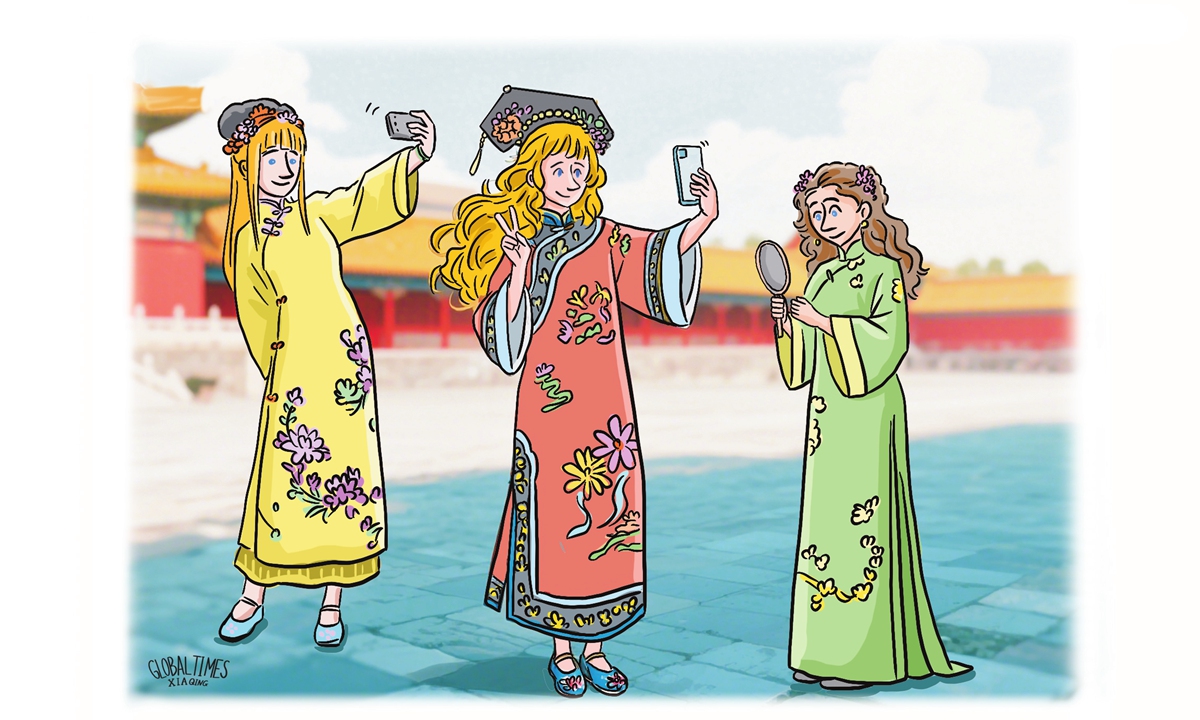
This summer, China's inbound tourism market has continued to heat up. As of mid-August, over 1.88 million foreign visitors had entered through Beijing's ports, marking a year-on-year increase of 36.6 percent. Online videos show that attractions such as the Forbidden City were packed with "foreign princesses." These visitors of diverse nationalities, dressed in Qing Dynasty-style princess costumes or traditional Hanfu, clothing traditionally worn during the Han Dynasty, eagerly posed for photos in front of the sights, becoming a unique "scenic attraction" in the eyes of Chinese tourists.
More flight routes and convenient services have provided foreign tourists with the flexibility to travel on a whim. Meanwhile, cultural experience industries - including themed photo shoots in "foreign princess" costumes and special foreign-language tours exploring the Forbidden City - have become increasingly mature and standardized, offering foreign visitors a stronger sense of participation and a deeper cultural impression.
The craze for taking "foreign princesses" photos reflects a structural shift in cultural perceptions between China and the world. In the past, Western perceptions of China were mostly limited to symbolic icons such as "kung fu" or "pandas." Today, foreign tourists, through firsthand experiences, are beginning to engage with more multidimensional aspects of Chinese culture, including clothing, etiquette and architecture. As a young Australian visitor put it, "Hanfu is not cosplay but a gateway to another culture." When he stood outside the East Prosperity Gate of the Forbidden City, holding a thread-bound book and dressed in a dragon robe, this shift, from visual curiosity to cultural empathy, embodied the experience of many young foreign travelers visiting China.
Among visitors to China, young travelers stand out for their strong capacity to spread information. They are eager to experience unfamiliar things and are equally willing to share their experiences through social media. Their willingness to try new things has also led their participation to evolve from surface-level photo ops to deeper, immersive experiences. They explore China's streets and alleys, as well as urban and rural areas, personally experiencing contemporary social life and the rich forms of Chinese culture. This gives them an authentic, "seeing is believing" understanding and a genuinely jaw-dropping impact, allowing them to recognize the limitations of their previous perceptions and share these insights on social media. Such vivid, firsthand dissemination often performs better in terms of views, influencing more foreign netizens and allowing China's reality and culture to be perceived more authentically. Content from the frontlines carries a "force of witness" that cannot be distorted or misrepresented by Western media.
When countless "forces of witness" converge into a torrent, the Western media's "distortion" of China's image will inevitably be shattered. The adage "seeing is believing" holds true: As videos, photos and social media increasingly showcase genuine experiences and heartfelt reflections, the once meticulously painted gloomy hues and selectively skewed views will no longer hold. As more visitors come to China and immerse themselves in its reality, they will continuously enrich Western public perceptions and understanding of the country, breaking down two barriers in grassroots exchanges between East and West.
First, this process dismantles the one-dimensional understanding of life in Chinese society. Second, it dismantles one-sided perceptions of Chinese culture and its international image. Those accustomed to a zero-sum view of the West, or who misunderstand Chinese culture and positions, are easily led toward the "China threat" narrative. Only by experiencing firsthand the warmth and friendliness of the Chinese people, witnessing their inherent love of peace, and grasping the profound meaning behind the ideal of "embraces cultural diversity and global harmony," can one truly see the authentic nature of Chinese civilization.
Mutual understanding between young people in China and abroad essentially progresses from misunderstanding and alienation born of unfamiliarity to gradual acquaintance, engagement and participation. Chinese youth once experienced a phase of fascination and even obsession with foreign cultures. But as cultural practices deepened and cultural confidence awakened, their perspective shifted from looking up to foreign cultures to viewing them as equals. Now, foreign young people are undergoing a similar shift in perspective. Many young people abroad have seen their understanding of China evolve - from prejudice and obscured images to slowly perceiving a more authentic China. Active cultural exchange between Chinese and foreign youth will cultivate more profound mutual understanding and build a bridge for genuine communication.
The author is a professor at Peking University. opinion@globaltimes.com.cn
RELATED ARTICLES