New research restores how 3,000-year-old bronze bull vessel was made
Uncover ancient ‘blind box’
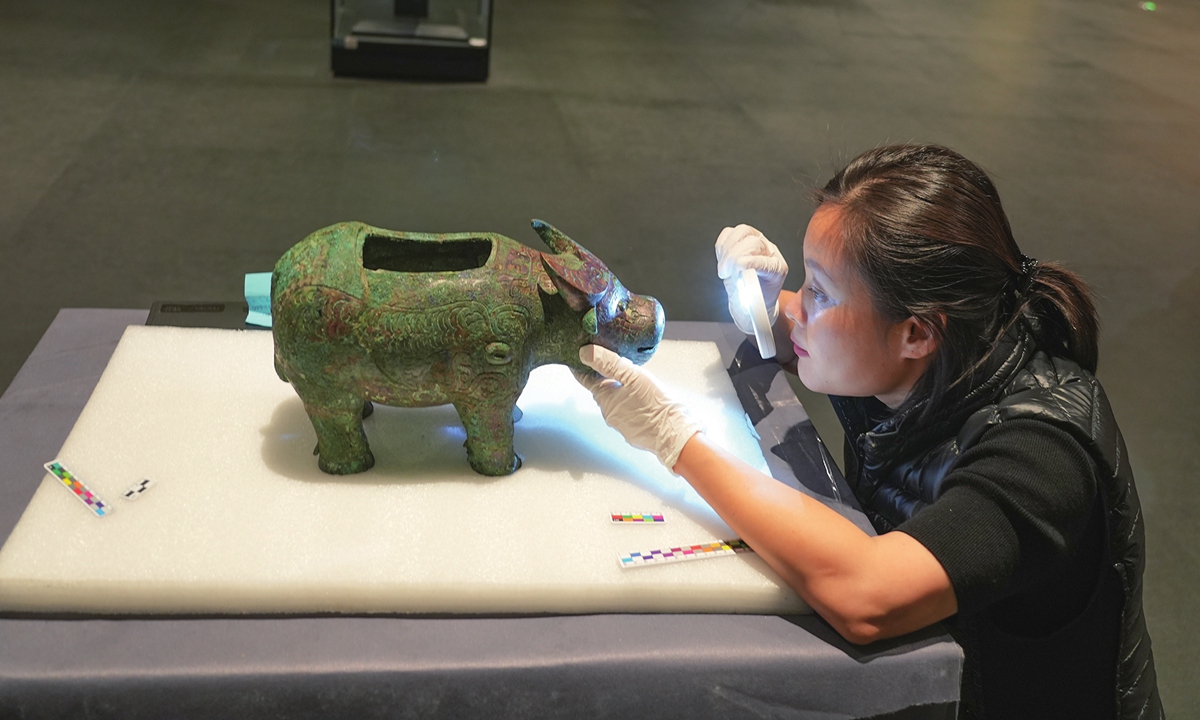
Researcher Yang Huan examines the original artifact of the Yinxu Ruins' bull-shaped bronze vessel. Photo: Courtesy of Yang Huan
With a round, plump body and refined patterns covering its surface, a bull-shaped ancient bronze vessel at the Yinxu Museum in Anyang, Central China's Henan Province, is a veritable pearl to the site's collection due to it being the only bronze vessel of its kind ever been unearthed from the Yinxu Ruins to date. The Yinxu Ruins is a UNESCO World Heritage Site that represents the peak of China's Shang Dynasty (c.1600BC-1046BC) civilization.
Although this some 3,000-year-old bull-shaped bronze vessel has been restored and put on public display, its origins remained shrouded in mystery. Recently, however, a research team at China's Northwest Polytechnical University uncovered the piece-mold casting process of the artifact. The public can now not only view the bronze vessel itself, but also learn how it was made by the Shang people.
Rewinding time
Compared to many bronze artifacts of simpler forms such as rectangular vessels with four legs, this bronze bull demonstrates much higher casting complexity.
Yet, even for the most intricate vessels like this, ancient craftsmen would always follow a fundamental forging process to pour molten bronze into pre-fabricated clay molds, also known as "taofan."
Deciphering such an ancient casting technique defies modern researchers' naked-eye observations. It is akin to "unwrapping a 3,000-year-old blind box sealed by Shang creators," explained Yang Huan, the lead researcher of the project, to the Global Times.
"We can hardly determine the exact ratios of metal liquids or casting temperatures," explained Yang, stressing that these invisible processes are "precisely the key" to unlocking bronze artifact research.
Blessed with modern technology, Yang and her team have finally devised a contemporary approach to decode the puzzle left by Shang artisans. They began by collecting high-resolution data from the original bronze bull artifact, then employed digital modeling techniques to create a 3D reconstruction of the vessel. The team also made calculations regarding the thermal properties of ancient taofan materials to engage interdisciplinary materials scientific research with cultural heritage studies.
Through persistent adjustments, Yang's team found the right hind leg of the bronze bull relic as the pouring gate deliberately chosen by Shang craftsmen. And it is this discovery that has revealed the incredibly modern bronze artistry of the ancient Chinese.
The selection of the pouring gate directly influenced the final perfection of the bronze artifact. Yang revealed to the Global Times that choosing the right hind leg as pouring gate can minimize casting defects. Additionally, the Shang craftsmen intentionally increased the gate's thickness to approximately 7mm, resolving molten metal flow insufficiency issues.
Beyond its right hind leg, the bull-shaped relic maintains a remarkably uniformed wall thickness of 3mm throughout its main body, with only the weight-bearing hoof surfaces thickened to 5mm. Such a design provided optimal structural support to the artifact, and was achieved purely manually without digital measuring tools in ancient times.
"Ancient techniques still hold vitality and remain applicable in the modern handicraft industry," Yang told the Global Times, adding that scholars worldwide "have long held a deep fascination with ancient Chinese bronzes," and this new research offers them fresh insights into China's bronze civilization. The research findings have since been published in the Journal of Archaeological Science, a leading international journal of archaeological science.
Vessel's cultural code
The research conducted by Yang and her team has not only reconstructed the production details of a bronze artifact, but also uncovered the cultural significance behind these ancient bronze objects.
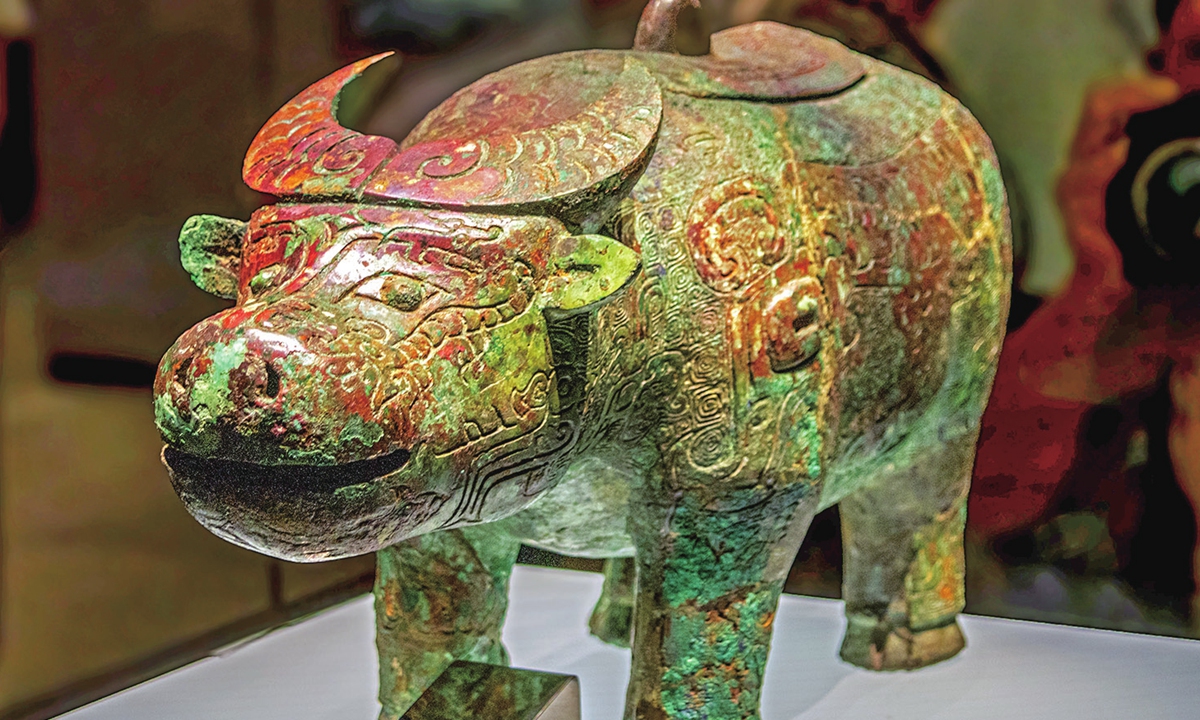
The original artifact of the Yinxu Ruins' bull-shaped bronze vessel Photo: IC
Taking the composition of the raw materials used to make the bull-shaped vessel as an example, it was a combination of around 90 percent bronze and 10 percent tin. Yang said that the purity of this particular piece of bronzeware was closely tied to the social status of its ancient owner.
Discovered in the year of 2000, the bull-shaped bronze artifact was discovered in a rectangular tomb in the palatial zone of the Yinxu Ruins.
After dusting off the mud, archaeologists revealed the artifact's surface motifs of dragons, birds, tigers, and other sacred creatures, signaling the status of its owner, He Yuling, deputy director of the Anyang Workstation at the Institute of Archaeology of the Chinese Academy of Sciences (CASS), told the Global Times.
The artifact was later found to be an ancient wine container that belonged to "Ya Chang," who was a tribal leader of the "Chang" state in the southern territories of the Shang Dynasty," He noted while recalling the site where he and his team discovered the relic 25 years ago.
Including Ya Chang's bronze bull vessel, a massive number of bronze relics have been unearthed from Yinxu Ruins with its iconic Fuhao Tomb itself containing nearly 470 pieces.
As He noted, these bronze artifacts on the one hand, reflect the "social-cultural beliefs, economic and social growth, ritual systems, and aesthetic taste of Shang people." Yet at the same time, they stand as timeless reminders, encouraging researchers to view ancient bronze cultures through new lenses as well as sharing their findings with researchers overseas.
Noting that she is preparing an "even more groundbreaking" study on bronze artifacts, Yang revealed that her team has introduced China's interdisciplinary approach to bronze research to Australia through collaborations with local researchers and students.
"If ancient bronzesmiths were the knowledge keepers of Chinese bronze age civilization, today's scholars must become storytellers, by translating 3,000-year-old techniques into lessons for classrooms and the public," Yang noted.
RELATED ARTICLES