A view of a shopping mall in Wuhan, Central China's Hubei Province File photo: VCG
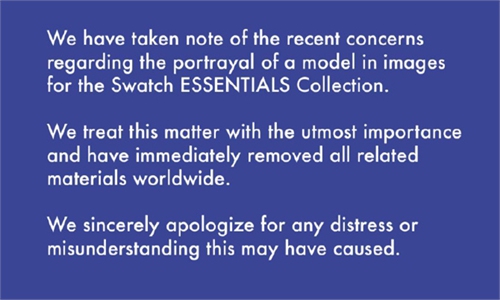
Swiss watchmaker Swatch recently sparked controversy over an advertisement featuring a male model deliberately pulling the corners of his eyes up and backwards in a "slanted eye" pose. This discriminatory gesture against Asians once again hurt the feelings of Chinese consumers. Although Swatch hastily deleted the image from its official website and issued an apology, the selective correction and the downplayed wording in its English statement exposed the company's arrogance and lack of cultural understanding in markets like China. In the first half of 2025, Swatch Group's net profits plunged by 88 percent, and its revenue share from China fell from 33 percent to 24 percent. Against this backdrop, many regard the company's publicity campaign as a "cultural provocation amid a performance collapse."
In response to the controversy, some questioned whether the public's reaction was "overly sensitive." This in fact ignores the profound historical context and the power structure behind the "slanted eye" image. From the 19th century, when British doctors associated Asian eye shapes with Down syndrome, to the stereotypical portrayals of characters like Fu Manchu and Charlie Chan, the West has, through medical discourse, literary creation and mass media, systematically constructed East Asians as the "other" - portrayed as intellectually inferior and morally corrupt. The essence of this cultural hegemony, as Edward Said revealed in Orientalism, is that Eastern peoples cannot represent themselves; they must be represented by Western discourse.
The makeup and gestures of the model in this incident are by no means simple artistic expression, but rather a contemporary reproduction of colonial discourse. The deliberately exaggerated "slanted eyes" feature essentially places Asian consumers in the position of being "represented," attempting to perpetuate the power order of "the East must be represented by the West." Chinese consumers' boycott is not about opposing a certain eye shape, but about resisting symbolic violence laden with historical trauma.
On the one hand relying on the Chinese market for revenue, and on the other hand hurting consumers with controversial advertising, Swatch's actions may seem contradictory, but behind them lies the misjudgment and opportunism of Western brands toward the Chinese consumer market.
From the perspective of marketing strategies, some Western brands regard controversy as a low-cost exposure tactic. Swatch may have believed that, under the logic of "negative publicity is still publicity," China's core consumers would not abandon the brand, and that potential customers might even pay more attention to it. However, they underestimated the cultural awareness of Chinese consumers.
A deeper reason lies in the anxiety and unwillingness of Western brands in the face of China's rise. As one of the world's largest luxury markets, China's domestic luxury brands are rapidly developing and expanding their market share. As a result, some Western brands attempt to maintain their psychological superiority through cultural suppression. This mindset was particularly evident when Swatch, at the early stage of the incident, selectively removed content from its Chinese mainland website while retaining materials for Europe, the US, and Hong Kong Special Administrative Region and Taiwan island.
In the face of cultural provocation, Chinese consumers, whose awareness of cultural sovereignty has long awakened, are not powerless. Dolce & Gabbana collapsed after its insulting-China incident and H&M lost billions in market value because of lies about Xinjiang cotton. These cases demonstrate that the right of consumers to choose is the most powerful form of discourse. When consumers "vote with their feet," they defend not only personal rights and interests, but also the reconstruction of global business ethics, expecting respect and equal dialogue from Western companies. For Swatch, if it cannot respect Chinese consumers, respond to the cultural demands of the Chinese market, and continues to indulge in the cycle of "arrogance-apology-repeat offense," it will eventually follow in the footsteps of Dolce & Gabbana.
Today, business activities have gone beyond the simple exchange of goods to become carriers of cultural values. This incident is a warning to Western companies hoping to share in China's consumption upgrade: the cultural dignity of the Chinese people is not to be provoked, and the prosperity of the consumer market must be built on mutual respect. We welcome sincere cooperation, but we will never accept any form of cultural bullying. Recognizing this is the prerequisite for Western companies to operate in China, and also the foundation for equal dialogue in the future.
The author is a PhD candidate at the School of Journalism at Fudan University. opinion@globaltimes.com.cn
RELATED ARTICLES