US targets Chinese steel, other sectors citing widely debunked ‘forced labor’ claim; move shows failure of previous attempts: expert
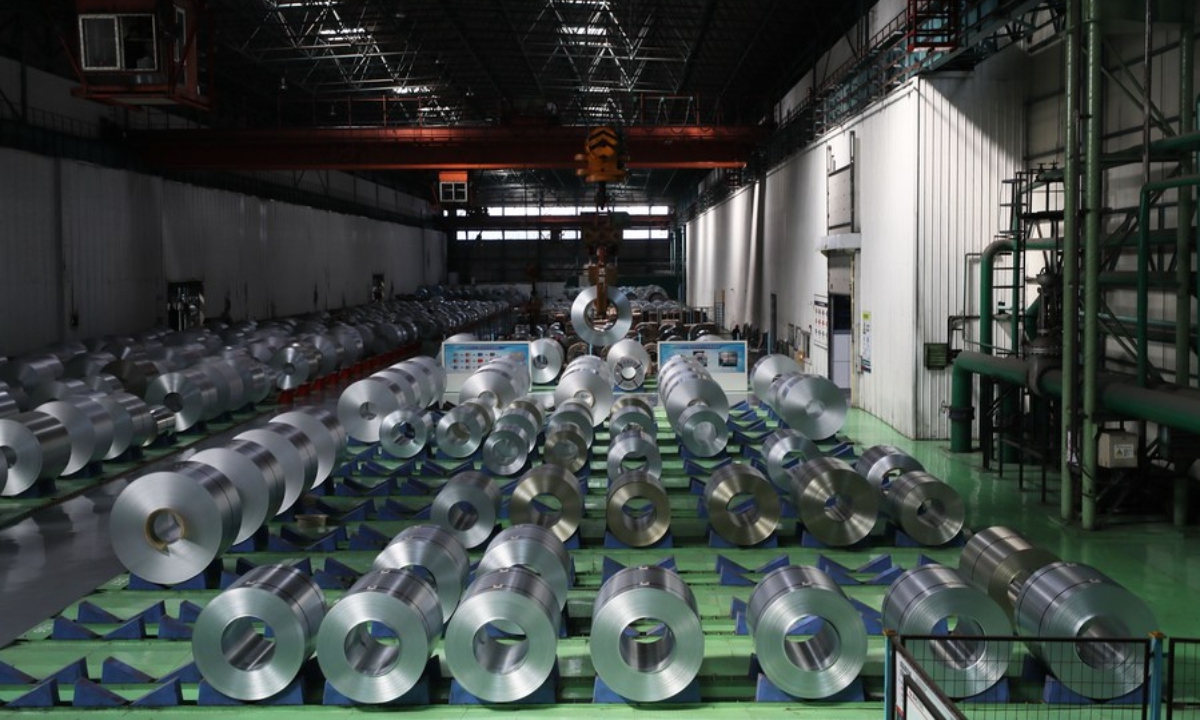
Steel rolls Photo: Xinhua
The US Department of Homeland Security (DHS) on Tuesday announced the designation of several new Chinese industries as high-priority for enforcement under the US’ so-called “Uyghur Forced Labor Prevention Act,” which has been firmly deplored and rejected by the Chinese side.
The latest US move shows Washington’s previous attempts to use the “witch hunt” to suppress Chinese industries have failed to reach its intended goal, a Chinese expert said on Tuesday.
In a post on its official X account, the DHS said that the US adds steel, copper, lithium, caustic soda, and red dates as high-priority sectors for enforcement under the so-called act, which restricts Chinese goods that the US claims to be made with “forced labor” from entering the US.
“Forced labor” is just another excuse made up by the US in a “witch hunt” to crack down on relevant Chinese industries, Zhou Mi, a senior research fellow at the Chinese Academy of International Trade and Economic Cooperation, told the Global Times on Tuesday.
“It is a narrative trick used by the US with ulterior motives, and it is intended to suppress the the competitive advantage of Chinese products,” Zhou said. He noted that the US’ latest attempt to expand the list of Chinese industries targeted shows that its previous attempts to use the so-called “forced labor” claim to suppress industries in Northwest China's Xinjiang Uygur Autonomous Region such as cotton have failed to reach its intended goal.
Despite previous crackdown attempts by US and some other Western countries, Xinjiang’s cotton industry has seen remarkable development. As one of the world's leading cotton-producing areas, Xinjiang reported a cotton output of 5.69 million tons in 2024, accounting for over one-fifth of the world's total. Notably, the region leads the country in mechanized cotton farming with a mechanization rate of 100 percent for cotton planting and about 90 percent for harvesting, according to Xinhua.
Chinese officials have repeatedly debunked so-called “forced labor” claims made by some US and Western officials.
On June 11, asked to comment on a report from Global Rights Compliance, a group in Europe, on Xinjiang saying that companies of critical minerals from Xinjiang risk buying products that have been produced with forced labor, Lin Jian, a spokesperson for the Chinese Foreign Ministry, said that “the so-called allegation of ‘forced labor’ in China’s Xinjiang region is nothing but a lie propagated by certain anti-China forces.”
“We urge certain organization to stop interfering in China’s internal affairs and undermining the stability and prosperity in China’s Xinjiang region under the pretext of human rights,” Lin said.
In December 2021, when the US side signed the so-called “Uyghur Forced Labor Prevention Act” into law, a spokesperson for the Chinese Foreign Ministry issued a statement stating that this Act maliciously denigrates the human rights situation in China’s Xinjiang in disregard of facts and truth.
“It seriously violates international law and basic norms governing international relations and grossly interferes in China’s internal affairs. China deplores and firmly rejects this,” the spokesperson said in the statement.
Global Times
RELATED ARTICLES