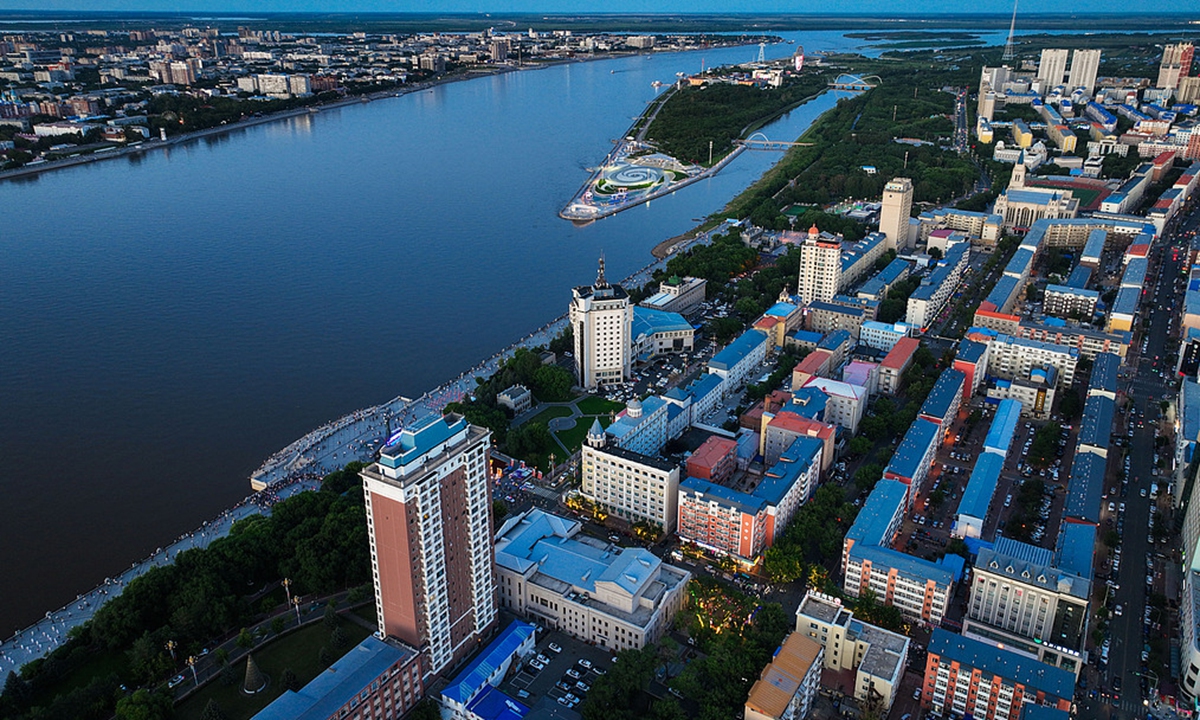
A view of Heihe city, northeast China's Heilongjiang Province, located on the border with Russia. Photo: VCG
From late July to mid-August, I joined a team organized by the Institute of Area Studies at Peking University for a 14-day field survey along the China-Russia border. We traveled nearly 3,000 kilometers, gathering a wealth of vivid firsthand material on the state of China-Russia border trade amid the Russia-Ukraine conflict. In this piece, I would like to share my observations on the current structure of cross-border trade and its specific impact on stimulating the vitality of border economies.
Through surveys of five border ports along the route, we found that China's exports to Russia are concentrated in automobiles, electronic products (such as computers and phones), industrial equipment and light industrial goods (including toys and footwear). At the same time, the influence of the Russia-Ukraine conflict on border trade is clearly visible: The purchasing power of Russians entering China has declined, while Russia's dependence on Chinese exports has increased.
In the past, Russian consumers preferred Toyota, Hyundai and other Japanese or South Korean cars. However, due to the conflict and Western sanctions, even if they bought these cars, follow-up maintenance services were hard to access. As a result, they have turned to Chinese cars, especially secondhand ones. Before the conflict, Russia often exported premium agricultural products and luxury goods to Western countries, but now it mostly sells them to China at lower prices. During our survey, we noticed that the price of Russian amber products had dropped to one-third of pre-conflict levels.
Russia's exports to China are mainly in two categories: bulk commodities, such as oil, minerals, grain and timber, and agricultural products and processed goods, such as candies, honey and aquatic products. Russian primary agricultural products are generally of high quality and their processed foods are subject to strict quality requirements, with very little use of food additives. The relative reliability of Russian agricultural and processed products stems both from strict laws and regulations and perhaps also from industrial structure: The limited extension of their industries into complex processing reduces unnecessary quality risks.
Given this overall structure of China-Russia trade, border cities tend to build their industries around imported resources. But this approach often presents a challenge: It is difficult for labor-intensive industries to emerge, making it hard to absorb sufficient employment. A common perception is that industrial restructuring is necessary. However, through interviews and roundtable discussions along the route, I realized that such restructuring may not be realistic. As the benefits from oil, petrochemicals, state farms and forestry that local development can enjoy are limited, it is difficult for China's northeast region to develop labor-intensive industries.
Instead, a more feasible future direction may be to transition from a "corridor economy" to a true "border-port economy," which involves making existing industries based on imports more refined and more advanced. For example, the leading industry of Suifenhe, a city located in Northeast China's Heilongjiang Province, is timber processing, but most of the work remains in primary processing, with short industrial chains. Suifenhe could consider upgrading its technology to use Russian-imported coniferous timber for deep processing into high value-added products, such as insulating paper. Similarly, the city's grain processing industry has short chains, mainly limited to low-value-added feed and oils. With technological empowerment, it could be expanded to produce high-value protein powder. Moreover, during our survey, we observed promising pilot practices, including a Suifenhe firm fermenting Russian honey into mead and a center in Dongning, also in Heilongjiang, processing Russian-sourced black fungus into over 20 value-added products.
Border cities need to identify their positioning in line with local conditions. Rather than seeking to overhaul existing industrial structures, it may be more practical to deepen and refine them, leveraging technology to drive the deep and fine processing of imports, extend industrial chains and increase added value. How to ensure scientific achievements align with the development needs of the border and how to enable scientific talent to find opportunities in border regions has become a key topic for promoting the development of China's northeast border areas.
The author is a professor at the School of Law of Xiamen University. opinion@globaltimes.com.cn
RELATED ARTICLES