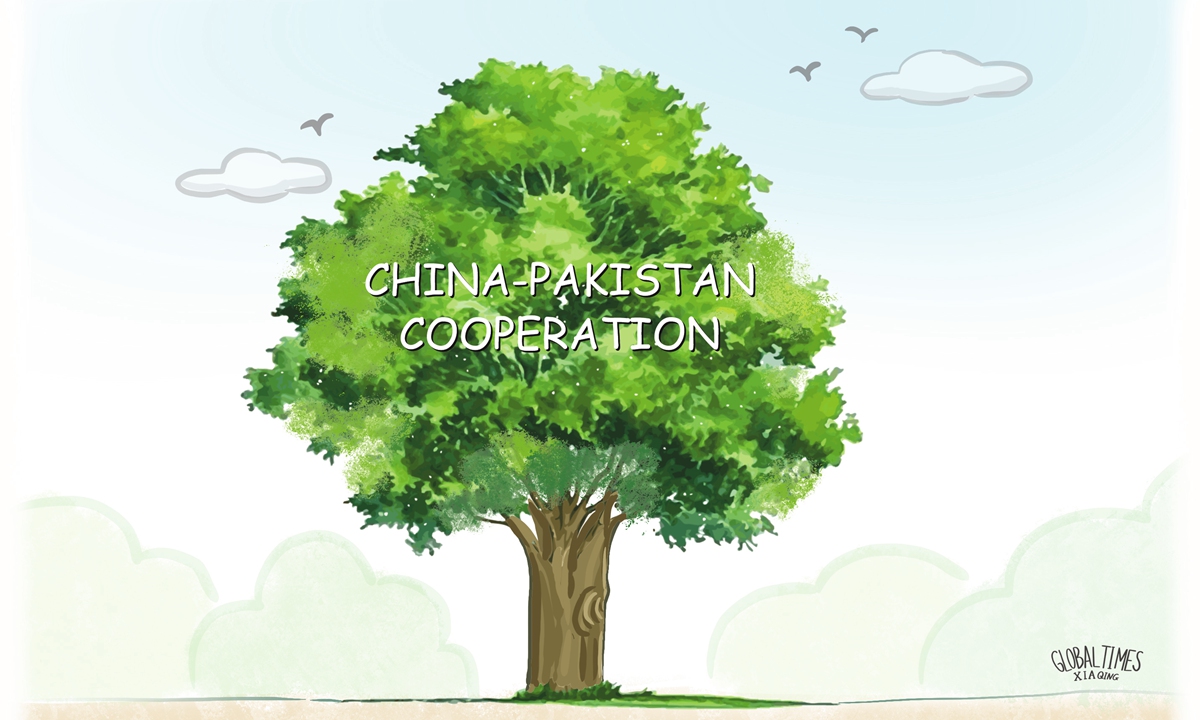
Illustration: Xia Qing/GT
Member of the Political Bureau of the CPC Central Committee and Foreign Minister Wang Yi kicked off a visit to Pakistan on Wednesday, during which the Sixth Round of the China-Pakistan Foreign Ministers' Strategic Dialogue will be held. This visit comes at a crucial juncture: The South Asian landscape and interactions between regional and external players are evolving rapidly; Pakistan is recalibrating its foreign policy; and the all-weather China-Pakistan strategic cooperation is entering several key stages.
Against this backdrop of "triple transformations" - at global, regional and bilateral levels - the dialogue is expected to focus on issues including the construction of the economic corridor, bilateral defense cooperation, regional security initiatives and cooperation in international affairs. Its significance is clear: The traditional friendship between China and Pakistan is unshakable, and the two sides remain firmly committed to building a closer China-Pakistan community with a shared future in the new era - a partnership that will never be subject to third-party interference.
Since the start of this year, South Asia's dynamics have been shifting. Relations among countries in the region - including Pakistan, India, Bangladesh and Sri Lanka - are being rapidly recalibrated, while the South Asia policies of external powers such as the US, Russia and Japan are also undergoing major changes. As an important player in the region, Pakistan has been proactive in adapting to these changes, notably by warming relations with both Washington and Moscow and achieving significant diplomatic outcomes. For China and Pakistan, who have stood the test of history as all-weather strategic cooperative partners, their relationship remains a cornerstone of Pakistan's diplomacy regardless of how South Asia's landscape evolves or how relations among other states are restructured. Pakistan has always been a priority in China's neighborhood diplomacy. The China-Pakistan partnership has not been, and will not be, affected by external changes. Instead, the all-weather strategic cooperation will grow even deeper and more substantial through the interplay of "change" and "unchange."
Since President Xi Jinping's historic visit to Pakistan in 2015, when the two sides established the world's first all-weather strategic cooperative partnership, China-Pakistan relations have advanced in leaps and bounds, guided by the development of the China-Pakistan Economic Corridor (CPEC) and unaffected by global turbulence or outside interference. To further strengthen this partnership amid a fast-changing global and regional context, the following must be given special attention to.
First, the upgrading of CPEC must not be disrupted. The CPEC has been at the heart of China's efforts to build a closer China-Pakistan community with a shared future in the new era. No country or force can, or should be allowed to, interfere in this process. Pakistan must stay vigilant against schemes by third parties that seek to "decouple" Pakistan from China under the guise of deepening cooperation, and firmly counter acts aimed at undermining CPEC.
Second, the safety of Chinese projects, personnel and institutions in Pakistan must be guaranteed.
President Xi has stressed that economic cooperation and security cooperation are like "two wheels" that must roll forward together. Pakistan's leaders have also repeatedly pledged to ensure the security of Chinese nationals, projects and institutions. Such guarantees should be built on bilateral and regional security cooperation, led by China and Pakistan themselves.
Third, China and Pakistan need to further strengthen coordination on regional and global issues. When the world is undergoing unprecedented changes at an accelerating pace, with mounting geopolitical conflicts and intensifying deficits in peace, development and governance, the two countries should deepen collaboration in upholding multilateralism, advancing the Global Development Initiative, Global Security Initiative and Global Civilization Initiative, and amplifying the voices of the Global South. China and Pakistan can contribute to building a multipolar world that is more equal and orderly, and economic globalization that is more inclusive and beneficial to all. The China-Pakistan friendship goes far beyond the bilateral scope, it's one of deep trust and shared hardship. In the face of South Asia's rapid transformations, it will not only remain unaffected but will emerge even stronger.
The author is director and associate research fellow of the Pakistan Research Center at Sichuan University. opinion@globaltimes.com.cn
RELATED ARTICLES