IN-DEPTH / IN-DEPTH
US-India economic spat reveals deep fight over national strategic positioning
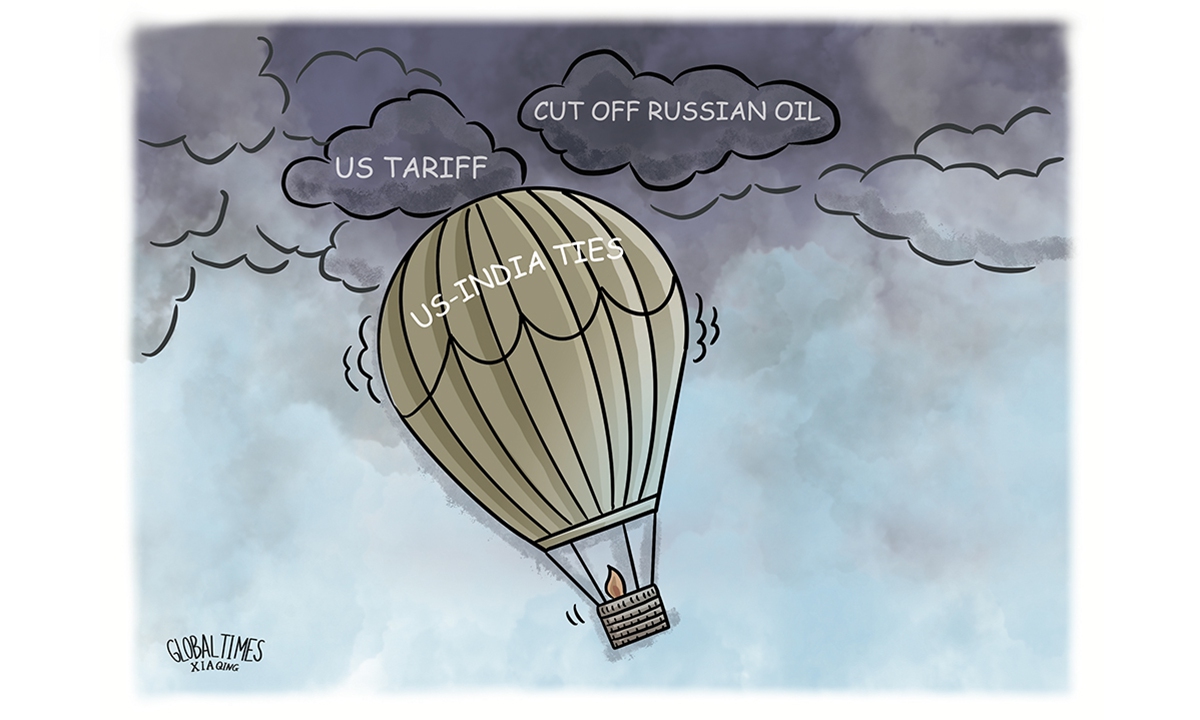
Illustration: Xia Qing/GT
Recently, factors including the tariff war, geopolitical differences, the resonance of domestic populism and clashes in diplomatic styles have pushed US-India relations to a low point. This rift is not accidental; it is an inevitable outcome of the fierce collision between the US "transaction-first" diplomatic logic and India's great-power ambition of "strategic autonomy."
During the "Trump 2.0" era, trade disputes have become the key factor in the deterioration of US-India relations. Washington's "America First" policy labels India as a "tariff abuser," accusing the latter of imposing tariffs as high as 100 percent on US goods such as agricultural products and medical equipment, leading to bilateral trade imbalances. Currently, the tit-for-tat tariff war signals toward US-India economic relations are sliding toward confrontation.
The deeper contradiction lies in the fact that the Trump administration has completely reversed the previous "strategic generosity" logic. During the Biden era, the US government included India to the Strategic Trade Authorization Tier 1 list in exchange for India's cooperation in the US' "Indo-Pacific Strategy." However, the Trump administration has converted India's strategic value into specific economic interests, demanding that India reduce the trade deficit, open its agricultural market and increase purchases of US weapons and energy. India has refused to compromise, especially in politically sensitive domestic areas such as agriculture and dairy industries, locking bilateral relations into a vicious cycle and sparking strong anti-US sentiment at home.
This economic confrontation is not merely a battle for interests, but more importantly, a clash of national identities. The US sees India as a secondary partner that must "concede benefits," while India views itself as a global power and expects equal treatment. This has shattered India's romantic illusion regarding US-India relations, forcing New Delhi to re-examine its dependence on the US.
Judging from a geopolitical perspective, there is a misalignment of strategic visions and trust crisis between the two countries. The strategic foundation of US-India relations was originally the "joint response to China's rapid global rise," but the current policy uncertainty in Washington has shaken this foundation. The US regards India as a key pawn in the "Indo-Pacific Strategy" and expects it to confront China. However, India's strategic focus has always been on South Asia and the Indian Ocean, maintaining control over neighboring smaller and weaker countries.
Moreover, India's neutral stance in the Russia-Ukraine conflict has further intensified US-India geopolitical and strategic differences. The US has demanded that India reduce military and energy cooperation with Russia, but New Delhi has refused. The White House interprets this as India "sitting on the fence" and "trying to benefit from both sides" between the US and Russia. This "either friend or foe" mindset is incompatible with India's vision of a "multipolar world."
Although US-India relations have hit a low point, the strategic needs of both sides in the Indo-Pacific region mean that complete confrontation is not feasible. India's leverage value in geopolitics and its cooperation potential in technology, energy and defense leave room for the restoration of US-India relations. For instance, India may increase purchases of US energy and weapons imports in exchange for tariff concessions from the White House; meanwhile, the support of the US Congress and strategic circles for the "Indo-Pacific Strategy" may restrict the Trump team from completely abandoning India.
In the future, US-India relations may exhibit "competitive alienation" - limited cooperation in low-sensitivity areas such as climate change and counter-terrorism, while frictions in core issues such as trade, technology, and geopolitics may persist. The US sees India as a "quasi-ally" that must obey, while India adheres to its great-power identity as a "leader of the Global South" and refuses to become a secondary partner or vassal of the US. This structural tension is not only a microcosm of bilateral relations but also a footnote to the transition between the old and new international orders amid the ebb of globalization. The future of US-India relations will depend on whether the two sides can rebuild a predictable coordination mechanism on the basis of respecting each other's strategic red lines.
The author is a deputy director of the Institute of South Asia Studies, Sichuan University
RELATED ARTICLES