China promotes import, adaptation of overseas TV works, optimizes drama production under new ‘21 measures’
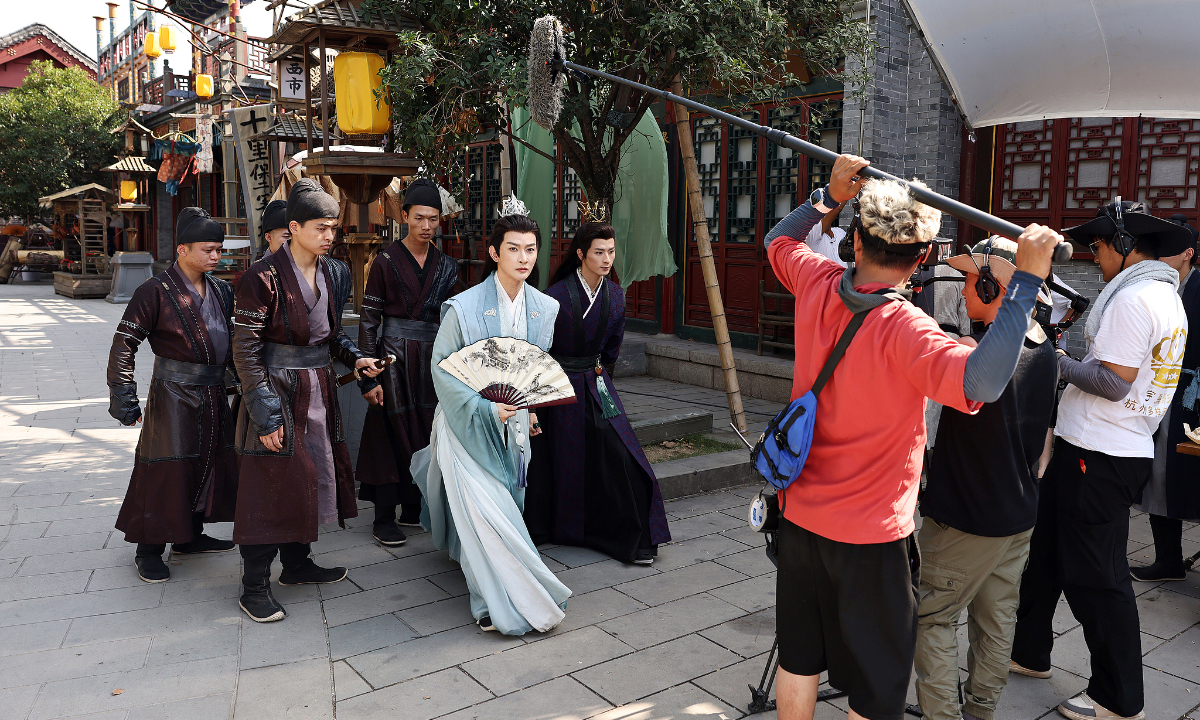
A micro-drama is filmed at Hengdian World Studios in Jinhua, East China's Zhejiang Province, on August 25, 2024. Photo: VCG
China's National Radio and Television Administration (NRTA) has unveiled a package of policies, widely referred to as the "21 measures," to optimize TV content, including adjusting episode counts and seasonal drama intervals, promoting high-quality micro-short dramas, and supporting localized adaptations of top global IP.
Notably, the measures promote the import of overseas outstanding works and encourage high-quality adaptations of overseas works, not limited to Japanese and South Korean intellectual properties (IPs),while supporting the prime-time airing of imported dramas, documentaries, and animations.
Renowned movie critic Tan Fei told the Global Times that the move signals broader opportunities for overseas works to enter the Chinese market.
"With quotas lifted, platforms will have more choices. We may see more overseas productions broadcast in prime time, which will also inspire domestic creators," Tan said. He added that the policy reflects an effort to bring audiences back to the TV screens and to deliver diverse, high-quality programming more efficiently.
Hu Xiang, associate researcher at the NRTA Development Research Center, explained the context behind the reforms. "With the rise of short dramas, gaming and livestreaming, audiences' tastes and viewing habits are changing rapidly, putting traditional TV drama production under pressure. These measures aim to unlock industry productivity through top-level design," Hu said, CCTV News reported.
Market sentiment was reflected immediately in the financial market, as shown by a long-awaited rally in the film and television sector on August 18. The cultural media index surged 3.11 percent on Monday with net capital inflows reaching 10.257 billion yuan ($1.42 billion). Share prices of related companies posted strong gains, per Securities Times.
While many of these film and television companies have since shifted from long dramas to the short-drama market after the NRTA advocated encouraging works of under 30 episodes in 2020 and called for preventing producers from splitting dramas into multiple parts or seasons in 2023, under the latest policy, the 40-episode cap on TV drama production will be appropriately relaxed, especially for major historical works or stories spanning decades.
This was identified as a move to address the decline in the number of episodes in long-form dramas over the past five years, given the background that the number of TV dramas fell from 254 in 2019 to just 115 in 2024, and episode counts also dropped from an average of 39.8 episodes each in 2017 to 28.8 episodes by 2024, per Red Star News.
"The return of long dramas means such works can be more expansive and expressive, without being forced to cut content due to length restrictions," Hu explained, while stressing that efforts to curb "watered-down" productions remain in place.
The measures also introduce a faster and more flexible review system. For major dramas slated for satellite TV prime time or leading online platforms, the NRTA and provincial authorities will conduct simultaneous reviews, CCTV reported.
Industry observers noted that the explicit support for short dramas entering TV broadcasting is particularly significant. Provincial broadcasters may set up dedicated short-drama slots to expand content supply. "Recognizing short dramas as a legitimate medium helps normalize their growth and encourages cross-platform circulation. Their fast pace and strong plots will also complement traditional narratives," Tan said.
Insiders at the NRTA's August 18 policy briefing further revealed that follow-up regulations will include graded management of problematic artists and stronger copyright protections.
Wang Xiaohui, Chief Content Officer of iQIYI, said during the briefing that the new regulations bring significant benefits to the film and TV industry. They are expected to accelerate content release, broaden creative space, enhance collaboration between online and broadcast platforms, and attract talent and investment to support healthy industry growth, as reported by Shanghai Securities Journal.
"The integrated approach of the 21 measures reflects the administration's responsiveness to both industry and audience demands. This time, the policies cover the entire chain and ecosystem. They respect artistic creation and market rules, while addressing industry needs and public expectations. This demonstrates both scientific planning and targeted implementation," Hu said.
RELATED ARTICLES