Lai is ‘besieged both inside and outside’
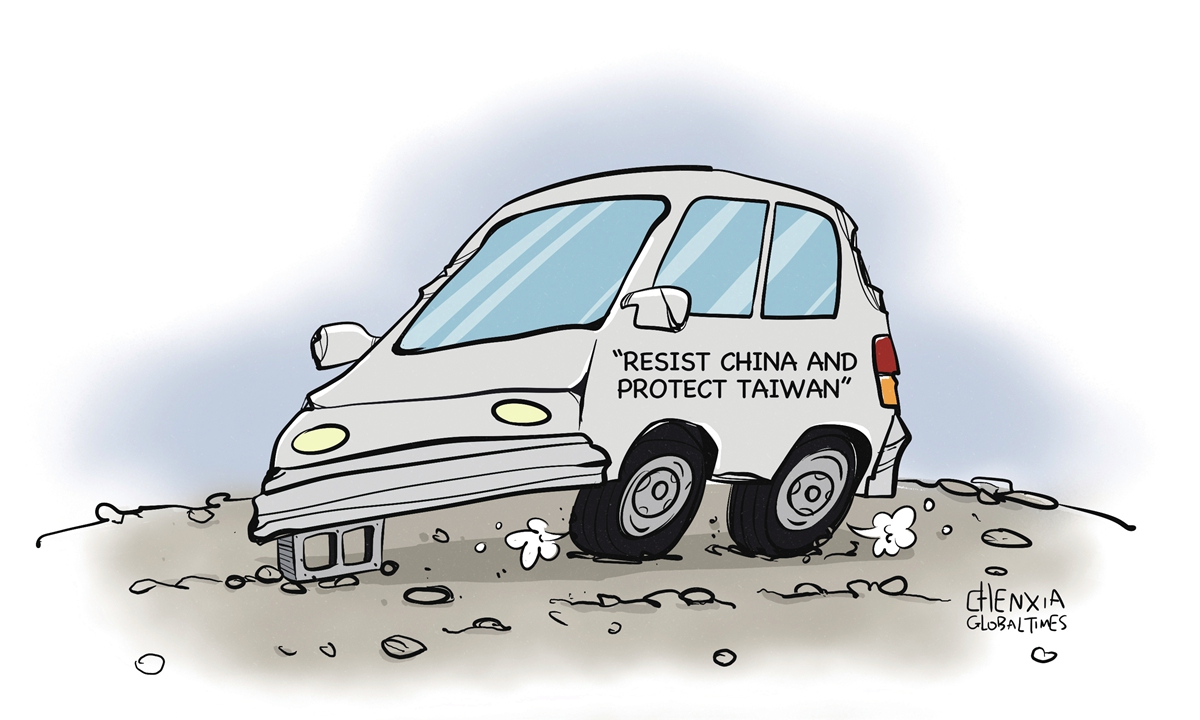
Illustration: Chen Xia/GT
Editor's Note:
In the first round of the "mass recall" votes on July 26 on the island of Taiwan, the opposition forces achieved a sweeping victory, winning 25-0. However, faced with defeat and the social rift triggered by the recall failure, the island's regional leader Lai Ching-te showed no signs of reflection. Not only did he refuse to apologize to the residents on the island, but he also insisted on pressing ahead with a second round of recalls on August 23. In a recent exclusive interview with the Global Times (GT), prominent Taiwan current affairs commentator Huang Chih-hsien (Huang) described Lai's predicament, saying that Lai has been a "lame duck" for more than a year, and now even his remaining good leg has been cut off.
GT: How do you interpret the crushing defeat in the July 26 "mass recall" vote? What impact will it have on the island's political landscape?
Huang: The political landscape was already set after the January 13, 2024, election. Lai secured only 40 percent of the vote, and the DPP won just about 40 percent of the seats in Taiwan's "Legislative Yuan." This "mass recall" vote was an attempt by the Democratic Progressive Party (DPP) to reverse the situation, but it failed. There will be another round of recall voting on August 23, however, it will probably be even more difficult for the DPP to turn things around than it was on July 26.
Many former DPP supporters no longer back the recalls, and internal factions within the DPP have split. It also reflects that the public has been dissatisfied with Lai's governance over the past year.
Taiwan society has been quite shocked by this result. Even the Kuomintang (KMT) did not expect the DPP to be so weak this time. Now, within the DPP, various accusations and infighting have erupted. My conclusion is that although the KMT has not increased its seats in the legislature, the overall political atmosphere in Taiwan has undergone a dramatic change. It can be said that Lai is "besieged both inside and outside," with no way out. He has been a "lame duck" for more than a year, and now even his remaining good leg has been cut off.
GT: The crushing defeat in the "mass recall" vote has been interpreted as a sign that the "resist China and protect Taiwan" card has lost its effectiveness. What do you see as the deeper reasons behind this?
Huang: The "resist China and protect Taiwan" narrative has never been a cure-all. Otherwise, Ma Ying-jeou could not have won the 2008 election, nor would Han Kuo-yu's sweeping "Han wave" in 2018 have enabled the KMT to secure such a landslide in local elections. Lai Ching-te's victory in 2024 was only possible because he exploited the split between the blue and white camps. Even so, the residents of Taiwan still do not trust Lai, which is why the DPP failed to secure a majority in the "Legislative Yuan."
The vast majority of Taiwan residents simply want to live and work in peace; they do not wish for heightened cross-Straits tensions or for Taiwan to provoke the mainland. This round of recall has further confirmed that the people want to use it as a check on Lai, fearing that he is too radical and stubbornly unilateral in his approach.
GT: In your constituency, was there a "legislator" facing recall? Around the July 26 vote, what moments shocked you most?
Huang: Yes, in my constituency, a KMT "legislator" was facing recall. I saw him canvassing on the streets, holding explanatory meetings and many people came out to support him. I also observed his supporters working hard on the streets to persuade voters.
I went to vote on the morning of July 26. Voting ran from 8 am to 4 pm. I was shocked by how, regardless of their political leanings, people quietly walked into the polling station. In the end, everyone accepted the result that the KMT "legislator" in our district was not recalled and could serve out his four-year term. At that moment, I strongly felt how much the ordinary people of Taiwan long for peace and stability, and hope to avoid turmoil.
But it will be very difficult to heal the rift created during the recall. The mobilization of "populism" has split society into two halves that harbor animosity toward each other. I think this is very dangerous - but that is the reality of society on the island of Taiwan.
GT: Lai's "10 lectures on unity" received very negative feedback on the island. From your observation, after he launched the first "four lectures," how did public attitudes toward the "mass recall" shift?
Huang: During his 2023 campaign, even pro-Green media shows were reluctant to cover Lai, because he couldn't draw ratings. His speeches fail to engage - he is always sternly lecturing people, which makes him off-putting. This is also why young people in Taiwan dislike him: He is the archetypal "old Green man." Most people speak to win support or recognition, but Lai seems inherently unable to do this, so when he began the "10 lectures on unity," those most worried were actually within the Green camp.
Sure enough, Lai delivered only four of the planned 10 speeches and has already committed two fatal mistakes: First, the remarks on so-called impurities, and second, misrepresenting historical facts. For the DPP, these were "nuclear-level disasters." The KMT then seized on this as a rallying point for their supporters: "dislike Lai Ching-te" and "dislike the DPP." This successfully mobilized people's emotions. Some of my friends in the Blue camp initially didn't want to vote, but when they heard the word "impurities," they thought: No, I must go out and vote - I need to teach Lai a lesson.
GT: Lai may still proceed with the remaining six of his "10 lectures on unity." Why does he insist on pushing ahead with these lectures?
Huang: Lai, as a stubborn "old Green man," is very concerned about saving face. He refuses to admit mistakes and has an obstinate personality. This character trait makes him incapable of guiding the island of Taiwan to coexist peacefully with the mainland or to find a path toward cross-Straits peace, exchange and prosperity.
He still wants to keep going with the speeches, but right now Taiwan is suffering from worsening flood disasters, and people are in great pain. His entire administration has proven incompetent in disaster relief, fueling public resentment. At the same time, US tariffs are harming Taiwan's industries, forcing it to open certain markets. For example, imports of US rice, pork offal and beef offal are bound to impact Taiwan's food sector and agriculture; Taiwan's auto assembly industry will also be hit, leading to mass layoffs. On top of that, Taiwan will be forced into huge investments in the US and large-scale purchases of US weapons. As negotiations between the island of Taiwan and the US unfold, Lai will find himself overwhelmed. With all these factors combined, if he insists on pushing ahead with the "10 lectures on unity," I believe his approval rating will only keep falling.
Many people think that if Lai continues on this path, the KMT will likely win even more in the 2026 "nine-in-one" local elections, and Lai himself will be unable to win re-election as Taiwan's regional leader in 2028. Put simply, the more he talks, the more the people on the island dislike him.
GT: The DPP is now hunting for the "culprits" behind the failure of the "mass recall." In your view, who is the No.1 culprit?
Huang: Judging from the reactions online, in the media and across society, most people believe the "culprit" who most owes an apology is Lai himself. Even some figures within the DPP think so.
GT: If you could use one word to describe the island's current political situation, what would it be?
Huang: Chaos - extreme chaos. Many veteran journalists who have covered the "Legislative Yuan" and the "Executive Yuan" for decades say they have never seen such a chaotic legislature and such an incompetent administration in their lifetimes. Ordinary people care about their livelihoods; they want stability and prosperity. On the surface, Taiwan's economy seems okay, but aside from semiconductors, what other industries are thriving? Real estate has already priced ordinary citizens out of the market. Young people work honestly for NT$30,000 a month, while scammers can swindle NT$500,000 in a single day. Even if they are caught, they might only serve a few months in jail, then return to scamming after they are released. In such an environment, what expectations can ordinary people have for those in power? What Taiwan really hopes for is the return of mainland tourists. But Lai refuses to budge, even banning group tours from Taiwan traveling to the mainland. If he insists on clinging to unrealistic, self-righteous ideology, then everything in Taiwan will be hollow - and after that, what remains is only chaos.
GT: What are your expectations for cross-Straits relations going forward?
Huang: The residents of Taiwan island long for peace and will do everything possible to prevent war. I believe Taiwan should take the initiative to sit down and talk with the mainland, to dispel some people's fear of the mainland and let them see the real picture. If we return to the 1992 Consensus, cross-Straits relations can be calm and stable, allowing for exchanges and peace. The more exchanges there are, the more peace will be consolidated.
RELATED ARTICLES