Chinese, Pakistani foreign ministers hold 6th round of strategic dialogue
Top Chinese diplomat's visit a continuation of tradition of 'family-like' exchanges: observer
By Published: Aug 21, 2025 09:55 PM

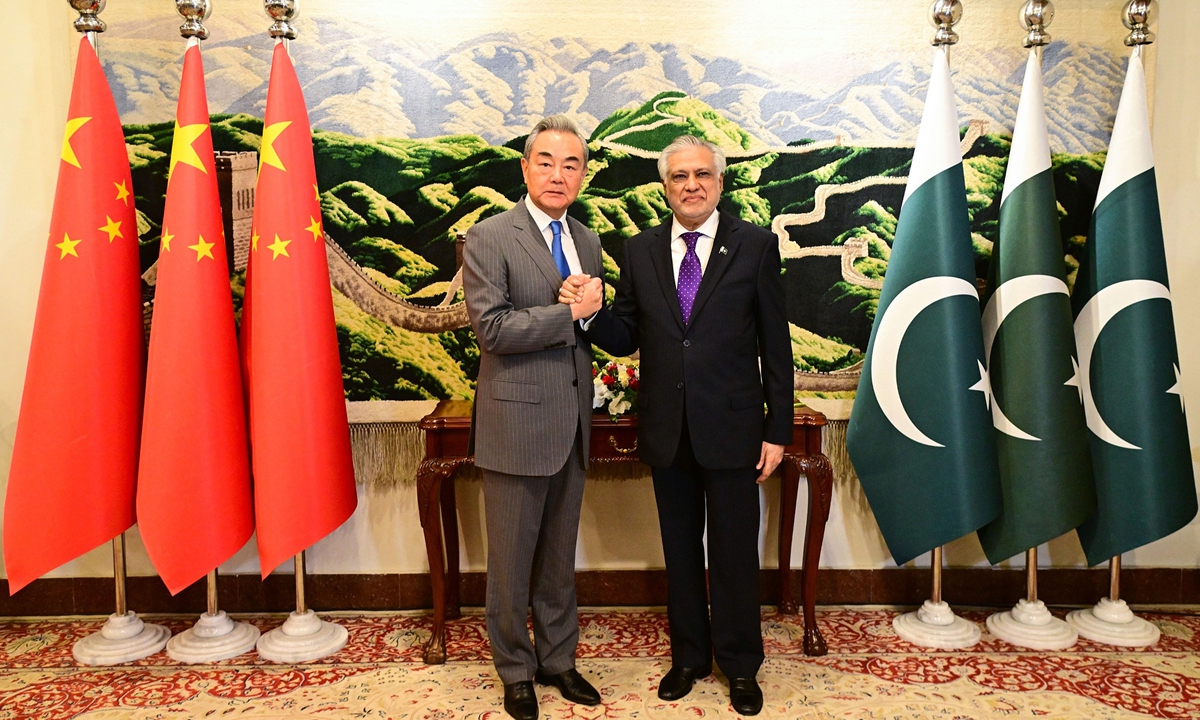
Wang Yi, a member of the Political Bureau of the Communist Party of China Central Committee and Chinese Foreign Minister, meets with Mohammad Ishaq Dar, Pakistani Deputy Prime Minister and Foreign Minister in Islamabad, Pakistan, 21 August 2025. Photo: VCG
Wang Yi, a member of the Political Bureau of the Communist Party of China Central Committee and Chinese Foreign Minister, arrived in Pakistan on Thursday and held Sixth Round of China-Pakistan Foreign Ministers' Strategic Dialogue with Mohammad Ishaq Dar, Pakistani Deputy Prime Minister and Foreign Minister.
According to a release from the Chinese Foreign Ministry on Thursday, during the dialogue, Wang said China and Pakistan share a bond of trust and loyalty, standing together through thick and thin as steadfast, reliable friends. China will continue to prioritize Pakistan in its neighborhood diplomacy, unwaveringly supporting Pakistan in safeguarding its national independence, sovereignty, and territorial integrity, combating terrorism, achieving unity and stability, accelerating development and revitalization, and playing a greater role in international and regional affairs.
Wang stated that China is willing to collaborate with Pakistan to implement the important consensus reached between leaders of two sides, prepare for high-level interactions in the second half of the year, and ensure that the construction of the China-Pakistan community with a shared future remains at the forefront of regional community-building efforts. This will benefit the peoples of both nations and serve as a model for maintaining regional peace, stability, development, and prosperity, according to the release.
Wang emphasized that China supports Pakistan in advancing its development and strengthening its national capabilities to fundamentally enhance its ability to address internal and external challenges. He called for both sides to jointly uphold the multilateral trading system and oppose unilateral hegemonic actions.
China is ready to deepen cooperation with Pakistan in areas such as information technology, cybersecurity, and people-to-people exchanges. It is also hoped that Pakistan will continue to foster a safe, efficient, and conducive business environment, effectively ensuring the security of Chinese personnel, projects, and institutions in Pakistan, according to Wang.
During the Dialogue, the two sides reviewed the entire gamut of Pakistan-China relations and discussed important regional and global issues, according to the Pakistani Foreign Ministry. They also exchanged in-depth views on multiple facets of bilateral cooperation including China-Pakistan Economic Corridor (CPEC) 2.0, trade and economic relations, multilateral cooperation and people-to-people ties, the ministry said on Thursday.
Underlining the all-weather strategic cooperative partnership between Pakistan and China, Dar and Wang agreed that Pakistan-China friendship is significant for maintaining regional peace and stability and also indispensable for progress and prosperity of the two countries. They also agreed to continue close coordination and communication, both bilaterally and at multilateral forums, the Pakistani ministry said.
Wang's visit to Pakistan was not merely a routine diplomatic activity, but rather another high-level interaction between China and Pakistan, as well as a continuation of the two sides' tradition of "family-like" exchanges, Qian Feng, director of the research department at the National Strategy Institute at Tsinghua University, told the Global Times on Thursday.
China and Pakistan maintain an all-weather strategic cooperative partnership, which occupies an extremely important position in China's neighborhood diplomacy and overall foreign policy, Qian noted.
This relationship has long been hailed as an ironclad friendship. Its defining features include a solid foundation, deep strategic mutual trust, and frequent high-level exchanges-hallmarks of China-Pakistan relations, Qian said.
The visit also comes at a time when Pakistan and US ties are improving visibly after US President Donald Trump claimed to have mediated a ceasefire between India and its western neighbor following a brief clash in May, Bloomberg said.
When commenting on the uptick or probably substantial improvement of relations between Pakistan and the US, the Chinese Foreign Ministry spokesperson Mao Ning said during a press conference on August 19 that the Pakistan-US relationship is a matter between the two countries.
China and Pakistan are ironclad friends and all-weather strategic cooperative partners, and our bilateral relationship is not affected by any third party and does not target any third party, Mao said.
Both India and Pakistan are China's important neighbors. We are willing to enhance friendly cooperation with both countries, and hope that differences between these two countries can be properly handled, the spokesperson added.
In response to some Western media that have hyped up that this visit took place against the backdrop of increasingly close relations between Pakistan and the US, Qian believed that those making such hype fundamentally misunderstand the essence of China-Pakistan relations.
"During this visit, both sides conducted in-depth discussions on bilateral relations and shared regional and international concerns. They emphasized deepening strategic mutual trust, reinforcing the China-Pakistan all-weather strategic cooperative partnership, and building a closer China-Pakistan community with a shared future," Qian said.
Pakistan Prime Minister Shehbaz Sharif will visit China later this month to formally launch the second phase of the CPEC 2.0, focusing on industrial zones, agriculture and Gwadar port expansion. The trip will coincide with the SCO summit in Tianjin, according to CNBC report.
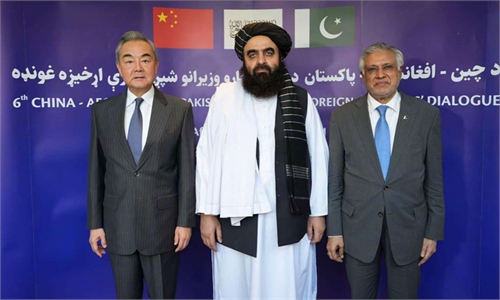
The meeting came after the sixth China-Afghanistan-Pakistan Foreign Ministers' Dialogue in Kabul, Afghanistan on Wednesday where Wang, along with Afghan Foreign Minister Amir Khan Muttaqi and Dar, attended the dialogue.
Based on the information currently released by various parties, the core agenda of the Kabul meeting remains the promotion of regional and transnational cooperation, Zhu Yongbiao, the executive director of the Research Center for the Belt and Road at Lanzhou University, told the Global Times on Thursday.
Afghanistan places great emphasis on economic development and welcomes foreign investment, particularly hoping that the CPEC can be extended into its territory. This aligns both with Afghanistan's need to strengthen its own "self-sustaining" capacity and with the interests of China and Pakistan, Zhu noted.
"Although the overall situation in Afghanistan has improved and the political environment is relatively stable, attracting foreign investment still faces many challenges. Against this backdrop, the trilateral meeting among China, Afghanistan, and Pakistan not only provides support to Afghanistan's economy but also helps stabilize Pakistan's situation and sends a positive signal for regional cooperation," he said.
RELATED ARTICLES