Why is Xizang able to create development miracle? This is a good question: Global Times editorial
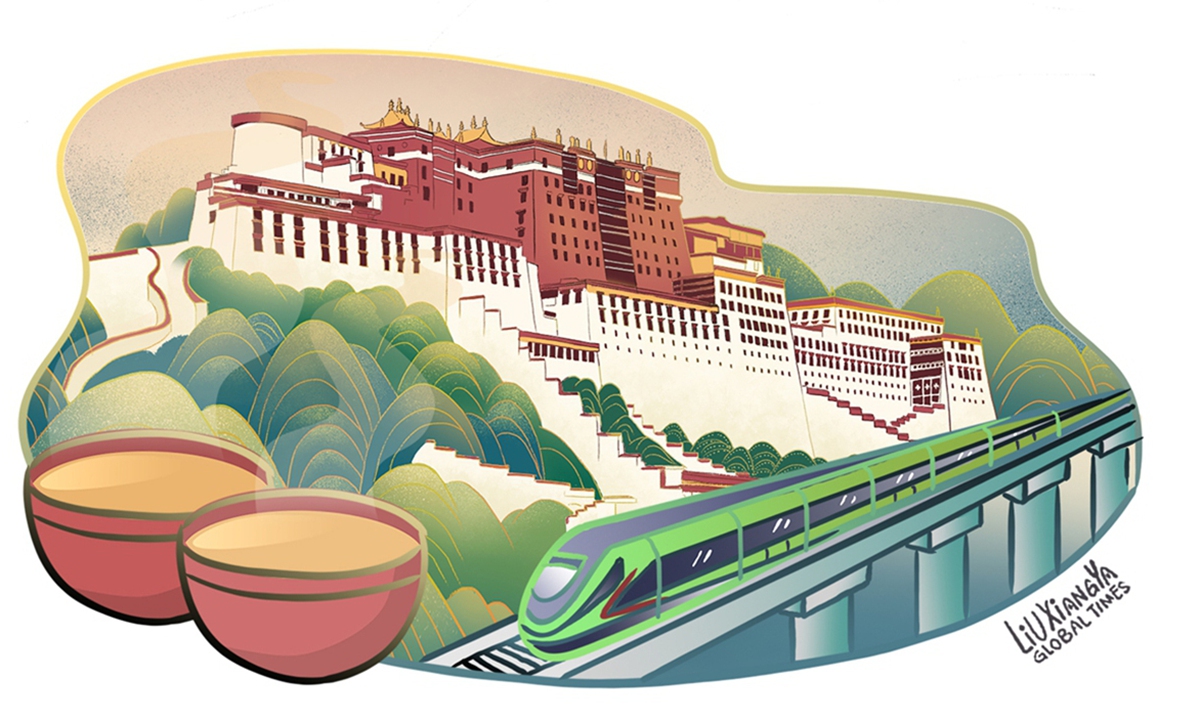
Illustration: Liu Xiangya/GT
On Thursday morning, a grand gathering marking the 60th founding anniversary of Southwest China's Xizang Autonomous Region took place at the Potala Palace square in Lhasa. Xi Jinping, general secretary of the Communist Party of China (CPC) Central Committee, Chinese president, and chairman of the Central Military Commission, led a delegation of CPC Central Committee to attend the celebration. This is the first such occurrence in the history of the Party and the country. Since the 18th CPC National Congress, Xi has attached great importance to the work in Xizang, cared deeply for people of all ethnic groups in the region, and established the Party's policies on the governance of Xizang in the new era. This has charted the course and provided fundamental guidance for Xizang's work in the new era, leading to comprehensive progress and historic achievements across all fields.
Over the past 60 years, the Xizang Autonomous Region has transformed from a once remote and impoverished land where "humans and livestock lived together and transportation was cut off," to a new frontier where tradition and modernity blend and people of all ethnic groups live in harmony. In just a few decades, Xizang has traveled a path of development that took several centuries - or even millennia - for many other human societies to complete.
Guided by the CPC's policies on the governance of Xizang in the new era, the region has entered the best period in its history in terms of development, transformation, and tangible benefits for its people. Its regional GDP has grown significantly, per capita GDP has risen markedly, infrastructure has advanced rapidly, and conditions in education and healthcare have greatly improved, bringing notable improvements to people's living standards. This is a vivid embodiment of the principle that "no border area shall be left behind in advancing Chinese modernization."
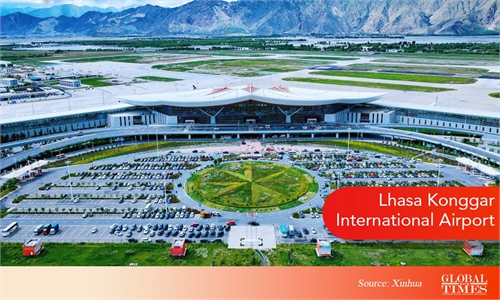
From the perspective of economic and social development, Xizang faced many "innate constraints": its high altitude, harsh natural environment and climate, underdeveloped infrastructure, and lagging basic education. Yet, through six decades of unremitting effort, the age-old challenges that had long constrained the plateau's development have been successfully overcome. Since the advent of the new era, Xizang's accelerated growth has been especially striking: It took 50 years to reach its first 100 billion yuan in regional GDP, but only six years to achieve the second 100 billion yuan, and in 2025 the region is steadily advancing toward the 300 billion yuan target. Transportation infrastructure has undergone a complete transformation: A 124,900-kilometer-meter road network now connects every township, 1,359-kilometer-meter of railways traverse the plateau, and 183 airline routes link Xizang closely with the rest of the world - altogether ending the closed and backward state of "people and livestock carrying loads on their backs."
Why has Xizang been able to create such a development miracle? This is a good question. In the new era, the Party's policies on the governance of Xizang in the new era has consistently advanced the four main tasks of "ensuring stability, facilitating development, protecting the eco-environment, and strengthening the borders," with a strong focus on forging a strong sense of community for the Chinese nation, and advancing the building of a community for the Chinese nation. These serves as the fundamental guideline for advancing work in Xizang.
In this process, the people's freedom of religious belief has been fully respected and protected, while cultural endeavors have flourished. Outstanding traditional heritages such as the Epic of King Gesar, Tibetan opera, Tibetan medicine, and Thangka have all been revitalized with new vigor and vitality. Multi-ethnic, embedded communities have become the norm, forming a harmonious grassroots fabric where people live together in mutual affection, "like tea and salt." These experiences also provide profound inspiration for other developing countries.
Xizang's path to modernization bears distinctive regional characteristics. On one hand, by developing plateau-specific industries suited to local conditions, especially characteristic farming and animal husbandry as well as clean energy, Xizang has established 47 nature reserves, covering 34.35 percent of its land area. The proportion of days with excellent air quality in Xizang exceeds 99.7 percent, and 100 percent of the water in its major rivers and lakes meets or surpasses Class III standards. It is thus among the regions with the best ecological environment in the world. On the other hand, through the effective transformation of ecological value, tangible improvements in people's livelihoods have been achieved, allowing herders and farmers to directly benefit from ecological protection. This practice of organically combining ecological conservation with income growth vividly demonstrates the scientific governance concept that "lucid waters and lush mountains are invaluable assets."
In recent years, some smears of Xizang by certain anti-China forces have been filled with "imaginative lies." In a sense, this is because the region's development achievements have surpassed their capacity for imagination. However, their "dark filter" is quickly shattering because with improved infrastructure, economic and social progress, and higher-quality tourism services, more and more foreign visitors are traveling to Xizang and falling in love with the region. Many online influencers who visited Xizang share their experiences on overseas social media platform, describing how what they saw here "defied imagination." Their posts have gained widespread likes and support.
From the peaceful liberation of Xizang to the founding of the autonomous region, from reform and opening-up to the new era, every step of Xizang's development has profoundly demonstrated the advantages of socialist system and the strong leadership of the CPC. Now, as the 14th Five-Year Plan (2021-2025) nears completion and the 15th Five-Year Plan (2026-2030) is being mapped out, people are confident that by staying committed to and fully implementing the policies on the governance of Xizang in the new era, Xizang is bound to shine even more brilliantly in the great cause of the rejuvenation of the Chinese nation.
RELATED ARTICLES