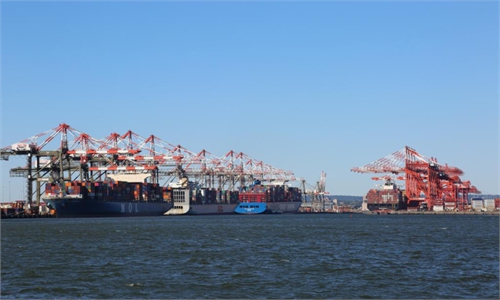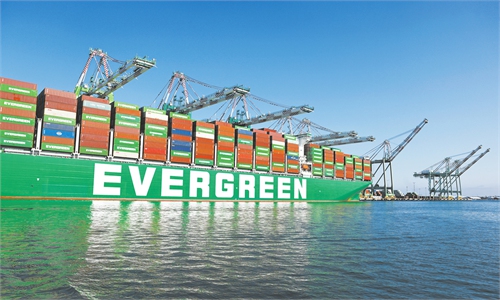
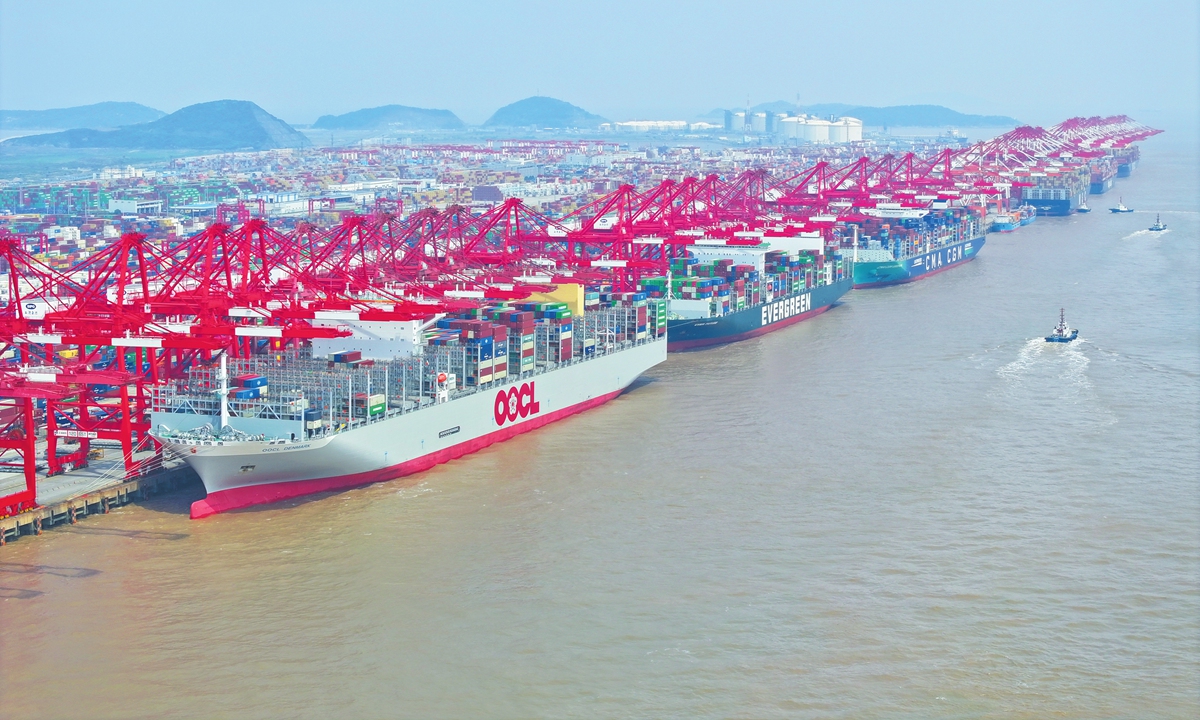
Cargo ships berth at Shanghai's Yangshan Port on May 22, 2025. Photo: VCG
China and the US have agreed to extend for another 90 days the suspension of certain reciprocal tariffs on each other's goods, after the latest round of trade talks in Stockholm, Sweden. The move by the world's two largest economies holds profound implications not only for their bilateral relationship but also for global economic stability, as the extension would avert a further escalation of the trade war and provide crucial time to build a broader consensus.
Tariffs between China and the US, particularly those set at high levels, are not only harmful to both economies but also pose broader risks to global growth, as they drive up consumer prices and dampen growth momentum. In addition, such trade barriers disrupt global supply chains—networks that cannot be reconfigured overnight.
In today's interconnected world, no single industry can or should be pursued by every country; rather, each nation ought to concentrate on areas where it holds natural advantages, based on its own resources and capabilities. This approach ultimately benefits both nations and the global economy at large.
From an economic perspective, the trade balance is a complex issue, and should not be used hastily as a pretext for punitive tariffs. Further, just as when you buy a bed from a store, it is unlikely you have something to sell to that store that they need, trade among countries is sometimes circular where country A sells to country B, which sells to country C, which sells to country A. Thus, looking at the trade balance between only country A and country B does not reveal the full picture.
While much of the trade debate has focused on goods, the trade in services—where the US runs a substantial surplus with China—should not be overlooked. According to official data from the US Department of Commerce, from 2001 to 2023, US services exports to China expanded from $5.63 billion to $46.71 billion, an 8.3-fold increase. Over the same period, the US annual services trade surplus with China expanded 11.5 times to $26.57 billion
The Trump administration sought to rebalance trade relations with China, as the US still runs a trade deficit when both goods and services are considered. However, the US has taken a rather extreme stance on what constitutes a "balanced" trade relationship and how rapidly that balance should be achieved. It is equally important that trade discussions are grounded in economic facts rather than driven by political ideology.
China has already taken substantial steps to open its markets and promote balanced trade in recent years, through a series of high-level international expos and trade facilitation initiatives, for example the China International Import Expo held each November in Shanghai.
The outlook for China-US trade talks remains uncertain, largely due to the unpredictability of the Trump administration's policy approach. This uncertainty poses a greater challenge for businesses than the tariff levels themselves, as it hampers long-term planning and has led many firms to delay investments and major decisions. Every political system has its strengths and weaknesses, but China has contributed to global stability by maintaining a quite predictable and steady policy climate, serving as a "stabilizer" for the world economy.
Meanwhile, in trade negotiations with the US, China has remained composed, resolute, and rational, avoiding any rush to strike a deal. Its calm and firm stance stems from its status as a major economic power and the US reliance on Chinese goods and markets.
I hope that step by step, closer ties between China and the US can be built on mutual benefit rather than ideological differences. Such progress would serve the interests of both nations, and the wider world. To support this, more people-to-people exchanges are essential, as direct engagement helps reduce differences and foster mutual understanding.
Many abroad remain unaware of the significant progress China has made in recent years, often continuing to view the country through a lens shaped by outdated information. Advances in intellectual property protection are such an example often overlooked. A clearer and more accurate understanding of today's China would not only contribute to more constructive trade negotiations but also enable Chinese companies to compete more effectively in global markets.
In the context of rising protectionism, it is increasingly important for nations to diversify global trade. There are unique opportunities for cooperation between China and European countries such as Norway. Taking Norway as an example, it refrained from imposing new tariffs on Chinese electric vehicles (EVs) over the past year, helping the country achieve the world's highest EV sales share at 89 percent in 2024.
Norway is a global leader in several green technologies, including green shipping, carbon capture and storage—where it built the world's first large-scale facility—and offshore wind platform development, drawing on its offshore oil expertise. China, meanwhile, is one of the world's largest shipping nations, the top producer of EVs, the leading manufacturer and user of wind energy equipment, and, like other industrialized economies, faces significant carbon emissions that could benefit from carbon capture and storage technologies.
Given these complementary strengths, there is strong potential for collaboration between Norway and China across these and other strategic green sectors.
The author is a US scholar and professor of strategy at BI Norwegian Business School. bizopinion@globaltimes.com.cn

Carl F. Fey Photo: Courtesy of Carl F. Fey
RELATED ARTICLES