Lee and Ishiba’s ‘shuttle diplomacy’: breakthrough or expediency in Japan-S.Korea ties?
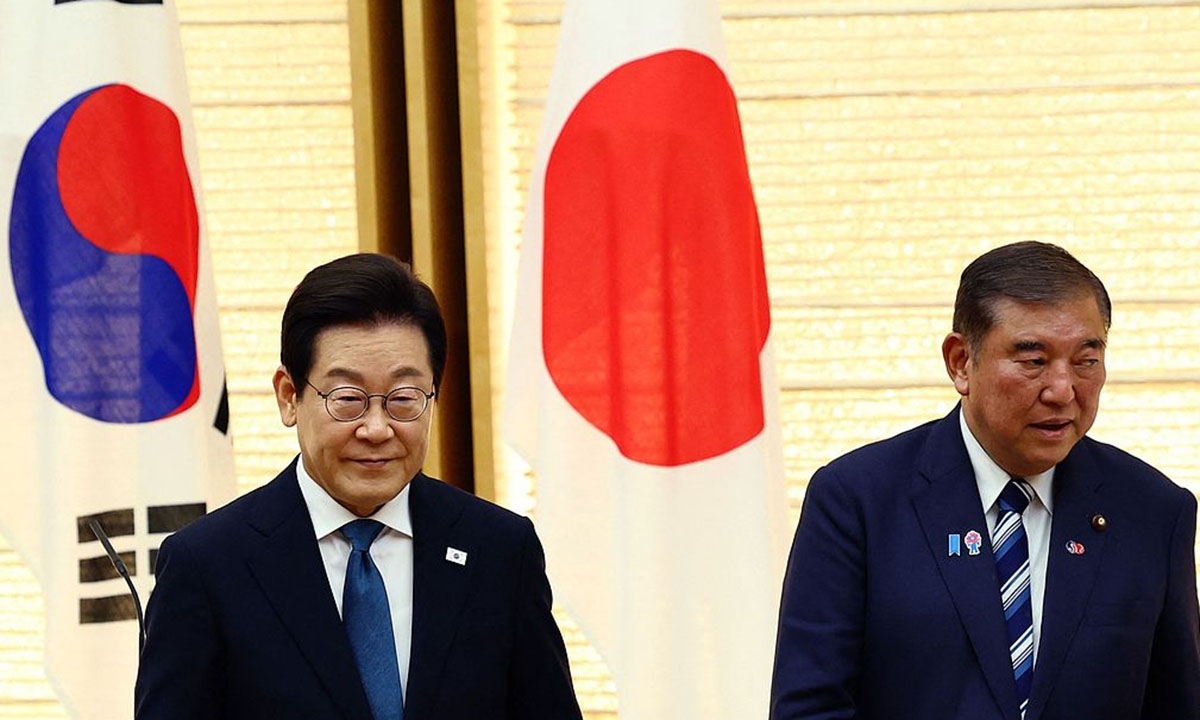
South Korean President Lee Jae-myung (left) and Japan's Prime Minister Shigeru Ishiba hold a joint press conference after their summit in Tokyo on August 23, 2025. Photo: VCG
South Korean President Lee Jae-myung was on a visit to Japan on Saturday and Sunday, the first time since taking office in June. He met with Japanese Prime Minister Shigeru Ishiba for around two hours in Tokyo on Saturday, and released a joint statement that outlined a number of areas of cooperation. Both South Korean and Japanese media noted that this marks the resumption of "shuttle diplomacy" between the two countries.
From a practical perspective, both Japan and South Korea have motivations for "shuttle diplomacy." For Japan, this motivation lies primarily in the economic and security sectors. Economically speaking, Japan's performance in recent years has been dismal, while South Korea has become a developed country with strong capabilities in advanced technologies, particularly semiconductors. Japan hopes to collaborate with South Korea in these areas to sharpen its industrial competitiveness. While in the security sector, Japan hopes to strengthen ties with South Korea and leverage it to contain North Korea. Coordination on North Korea and regional security is one of the areas of cooperation in the joint statement.
For South Korea, Lee is the first South Korean president to make Japan their first bilateral visit after assuming office. South Korea considers Japan as one of the most important neighbors, and both have high complementarity in supply chain security and high-tech industries. Cooperation in these areas can help the two neighbors navigate global uncertainties.
Lee may also seek phased resolution of historical issues that have long perplexed bilateral relations. Through this visit, Lee wants to send a signal that he wants to solve the issues through dialogue instead of divergences and therefore create necessary atmosphere for future negotiations.
Regarding regional and global cooperation, Lee and Ishiba stressed the importance of steady South Korea-Japan and South Korea-Japan-US collaboration amid a rapidly changing international environment. This shuttle diplomacy may also have certain impacts on the US alliance with its two allies, mainly in the following aspects. First, it could adversely affect regional security. For the US, improved relations between Japan and South Korea mean more favorable conditions for the "NATO-ization" of its Asia strategy.
The expansion of AUKUS, the further advancement of the Indo-Pacific Strategy and even enlargement of the Five Eyes Alliance, are all possibilities. This would plunge the already unstable Northeast Asian region into deeper conflict and mistrust. As a result, China could face an even more severe security environment.
Second, it could erect artificial barriers for the regional economy. Technological collaboration between the two countries may be leveraged by the US administration, with one possible outcome being the establishment of technological blockade within the US-led alliance against the other countries - particularly in the semiconductor industry. Needless to say, these barriers would be primarily directed against China.
However, this round of shuttle diplomacy also faces certain obstacles. The first is the burden of history. This year marks the 80th anniversary of Japan's surrender, a sensitive milestone for many Asian countries, especially those in East Asia. Given the current rise of right-wing forces in Japan, it remains highly uncertain whether Tokyo can accommodate Lee's demands. It is worth noting that the joint statement during Lee's visit avoided direct mention of sensitive issues, including historical disputes.
Another issue is industrial competition. Both Japan and South Korea are advanced industrial nations that compete in sectors including shipbuilding, automobiles and electronics.
Moreover, as medium-sized economies with relatively small domestic markets, their competition over overseas markets has grown increasingly fierce. This rivalry directly constrains the extent to which the relationship between the two countries can substantially improve.
All in all, South Korea and Japan should bear in mind that true regional stability cannot be achieved through externally imposed alliances or selectively forgetting history. Instead, it requires profound reflection on history, full respect for the interests of all parties, and genuine multilateral cooperation that transcends camp confrontation. Without these key foundations, the shuttle diplomacy may turn out to be just a practical expedient.
The author is deputy director of the Northeast Asia Research Center, Shanghai University of Political Science and Law. opinion@globaltimes.com.cn
RELATED ARTICLES