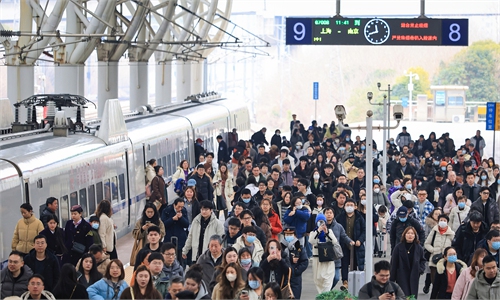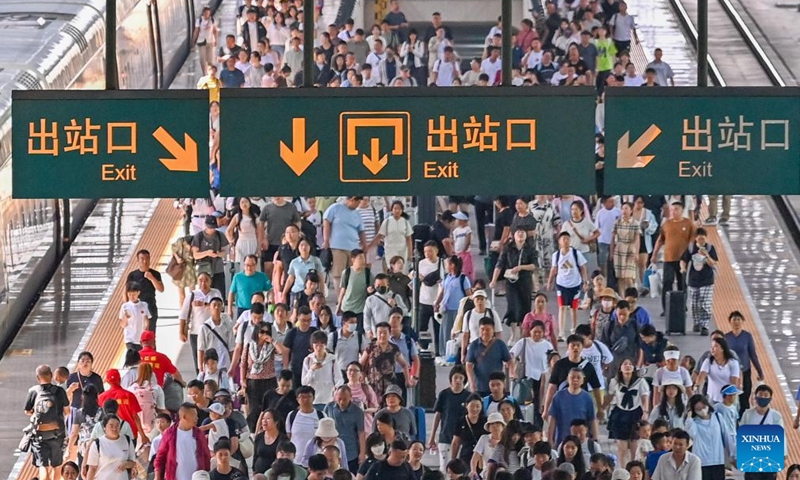
Passengers exit the Harbin Railway Station in Harbin, northeast China's Heilongjiang Province, Aug. 2, 2025. This year's summer travel rush will last for 62 days from July 1 to Aug. 31. Photo: Xinhua
From July 1 to Saturday, China's railways carried 823 million passenger trips, up 6.4 percent year-on-year, with an average of 15.23 million per day, China State Railway Group said in a statement to the Global Times on Sunday.
This marks the latest effort by China's railway authorities to ensure smooth travel during the peak summer tourism season, traditionally one of the busiest periods for domestic trips.
It is not only the railway sector that has seen record traffic; the aviation industry has also reported strong passenger flows.
Since the start of the summer travel rush (July 1-August 19), domestic airlines carried more than 99.81 million passenger trips on domestic routes, up about 3 percent year-on-year, while international routes handled more than 12.94 million inbound and outbound passenger trips, up about 10 percent from last year, according to data provided by industry information provider Umetrip to the Global Times.
Since August 1 till August 19, domestic routes alone recorded more than 39.26 million passenger trips, about 7 percent higher than in July, with August 15 setting a new daily peak for the summer, according to Umetrip.
This summer has seen a clear shift toward personalized, niche, and experience-driven travel, which have become top choices for many tourists.
Data from Meituan Travel showed that in Northwest China's Xinjiang Uygur Autonomous Region, searches for "skydiving at Sayram Lake" and "sailing at Sayram Lake" surged 600 percent, driving popularity of hotel in the area up 476 percent, according to the Xinhua News Agency. In Northwest China's Gansu Province, searches for "desert camping sites" jumped 226 percent.
These novel experiences are enriching travel options and injecting fresh momentum into the cultural and tourism market.
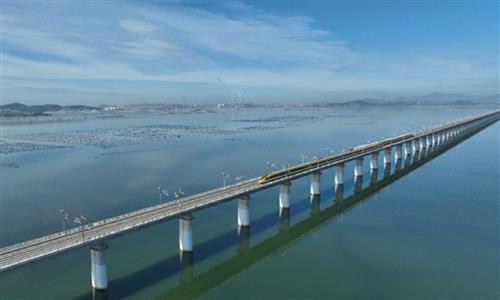
Experts said that the convenience of transportation infrastructure has provided strong support for the sector's rapid expansion.
The continuous expansion of China's railway network and the steady improvement of its transport capacity have strengthened the sector's ability to support and drive cultural and tourism development, Li Hongchang, a researcher at the Sustainable Transportation Innovation Center and professor at Beijing Jiaotong University, told the Global Times on Sunday.
China's transportation system has adopted 5G and BeiDou technologies for train operations, while a travel platform like 12306 provides real-time updates, and stations offer artificial intelligence guides and 3D navigation to enhance seamless transfers and efficient travel, Li said.
Global Times
RELATED ARTICLES