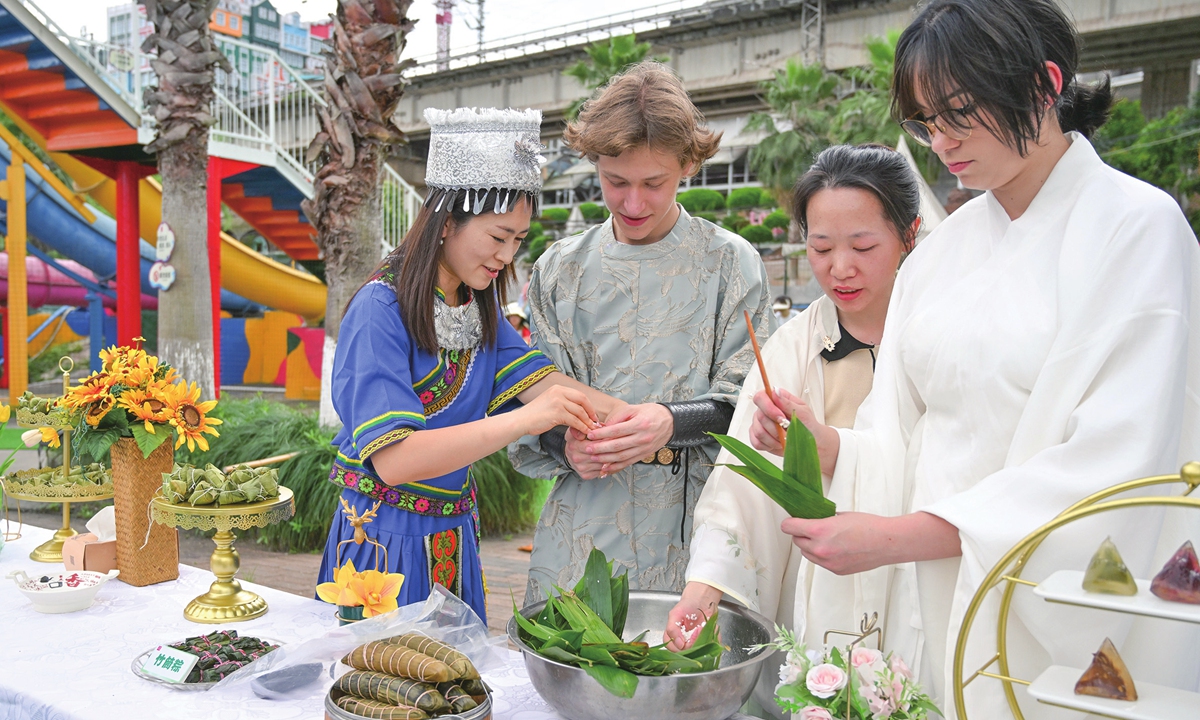
Foreign tourists experienced making zongzi, a traditional Chinese rice dumpling, in Fuling district of Chongqing Municipality on May 30, 2025. Photo: IC
Editor's Note:
Facing profound changes and pressing challenges, the international community seeks fresh wisdom and practical solutions. China, under the leadership of Chinese President Xi Jinping, plays a vital role in promoting common development, fostering dialogue among civilizations and enhancing global governance. The Global Times has launched a special series titled "Steering the New Era." Through in-depth conversations with renowned scholars and global dignitaries, the series explores China's development experiences and governance visions.
In the second installment of the series, Helga Zepp-LaRouche (Zepp-LaRouche), the founder of the Germany-based think tank Schiller Institute, shares her insights on China's role in advocating for respecting the diversity of world civilizations and strengthening international cultural and people-to-people exchanges with Global Times (GT) reporter Su Yaxuan.
GT: The Schiller Institute has long rejected the Western notion of a "clash of civilizations." You have also emphasized that the Global Civilization Initiative (GCI) represents the only viable solution to the current global strategic crisis. Do you see it as offering a new model for civilizational interaction in today's world?
Zepp-LaRouche: My institute was actually founded in 1984 on the same idea, that the world was in need of a new and just world economic order, but that this would only work if it was combined with the concept of a dialogue of all cultures, in such a way, that each nation or civilization would get to know the best cultural contributions of all other nations or civilizations. By knowing the beauty of other cultures, all prejudices and anxieties would disappear and make room for the joy of discovery and even love.
When I read about GCI, I was extremely happy. I am confident that it will contribute to eventually making war obsolete, because if you know all the best creations of the different peoples, it completely changes your outlook. By relating to the best of the other nations, you are making friends, and you discover that in all of these creations of art, there is an underlying human quality that unites us as one species.
GT: You've visited museums in China and observed how Chinese people learn and carry forward their traditional culture. However, doubts remain in some Western societies about China's independent path, especially amid growing tensions among different global civilizations. Based on China's experience, what valuable insights do you think this Chinese approach offers for easing civilizational conflicts and fostering intercultural dialogue?
Zepp-LaRouche: Recently, I visited Qufu (in Shandong Province), the birthplace of Confucius. I was overwhelmed to see with what care China is keeping the wisdom of Confucius alive with shows in the Confucian temple (Kong Miao) and the Kong family mansion (Kong Fu), a beautiful new museum where many relics are displayed and stories enacted. All the cultural goods are digitized and, in this way, made available to millions of people.
Several years ago, I participated in a conference on the "Dialogue among Asian Civilizations" in Beijing, and I was impressed to see that not only China, but all Asian cultures are emphasizing their ancient traditions, highlighting their historic contributions of 5,000 years or more. It is quite evident that the assertion and celebration of the national identity of each of their own traditions and histories is what gives Asian nations the confidence to have an optimistic outlook for the future.
I can only hope that this will serve as an inspiration to elected officials in the West to put in a similar effort to actualize the cultural treasures of our own countries, so that our young people will learn about and preserve these traditions.
GT: You have repeatedly expressed your support for China-proposed Belt and Road Initiative (BRI). In your view, how do the BRI and other Chinese initiatives reflect China's efforts and achievements in promoting cultural dialogue?
Zepp-LaRouche: I visited China for the first time in 1971. Therefore, I have firsthand experience of the unprecedented industrial miracle that the Chinese people have accomplished. In just over 40 years, China went from a very poor rural country to a powerful industrial nation.
China has lifted about 800 million of its own citizens out of poverty and is expanding this process to other countries of the Global South through the BRI. If one looks at this enormous transformation not from a geopolitical, but an objective point of view, then this represents, in all likelihood, the biggest civilizational contribution to the development of mankind in all of our shared history.
And contrary to many Western countries, China is not proselytizing its own philosophy onto other nations, but practices the principle of noninterference. This is why many Africans are now saying that China is a true friend to their countries, and even to their continent.
GT: You have previously emphasized the importance of convincing Western countries that cooperation with China serves not only their national interests but also the greater good of humanity. In light of today's global instability and the erosion of international norms, what steps do you think China and the West should take to build a new framework for peaceful coexistence and shared development?
Zepp-LaRouche: The ongoing war in Ukraine and the recent very dramatic military attacks on Iran, first by Israel and then the US, have demonstrated several things. First, the West is applying an obvious double standard when it comes to the definition of what an "unprovoked war of aggression" really is. We have entered a period of de facto lawlessness, which, given the existence of thermonuclear weapons, is a very dangerous condition.
The most important thing that China and Western countries should do is officially initiate the creation of a new global security and development architecture, which must take into account the interests of every single country on the planet. The two most important principles are, first, that for the sake of peace, one has to take into account the interest of the other, and that means all others. And second, one has to replace the policy of revenge with a policy of love.
China's three global initiatives absolutely correspond to that approach, and especially the GCI; opening a true dialogue of civilizations can awaken the minds and hearts of people to arrive at a new epoch in the history of mankind, where we become truly human.
RELATED ARTICLES