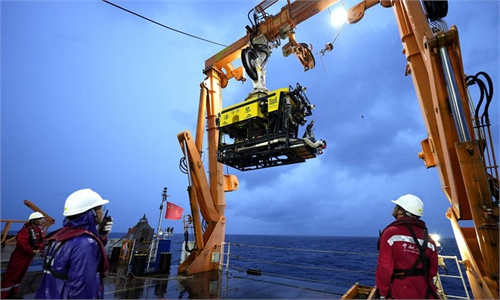
The monitoring and data center of the facility Photo: Website of the Tongji University
China has achieved significant breakthroughs in deep-sea technology, with the Mengxiang drilling vessel has been commissioned, the Fendouzhe manned submersible is operational, and the seabed scientific observation network is soon to be connected, according to Jian Zhimin, an academician of the Chinese Academy of Sciences and dean of the School of Ocean and Earth Science at Tongji University.
Jian made the remarks during the 229th session of Shanghai Popular Science Forum and the 106th session of academician and expert forum, jointly organized by the Shanghai Science and Technology Museum, the Shanghai Science Education Development Foundation and the Shanghai Consulting and Academic Center for Acadenucian of Chinese Academy of Engineering on Sunday at the lecture hall of the Shanghai Natural History Museum, China Science Daily reported on Monday.
In a science report titled "mysteries of the deep blue: exploring the technological frontiers of the ocean's deepest depths," Jian introduced the significant value of deep-sea research and the cutting-edge progress of China's deep-sea science and technology.
Jian stated that the deep sea is a critical regulator of Earth's climate change, maintaining the global water cycle and thermal balance. It serves as a natural channel connecting the Earth's deep interior to its surface, harboring valuable resources such as petroleum and metal minerals.
Jian also emphasized that exploring the deep sea requires overcoming extreme environmental challenges, which relies on cutting-edge technological equipment. Among these, three high-tech methods - deep drilling, deep submergence, and deep-sea networks - are particularly prominent and have become crucial areas of international maritime competition.
During his sharing, Jian mentioned that the seabed scientific observation network is soon to be connected.
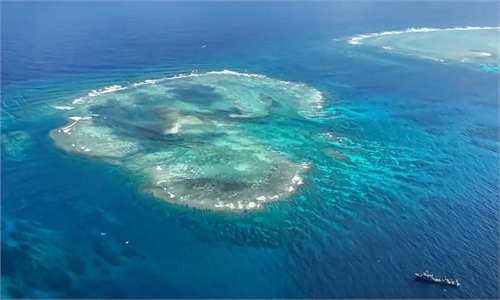
The Global Times learnt from the School of Ocean and Earth Science at Tongji University that the construction goal of the national seabed scientific observation network is to establish a seabed scientific observation network based on electro-optical composite cables in key sea areas of the East China Sea and South China Sea.
This will achieve comprehensive, integrated, real-time and high-resolution three-dimensional observation of typical marginal sea areas from the seabed to the sea surface. A monitoring and data center will be built in Lingang, Shanghai, to monitor, store and manage data for the entire seabed scientific observation system, according to the school.
Upon completion, the national seabed scientific observation network will become a world-class seabed observation and research facility with internationally advanced comprehensive indicators. It will establish a major open and shared scientific platform for marine scientific research in China and serve various comprehensive needs such as marine resource development and marine disaster prediction, the school introduced.
The national major scientific and technological infrastructure project of the National Seabed Scientific Observation Network Monitoring and Data facility was officially approved in March 2017 by the National Development and Reform Commission, per the School of Ocean and Earth Science at Tongji University.
Global Times
RELATED ARTICLES