Brazil’s reindustrialization shows China’s openness empowers Global South’s green growth
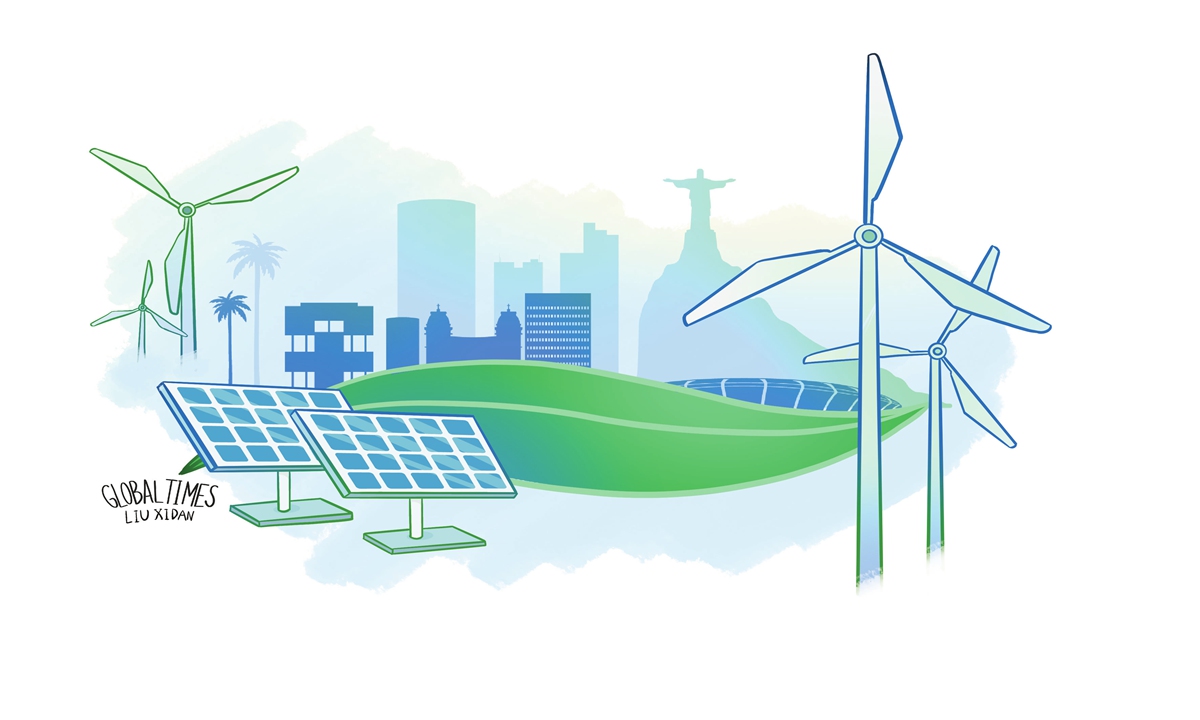
Illustration: Liu Xidan/GT
The Financial Times published a column on Monday headlined "Can China's clean energy push help Brazil reindustrialize?" The article noted that from electric vehicles (EVs) to wind turbines, Chinese clean energy enterprises' investment is powering a wave of green manufacturing in Brazil.As Brazil advances reindustrialization to secure jobs and expand its clean energy exports amid the global energy transition, rising Chinese investment in clean energy industries is providing vital capital and expertise that underpin sustainable growth. This complementary partnership highlights a successful model of cooperation between China and the wider Global South.
Citing local projects ranging from those by Chinese carmaker Great Wall Motors and the world's largest producer of EVs, BYD, to Chinese wind turbine producer Goldwind and the world's largest utility company, China's State Grid, the column pointed out the significant trend and progress of expanding cooperation between China and Brazil in the clean energy sector.
While some multinationals from Western countries are scaling back from the Brazilian market, Chinese enterprises' clean energy investments are helping the South American country to boost local production and ensure employment.
According to data from the China Council for the Promotion of International Trade, on May 12 at the China-Brazil Business Seminar in Beijing alone, the two sides announced that several Chinese companies would invest more than 27 billion reais ($4.98 billion) in Brazil across multiple sectors. Among them, Great Wall plans to invest 6 billion reais to expand its local factory, with plans to export vehicles to South America and Mexico.
Speaking at the opening ceremony for a Great Wall factory in the state of Sao Paulo on August 15, Brazilian President Luiz Inácio Lula da Silva said that in the past, automakers such as Ford and Mercedes decided to scale back their operations in Brazil, but he celebrated the arrival of other companies, like Great Wall, Reuters reported.
Great Wall's Brazilian arm has the capacity to produce 50,000 vehicles per year and is expected to generate more than 2,000 jobs when it begins exporting vehicles to Latin America, the report said.
Industrialization is a key issue in the economic development of many countries today, and Brazil's reindustrialization is one example of this green development, showing how Chinese technology transforms sunlight and wind into industrial competitiveness. Beyond Brazil, China's clean energy investments are playing a major role in fueling reindustrialization and economic growth in other countries, particularly across Africa and Latin America.
China has implemented hundreds of projects in the field of clean energy in Africa. The installed capacity of photovoltaic power plants jointly built by China and Africa exceeds 1.5 gigawatts, and 30 clean energy projects will be launched in Africa, Chinese Foreign Ministry spokesperson Guo Jiakun noted in January.
In countries such as South Africa, Kenya and Zambia, Chinese companies have participated in multiple clean energy projects, promoting the development of local manufacturing and creating numerous jobs.
For instance, the Kafue Gorge Lower Hydropower Station in Zambia, which began operation in 2023, provided a total of 15,000 local jobs and trained local talent during the construction, according to the Xinhua News Agency.
These cases show that China's clean energy investments not only address energy shortages, but also serve as a "green engine" for the reindustrialization of African and South American countries through technology transfer, localized manufacturing, and industrial chain building.
China's open attitude toward clean energy contributes significantly to driving the global green economic transition. The world is undergoing a shift from traditional energy to clean energy, and an open market environment can help unlock the potential of this transition while promoting industrial development.
The growing involvement of Chinese clean energy enterprises in emerging markets underscores the strategic importance of international collaboration in the global energy transition. As more countries embrace clean energy solutions, open and cooperative approaches like China's offer a blueprint for aligning environmental objectives with economic development, demonstrating that green transition and industrial revitalization can advance hand in hand.
The author is a reporter with the Global Times. bizopinion@globaltimes.com.cn
RELATED ARTICLES