Shaoxing’s Lu Xun Memorial defends mural of famed writer with cigarette amid controversy
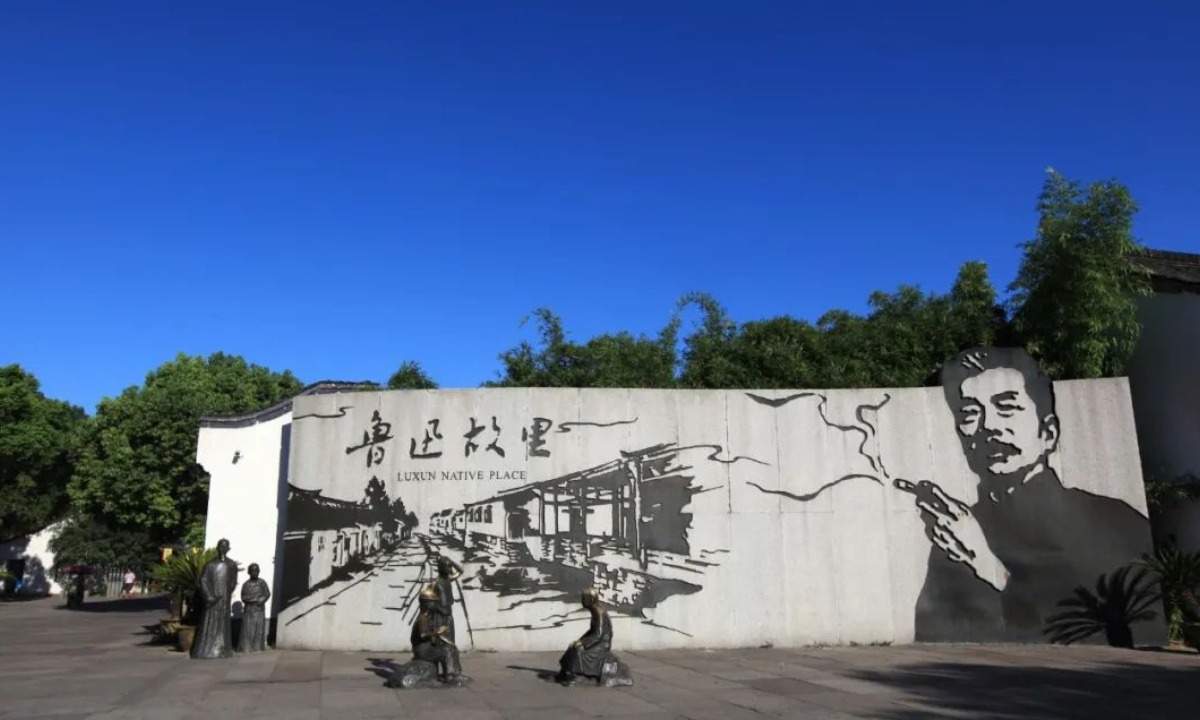
The mural on a scenic wall at the entrance of Lu Xun’s former residence Photo: Courtesy of the Lu Xun Memorial Hall
The Lu Xun Memorial Hall in Shaoxing, East China’s Zhejiang Province, responded Monday evening to debate over a mural showing the famed writer with a cigarette, stressing that the site has always adhered to the principles of “respecting Lu Xun, respecting history, and respecting art,” according to a statement released on its official WeChat account.
The remarks followed a visitor’s complaint that the mural, located on a scenic wall at the entrance of Lu Xun’s former residence, could mislead young people by presenting smoking as acceptable behavior. The mural, long regarded as a “check-in spot” for tourists, briefly trended on Weibo and sparked widespread discussion.
While some voiced concern, many citizens reportedly contacted the memorial and local cultural authorities to urge the site to preserve the mural, arguing that the image reflects historical reality and should not be changed over objections from some individuals.
A staff member from the Shaoxing Municipal Administration of Culture and Tourism confirmed on Monday that numerous calls had been received. “Everyone emphasized that this is part of history and a cultural landmark of Lu Xun’s hometown. They said we cannot make blind decisions based on a single complaint,” the official said, adding that no decision has yet been made on whether to alter the mural.
The memorial’s statement noted that the wall was designed in a woodcut style, echoing Lu Xun’s role as a pioneer of modern Chinese woodcut art. Since its completion in 2003, it has become an integral part of the cultural site and a popular destination for visitors worldwide.
The mural was erected as part of a cultural preservation project launched in 2002 and completed in 2003, which integrated Lu Xun’s ancestral home, childhood residence and garden, the memorial hall, and a cultural park into one unified heritage site. The scenic wall serves as the landmark entrance to the complex.
The debate also drew attention of the Lu Xun research society from Zhejiang Province. In a statement carried by local media, the group opposed what it called opportunistic attempts to exploit the “Lu Xun smoking” image for online hype.
Zhuo Guangping, secretary-general of the research society, said on Monday that Lu Xun’s image should be understood in full. “Lu Xun had a stern, combative side, but he also had the habits of an ordinary person. He liked smoking and often fell into deep thought—that was part of his real life. We should not simplify or fragment his image,” Zhuo told Beijing News.
He further argued that smoking, often linked with contemplation, can be seen as a reflection of Lu Xun’s intellectual depth. “We should focus more on his profound ideas rather than fixating on a single moment of daily life,” he added.
Zhuo stressed that the mural carries lasting historical and cultural value. “As an artistic work that has stood for decades, it is a symbolic scene in Lu Xun’s hometown and a collective memory for generations of visitors. To remove it over a single disputed gesture would be a disservice to both history and art. I believe most people would not support that,” he said.
Global Times
RELATED ARTICLES