Tourists looking to discover the history of the Silk Road should visit Xinjiang: British travel agency head
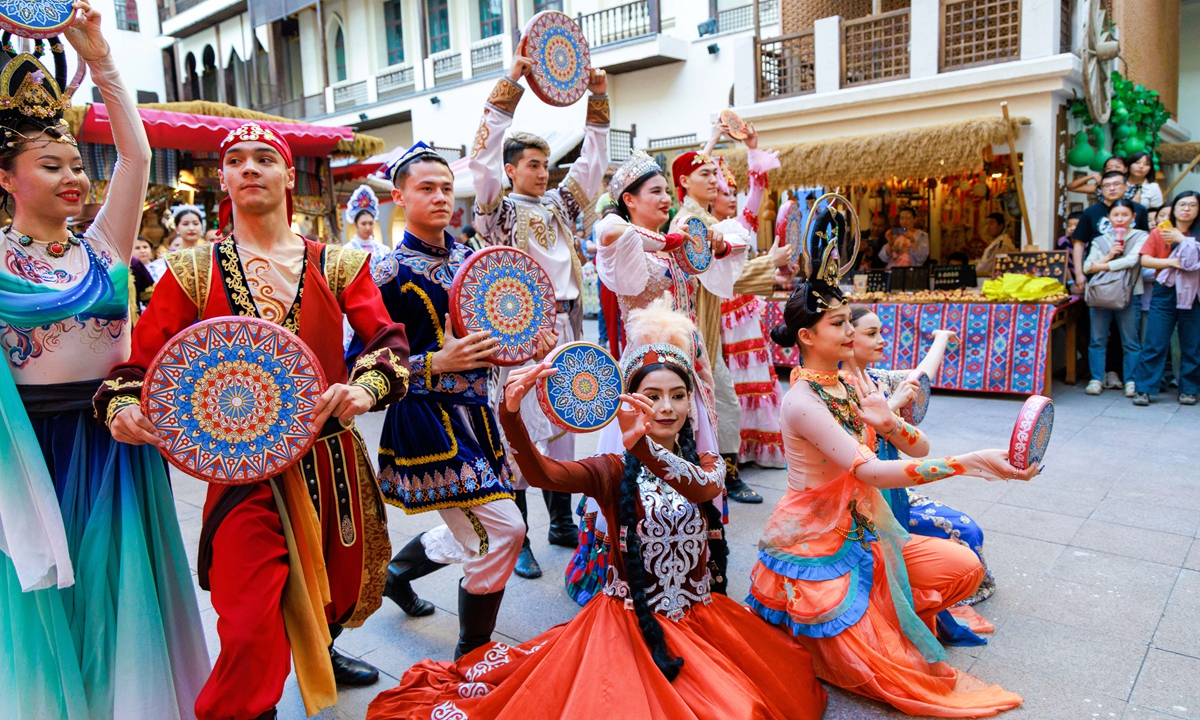
Xinjiang International Grand Bazaar in Urumqi. Photos: VCG
Editor's Note:
Despite some Western political forces continuing to run smear campaigns against Northwest China's Xinjiang Uygur Autonomous Region, they won't deter the people in the region from embracing peace and prosperity, nor will they halt Xinjiang's steady development. Seeing is believing, and facts and truth will eventually debunk all lies.
In the "Xinjiang Upclose" series, the Global Times will publish conversations with and articles from scholars and observers from around the world who have visited Xinjiang, sharing their firsthand experience of traveling to Xinjiang and observing the daily lives of its people. Through their insights and experience, we aim to present an authentic perspective on Xinjiang.
In the eighth installment of the series, Global Times (GT) reporter Wang Wenwen interviewed John Coles (Coles), managing director of a London-based travel agency, about his impressions of Xinjiang and the region's tourism potential, especially for Western visitors.
GT: You once mentioned that before arriving in Xinjiang, you were influenced by Western media reports and had doubts about what you would find in Xinjiang. However, seeing Xinjiang in person provided a fresh perspective. How did the whole trip reshape your understanding of Xinjiang?
Coles: Xinjiang is a huge region with dramatic and diverse scenery. There are high snow-capped mountains and vast baking hot deserts. It was thrilling to travel across such landscapes. The most spectacular journey was from Kashi (or Kashgar as Westerners have known it) along the Karakoram Highway, passing wide river valleys, beautiful lakes, strange rock formations and steep mountain passes. This ancient route over the mountains to South Asia and Arabia was part of the famous Silk Road. Today, security concerns prevent tourists from crossing into Pakistan, so we traveled as far as Tashkurgan, close to the border, where we stayed overnight in a comfortable modern hotel, and the next day we returned along the highway to Kashi.
In the West, we read news reports on Xinjiang, which focus on the "persecution" of the Uygur ethnic people. So, I was keen to visit the large cities of Kashi and Urumqi (the regional capital) and see the local communities. I liked to get away from the busy tourist areas. I was happy to be able to wander freely through Uygur neighbourhoods, seeing people go about their daily lives, working in offices and stores, shopping in the street markets. One of the benefits of travel is being able to see things with our own eyes, which gives a better understanding of the world.
Another memorable moment occurred when we stopped for refreshments at a motorway service station. At the back of the parking area were four huge lorries carrying enormous turbine blades. I learned that these were to be erected in a wind farm in the dry valley between Urumqi and Turpan, a city known as the land of fire in Xinjiang. There are presently 2,000 wind turbines in that wind farm and a further 2,000 under construction, which demonstrates China's commitment to "green" energy.
GT: Is Xinjiang still a mysterious place for European travelers? What advice would you give to those travelers interested in visiting the region?
Coles: Xinjiang is not as well known to Europeans, and to be honest, most would not be able to locate it on a map. Xinjiang certainly has the landscapes and cultural attractions that appeal to tourists looking to discover the history of the Silk Road. It would be difficult to combine Xinjiang with Uzbekistan, as there is no land border, so I would recommend making Xi'an (in Northwest China's Shaanxi Province) the gateway to Xinjiang because the city is famous throughout the world for its Terracotta Army. The former imperial city of Xi'an was the Eastern terminus of the Silk Road, so it's an attractive way to promote a tour from Xi'an into Xinjiang as the "Eastern Silk Road."
GT: What cultural elements in Xinjiang would European travelers find most intriguing?
Coles: I was most surprised and delighted to see the ancient historical sights which date back hundreds, sometimes thousands, of years and are linked to the history of the Silk Road.
The ruins of the city of Jiaohe near Turpan are an intriguing sight. The city was built more than 2,200 years ago on a terrace within a dry harsh desert. I was amazed to learn that it was dug into the ground, so the roads, homes, palaces and temples were constructed from top to bottom. Jiaohe was abandoned centuries ago, but it is now considered one of the largest and best-preserved earthen structures in the world.
Another fascinating sight near Turpan is the Bezeklik Thousand Buddha Caves, a former Buddhist monastery built high on the cliff beside a spectacular river valley below the Flaming Mountains. The site was built from the 5th to the 14th century. Today, tourists can visit some of the caves cut into the rock. These are typically rectangular rooms with arched ceilings, elaborately decorated with images of the Buddha.
China is developing at a remarkable pace, and I was astonished to learn how Xinjiang has changed during the past two decades. There is always a challenge to preserve traditions and conserve historic buildings. The glass skyscrapers of Urumqi are undoubtedly impressive, but such buildings are familiar throughout China and the developed world. Western tourists making the long journey to Xinjiang are looking for authenticity and genuine cultural experiences.
GT: You mentioned several times the ancient Silk Road. You once said that "the Silk Road carried not only goods but also ideas." Can you elaborate on this?
Coles: The Silk Road was not actually a single road, but a network of routes through Central Asia which connected Europe, the Arab world and South Asia with China. These ancient trade routes were used from the 2nd century BC until the mid-15th century AD, at which point sea routes became more prominent.
Traders would not make the entire journey along the Silk Road, as there were trading posts along the way where goods were bought and sold. At a time when communication was largely by word of mouth, traders meeting at these places would share news and stories with each other, so the Silk Road became a conduit facilitating a flow of information.
A famous example is the Venetian merchant and explorer Marco Polo, who Europeans often associate with the Silk Road. Polo spent around 25 years traveling in Asia during the 13th century. When he returned to Italy, he wrote a book, The Travels of Marco Polo, which gave Europeans an insight into the exotic places and people that he encountered in Asia.
GT: If you design a route themed around "the Silk Road spirit," which attractions would you recommend tourists visit and what local activities could they experience?
Coles: British tour operator Wendy Wu Tours offer a wide range of tours throughout China, including an excellent tour entitled Silk Road Explorer. This 27-day tour commences in Xi'an and travels overland to Kashi, via Lanzhou (in Northwest China's Gansu Province) and Turpan. The final rail trip is to Turpan, followed by a fascinating four-day road trip along the Silk Road to Kashi, in time for the bustling Sunday Bazaar. The tour concludes with a flight to Urumqi and two nights in the city. Sadly, the tour does not include the journey I took along the Karakoram Highway, presumably because they did not wish to add another two days to an already lengthy tour.
RELATED ARTICLES