Intl seminar held in Xinjiang to discuss countering terrorism and strengthening joint efforts
Foreign experts engage with local residents, witness regional development
By in Urumqi Published: Aug 26, 2025 10:54 PM

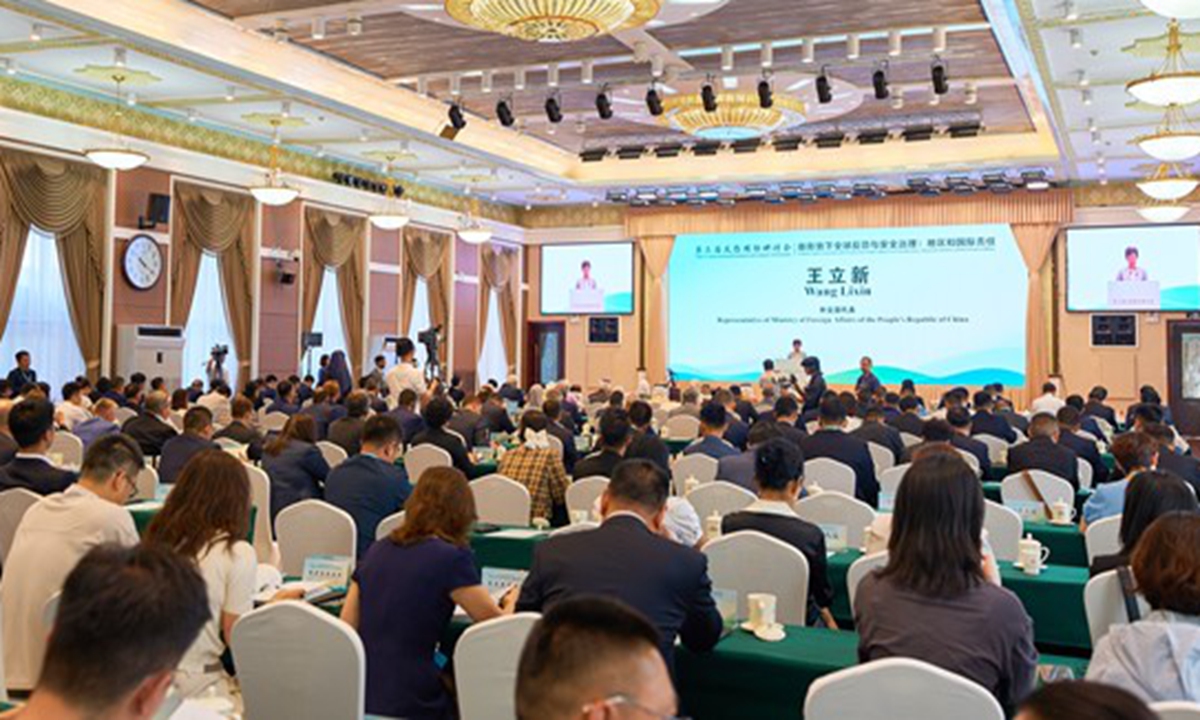
An international seminar on counterterrorism held in Urumqi, Northwest China's Xinjiang Uygur Autonomous Region, on August 26, 2025. Photo: Fu Haichao
An international seminar on counterterrorism was held in Urumqi, Northwest China's Xinjiang Uygur Autonomous Region, on Tuesday, with officials and scholars from more than 20 countries — including the United Arab Emirates (UAE), Egypt, Russia and the African Union— gathering to discuss the importance of countering terrorism and extremism, as well as strengthening joint efforts.
The third seminar, titled "Global Counterterrorism and Security Governance under New Circumstances: Regional and International Responsibilities," was co-hosted by the Foreign Affairs Office of the People's Government of Xinjiang Uygur Autonomous Region, the China Institute of International Studies and the World Muslim Communities Council.
During the opening ceremony, Xu Guixiang, Secretary of the Leading Party Members Group of the Xinjiang Foreign Affairs Office, said the seminar is both timely and important. He noted that Xinjiang is China's frontline in the fight against terrorism and a vital shield for regional security, making it particularly significant to host the event there.
In the past, Xinjiang was deeply affected by the "three forces" of terrorism, separatism and extremism. Frequent violent and terrorist incidents brought great suffering to people of all ethnic groups and severely impacted the region's economic development and social stability, said Xu.
In the face of these threats, Xinjiang took decisive measures to carry out counterterrorism and deradicalization efforts in accordance with the law, achieving remarkable results and valuable experience. It is hoped that this seminar will further build consensus, enhance capabilities and deepen cooperation in counterterrorism, thereby contributing more effectively to safeguarding world peace and stability, said Xu.
Ali Rashid Al Nuaimi, Chairman of the World Muslim Communities Council, said that globally, the security landscape is changing rapidly, and joint, concerted efforts are needed to respond to terrorism. One concerning trend is the politicization of terrorist organizations, with some countries using them as instruments to pursue selfish interests.
The terrorism in China's Xinjiang region also poses a threat beyond China. Groups such as the "East Turkistan Islamic Movement" share the same extremist ideology as ISIS and other terrorist organizations, using ideology as a tool to advance political agendas, said Al Nuaimi.
He called on the world to work together to combat and eliminate terrorism. Many countries are already adopting preventive and preemptive measures. In China's case, the government has introduced effective policies to address the root causes of extremism, including promoting education.
Both the central government and regional Xinjiang government have taken active measures, incorporating religious and ethnic diversity into their policies, and achieved significant results that deserve recognition, said Al Nuaimi.
"I believe this seminar is highly significant as global counterterrorism enters a new turning point, shaped by developments in Syria. These changes pose serious challenges to China, especially the Xinjiang region," said Li Wei, the Executive Director of the Center for Counter-Terrorism Studies in China Institutes of Contemporary International Relations.
This seminar helps build international consensus, showcase China's achievements and efforts in counterterrorism, and discusses how the world can respond to the threat of terrorism, Li told the Global Times on Tuesday.
Zhang Jiadong, director of the Center for South Asian Studies at Fudan University, who also attended the Tuesday seminar, told the Global Times that holding an international forum in the Xinjiang region, a place once deeply affected by terrorism, carries significance beyond simply showcasing our achievements.
It demonstrates how a region once troubled by violence has been transformed into one of peace and development, where people can live and work in security. This in itself is a remarkable accomplishment," said Zhang, adding that, more importantly, foreign officials and scholars had direct engagement with local residents, and seeing their development and harmonious lives was more convincing than words.
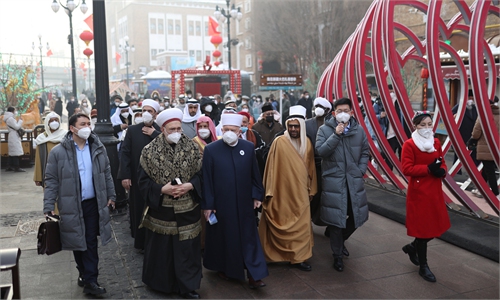
Before the seminar on Tuesday, many foreign scholars also visited the Xinjiang International Grand Bazaar, residential communities, mosques and the Xinjiang Islamic Institute.
"The most important part of this seminar is the chance to exchange experiences —learning from China's approach and reflecting on what is happening in our own country," Rogotnev Ilya Yuryevich, Director of the North-South Center for Strategic Communications at Perm National Research University in Russia, told the Global Times.
"Yesterday, we visited an exhibition devoted to counterterrorism efforts in Xinjiang. I found it very impressive because it shows both the tragic history of this region and its role as a multicultural hub of dialogue among different peoples, ethnic groups and religions. I believe such exhibitions should also be held in other countries," Yuryevich said.
He added that visiting Xinjiang and taking part in a counterterrorism seminar was very meaningful. "We see much of the Western media as biased or fake news. What I saw in Xinjiang is a multicultural, peaceful, modern city. China has clearly developed this region, and now I see Xinjiang as a truly modern and successful place."
After visiting the Xinjiang Islamic Institute, Fadel Kaseb, a Jordanian senior researcher and analyst at the Arab Institute for Security Studies, told the Global Times he was impressed by what he saw in the classrooms, the library and the student accommodations.
He said that people in the region have freedom of religion, which counters the negative narratives they often hear in the media, he noted.
"What we have seen today is truly impressive. It is good for the young generation to be able to study and grow. I believe this is part of the Chinese government's efforts to present a genuine image of Xinjiang to the rest of the world," the expert said.
RELATED ARTICLES