CCCEU comments on security concerns, supplier choices of Chinese products in German wind turbine market
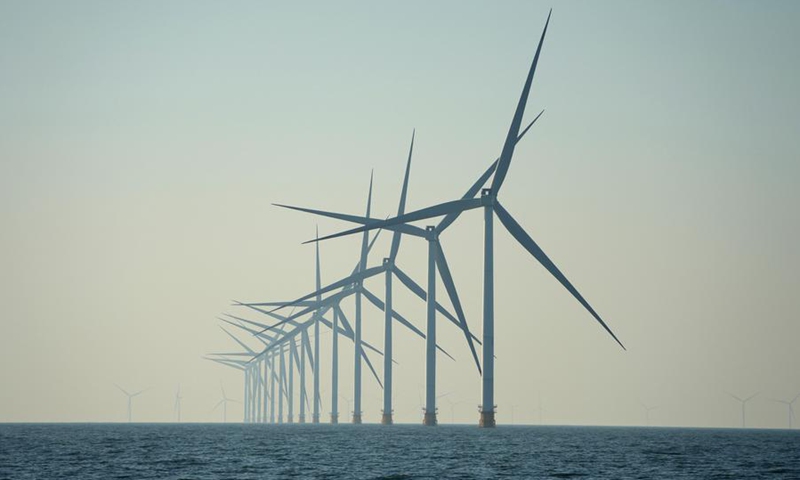
Offshore wind turbines are pictured in the waters of Laizhou City, East China's Shandong Province, on January 7, 2025. Photo: Xinhua
In response to media inquiries concerning security issues and supplier selection of Chinese products in the German wind energy market, the China Chamber of Commerce to the EU (CCCEU) said that "we note with disappointment the recurring attempts to portray Chinese clean tech companies as a 'security risk' with no factual evidence."
Chinese wind turbine manufacturers are globally recognized not only for their advanced technology and high quality, but most importantly, for their proven track record of reliably delivering complex projects, the CCCEU said in a statement seen on its official WeChat account, after receiving media inquiries on Wednesday.
Chinese wind turbines operating in Europe fully comply with EU's regulations on cybersecurity, grid connectivity, and critical infrastructure. Once deployed, these turbines, operating within European networks, will be managed by local operators and will be subject to oversight by competent authorities, said CCCEU, responding to a media question claiming that security experts in Germany have been warning for months against the use of Chinese wind turbine systems off the German coast.
The CCCEU said that framing clean energy cooperation as a matter of "national security" risks undermining Europe's climate ambitions and contradicts the principles of fair competition and a rules-based global trading system.
CCCEU also responded to a question regarding media reports saying that a private company in Germany opted for a European supplier, Siemens Energy, instead of a Chinese company.
On Monday, Reuters reported that a German company may scrap a deal with a Chinese firm to supply turbines for one of its North Sea offshore wind farms, citing operational reasons, although it added improved security was "a positive side effect".
China's Ming Yang Smart Energy was due to provide turbines for the 300-megawatt Waterkant wind farm under a deal announced in 2024, but Hamburg-based asset manager Luxcara said it had instead reserved capacity for 19 Siemens Gamesa turbines, a subsidiary of Germany's Siemens Energy, according to the Reuters report.
"We have been following this development closely. We are concerned that such supplier choices reflect a troubling trend in which politicization and unfounded suspicion are increasingly shaping business decisions in Europe. To this end, the decision indeed presents a serious and concerning challenge for Chinese peers. When procurement decisions are driven more by geopolitical narratives than by commercial logic, fair competition is inevitably compromised," CCCEU noted.
Chinese clean tech companies remain committed partners in Europe, invest locally, create green jobs and deliver projects, contributing to affordable energy and the green transition. Excluding them on the basis of origin rather than merit not only reduces efficiency and consumer choice, but also undermines Europe's stated objectives of openness and sustainability, CCCEU said.
"We urge European stakeholders to ensure that market rules, allowing free commercial choices while remain the guiding principle in public tenders and private procurement. Chinese companies remain confident in their ability to deliver innovation and value, and expect a genuinely level playing field in Europe," CCCEU stated.
Global Times
RELATED ARTICLES