Germany’s reported ‘de-risking’ plan for Chinese wind power components to create new risks for its supply chain: expert
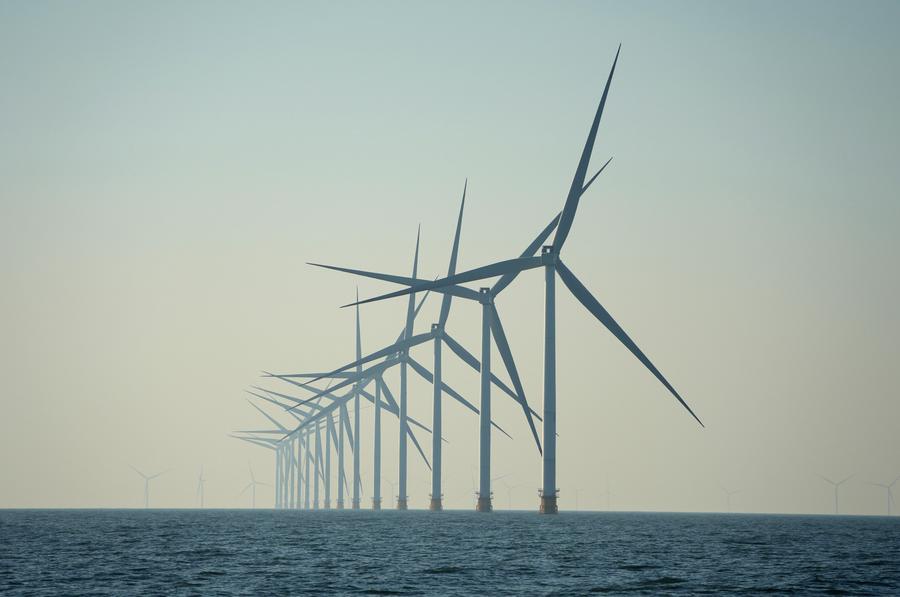
Offshore wind turbines are pictured in the waters of Laizhou City, east China's Shandong Province, Jan. 7, 2025. (Photo: Xinhua)
Germany's economy ministry published plans on Tuesday local time to diversify the sourcing of crucial components used mainly in offshore wind turbines by 2035 to reduce dependency on China, Reuters reported. Chinese experts said that China's exports of relevant components follow legal procedures, and arbitrarily cutting Chinese supplies would raise costs and create new risks for Germany's supply chain.
The move is part of the German government's broader "de-risking" strategy. Wind generation plants, especially out at sea, need powerful permanent magnets containing rare earths to optimise output and reduce maintenance, but their scarcity creates supply risks, the ministry said, according to Reuters.
"Germany's approach is unreasonable," Zhang Jian, a vice president of the China Institutes of Contemporary International Relations, told the Global Times on Wednesday. "China has consistently advocated openness and cooperation. Its exports to Germany and Europe are the natural result of global industrial specialization," he said.
China provided 90 percent of permanent magnets, not just for wind but also electric cars, machine building and military industries, the German ministry said, according to Reuters.
"China and Germany share a solid foundation for manufacturing cooperation," Zhou Mi, a senior research fellow at the Chinese Academy of International Trade and Economic Cooperation, told the Global Times. "Both are manufacturing powerhouses with long-standing industrial ties. Germany has also been proactive in advancing the green transition, which aligns well with China's strengths in new-energy technologies."
Zhou said that continued cooperation between China and Germany in areas such as magnets and special components servers the mutual interests of the two countries. "Forcibly removing Chinese inputs from German supply chains defies economic logic. Such 'de-risking' will ultimately hurt Germany's own economy," Zhang said. "Artificially trying to replace China in key sectors will increase costs, disrupt production, and undermine Germany's competitiveness over time."
Global Times
RELATED ARTICLES