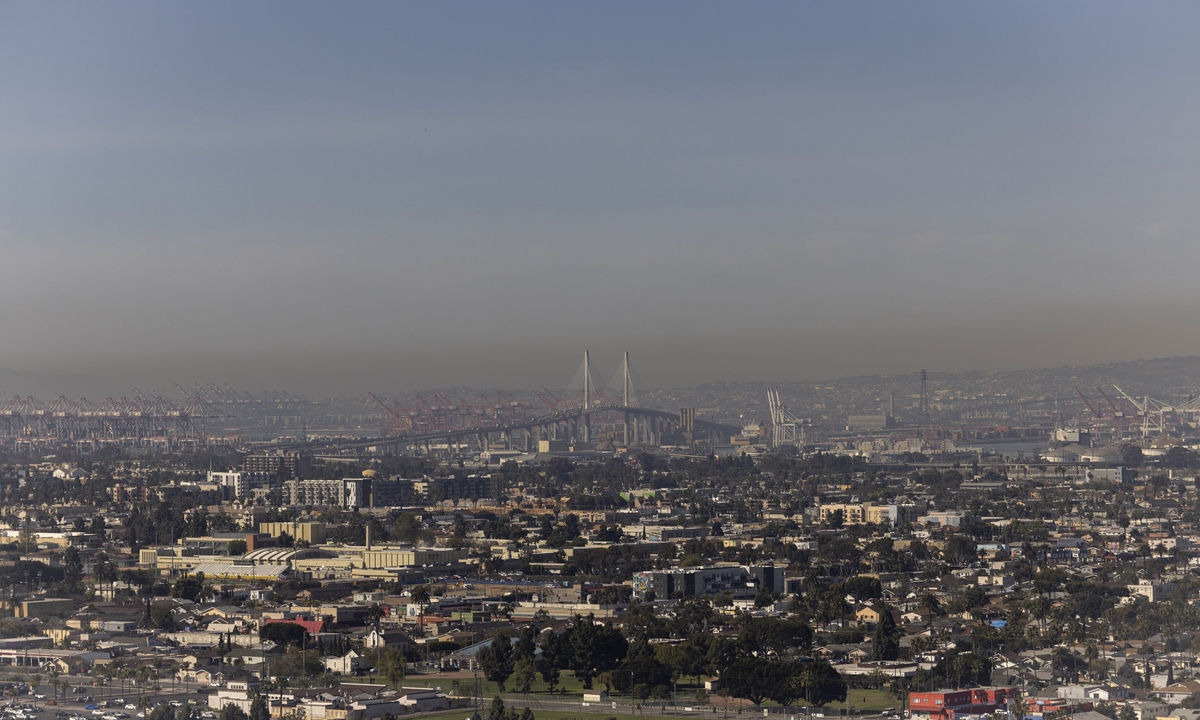
Smog lingers over the city overlooking the Ports of Long Beach and Los Angeles as seen from Signal Hill in California, US, on March 10, 2025. Photo: VCG
Editor's Note:
The US government has carried out yet another action that hinders the global fight against climate change. Recently, the US Environmental Protection Agency announced a proposal to undo the 2009 Endangerment Finding, which allows the agency to limit planet-heating pollution from cars and other industrial sources. Hours later, the US Department of Energy published a 150-page report titled "A Critical Review of the Impacts of Greenhouse Gas Emissions on the US Climate" to defend the proposal, claiming scientific concern about the climate crisis is overblown. These moves have galvanized scientists in the US climate community into action, saying the report misrepresents decades of climate science and will jeopardize efforts to fight climate change. In her I-Talk show, Global Times (GT) reporter Wang Wenyen talked to Michael Gerrard (Gerrard), director at the Sabin Center for Climate Change Law of Columbia Law School, to discuss the impact of the report and the US government's retreat on the climate issues.
GT: How does the report contrast to the established climate science?
Gerrard: The established climate science is that climate change is already occurring, causing very severe negative impacts, and that those impacts will become much worse in the coming decades. The report that was commissioned by the Trump administration was written by five scientists who are very well known for minimizing the impacts of climate change. They're not climate change deniers. They don't say that climate change isn't happening or that it's not mostly caused by fossil fuel combustion. But they do say that the impacts are not all that serious and do not warrant such an important effort to try to make an energy transition. Those few points, unsurprisingly, are what comes forth in the report. So the report depicts a much less serious climate situation than mainstream science has adopted.
GT: You once said the move is a result of political and economic considerations. Can you elaborate?
Gerrard: An underlying objective of the Trump administration, as we see in many different kinds of actions, is to maximize both the supply of fossil fuels and the demand for fossil fuels. In terms of affecting the demand, they want to discourage electric vehicles, they want to discourage wind and solar and those kinds of renewables. On the supply side, they want to encourage oil drilling, coal extraction and so forth. Serious climate regulation gets in the way of all of that; if we have a stringent control on emissions, that necessarily requires more restrictions on the extraction of fossil fuels and their use. They don't want to do that. One of the strategies they're using is to try to downplay the impacts of climate change to try to take away the justification for serious controls on fossil fuel use and production.
GT: From withdrawing from the Paris Agreement and dismantling the Office of Global Change to now attempting to revoke the Endangerment Finding, what is driving the Trump administration to repeatedly roll back climate policies? How will it hurt the US image globally?
Gerrard: I think they believe that many of their supporters don't believe that climate change is such a serious problem. Many of the supporters are tied to the fossil fuel industry. There are many campaign contributions from the fossil fuel industry and people associated with it to the Trump campaign and to the Republican members of Congress.
There may also be a cultural issue here that they think American strength is built on fossil fuel production. And the renewables are a reflection of not strength, but of what they think of as the woke ideology, the ideology of the left that is in favor of diversity and various other things that the Trump administration doesn't like.
The US image globally is already suffering quite a bit from the actions of the Trump administration in a variety of ways. Certainly, the erratic tariffs are one example of that. As you know, Trump withdrew from the Paris Agreement during his first term, so it's no surprise that he did that during his second term. But I think that, certainly, the image of the US government right now globally is not good. The US is not a reliable negotiating partner, and certainly doesn't want to act on climate change.
GT: According to US media, the Trump team readies more attacks on mainstream climate science. Some climate scientists have already united to oppose these moves. Do you think their campaigns will exert any real impact?
Gerrard: I think the Trump administration is quite intent on where it wants to come out. I don't think that their minds are completely open to being persuaded in another direction in many ways. They are acting contrary to science, that certainly shows itself in their policy on vaccines. So I don't think it'll change the minds of the Trump administration.
I think the more important audience is the courts, whether the courts will find this new report to be so contrary to the scientific consensus that it is arbitrary and capricious, and it is difficult to predict how that will come out. What we've seen over the last several months is that the lower-level courts, the district courts, have often favored the plaintiffs who are suing the Trump administration. But often the US Supreme Court goes in the other direction.
The US federal government right now is withdrawing from the fight against climate change, but that's not to say that the US as a whole is doing that. Many of the states are continuing to work against climate change. Civil society and many others are continuing the fight against climate change. But it will be more difficult. There's no question that these are very challenging times. It is extremely concerning. Those of us who believe that climate change is a major problem are very distressed by what's happening, but it provides even greater motivation to continue these efforts.
GT: As the US government is abandoning the global climate fight, how should other countries, including China, collaborate to go green?
Gerrard: The US withdrawal from action on climate change is creating a lot of opportunities for other countries. The most prominent one that I would mention is with respect to electric vehicles. Transportation is the largest source of greenhouse gas emissions in the US. The US was on a path to move mostly to electric vehicles within the next decade or so. The Trump administration is trying to stop that. Meanwhile, we know that China is manufacturing high-quality electric vehicles at a low cost. The US is not opening its market to those vehicles, but most of the rest of the world is. I think that there's a real opportunity for the Chinese electric vehicles to become dominant globally. China is also building wind and solar and nuclear at a far faster pace than anyone else in the world. It is developing those technologies to drive down their costs. There are also a lot of developments in technology in Europe and some other parts of the world.
GT: Climate change is considered one of the areas where China and the US can cooperate. Do you think the mind-set and actions of the US government hinder bilateral cooperation between the two countries?
Gerrard: Yes, I do. I think that the US is going to be less inclined to cooperate on the development of clean technologies if it believes that those clean technologies are bad for fossil fuels, which they are. Certainly, electric vehicles are the principal threat to the demand for oil; solar and wind are a major threat to the demand for natural gas, since most electricity production in the US these days is from natural gas, but wind and solar compete with that. I do think that the current US government's attitude on climate change does inhibit bilateral cooperation between the US and China, at least on those technologies.
RELATED ARTICLES