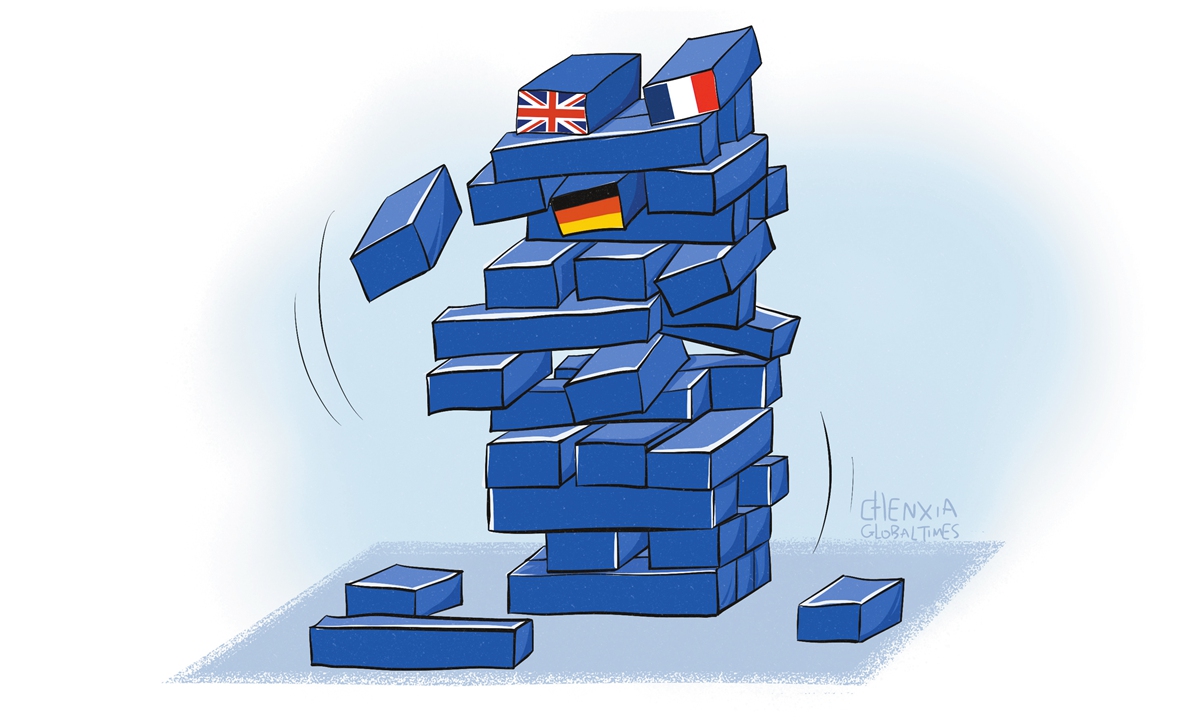
Illustration: Chen Xia/Global Times
Caught between two raging wars and a trade conflict, Europe's already beleaguered economy appears to be spiraling deeper into trouble. From the debt crisis alarms ringing in the UK and France to Germany admitting that its welfare system is unsustainable, Europe's major economies resemble fragile building blocks, teetering on the brink of instability.
On Monday, French Prime Minister François Bayrou warned that the country is facing an "immediate danger" of over-indebtedness. On Saturday, The Telegraph quoted economists as warning that the UK is facing a 1970s-style debt crisis. On the same day, Deutsche Welle reported that German Chancellor Friedrich Merz admitted that "the welfare state that we have today can no longer be financed with what we produce in the economy."
On the surface, these countries seem to be grappling with fiscal challenges, but beneath that lies something far deeper: Europe appears to be losing its grip on its identity and direction in geopolitical games. And the biggest accelerant of this crisis is the three wars Europe finds itself caught up in.
One is conflicts with real gunfire and smoke of war - the war between Russia and Ukraine, and that in Gaza - which continue to fuel Europe's growing security risks. Take the Russia-Ukraine conflict. Over the past three years, there have been opportunities to de-escalate, but the US has used the Ukraine crisis to pursue a strategy of weakening Russia as well as containing Europe, pouring fuel on the fire and making resolution seem ever more distant. Yet, some European countries have been blindly following the US-led NATO expansion strategy, confronting an unmovable neighbor spanning the Eurasian continent. This has eventually led to Europe's current deadlock. To this day, some European politicians are still trying to convince voters that only military buildup can ensure their well-being, using this argument to justify increased defense budgets and cuts to welfare programs.
What has Europe gained from this? It has lost the Russian market and energy supplies. The risks of war have led to deindustrialization and capital flight, while the refugee crisis has deepened societal divides, pushing many major economies into negative growth.
The second battlefield is the trade war. "America First" is the cornerstone of the current US administration's foreign policy, and Europe is obviously no longer treated as an equal partner but as a target for manipulation, pressure, and extraction of direct benefits.
Take the recent negotiations between the two. The EU gets charged 15 percent tariffs on its exports to the US, while committing to zero tariffs on certain US imports in the EU. Furthermore, Brussels also agreed to invest $600 billion in the US including American military equipment, and spend $750 billion on energy.
What is the US giving up in the deal? When asked about it in the White House, European Commission President Ursula von der Leyen was seen almost saying "none," as she stressed that "the starting point was an imbalance, a surplus on our side." On Tuesday, Politico weighed in on the deal with strong wordings, stating that "Europe's 'century of humiliation' could be just beginning."
Some scholars have pointed out that facing the US' relatively obscure but longstanding and deeply toxic strategy against Europe, it has lost the ability to fully rescue itself strategically. Although Europe's level of development still seems to be among the best on the surface, it is in fact no longer one of the world's poles and is continuing to decline.
Despite the occasional cries from European politicians for "economic development" and "strategic autonomy," they appear to be mere lip service. It continues to largely follow the US' command in various areas, including ramping up military expenditure. And on key issues, including how to deal with Russia and the US in the long term, the EU still lacks consensus, even after they are bleeding too much in the crisis.
Europe isn't simply grappling with an economic crisis; it's caught in a larger "strategic misstep" - following the wrong lead, down the wrong path, in the wrong direction. The challenge now is for Europe to shift its course, move beyond outdated dependencies, and explore new avenues for economic cooperation.
The question remains: will Europe awaken this time?