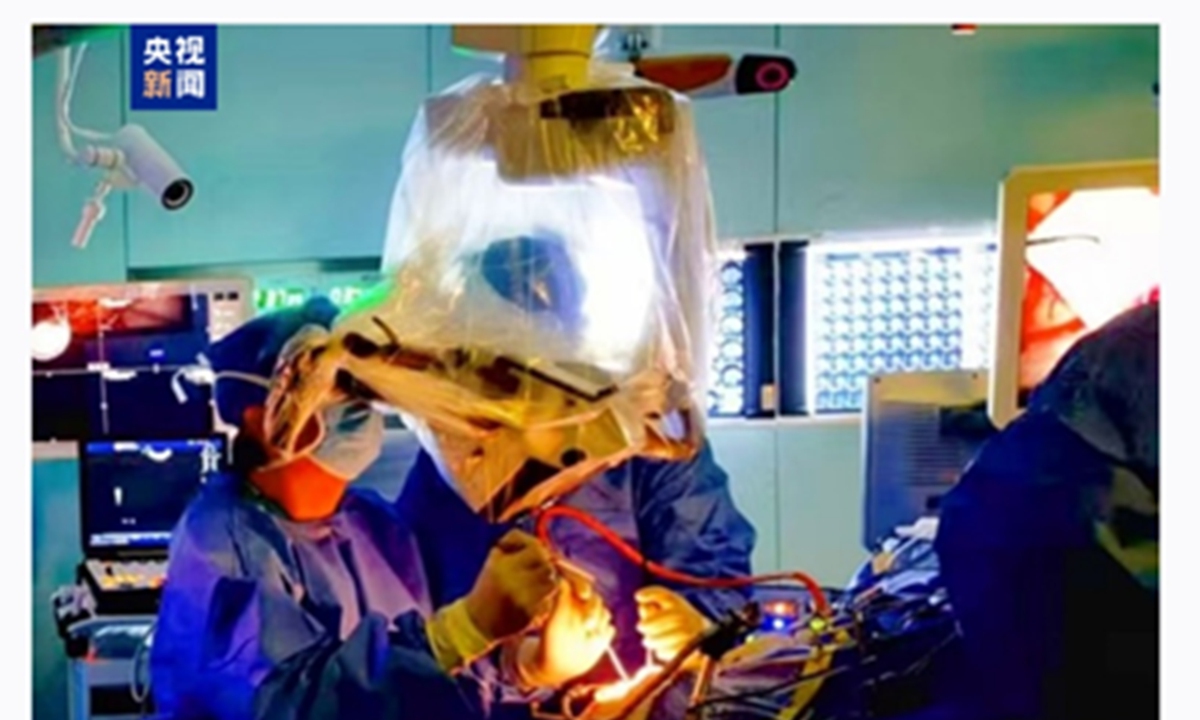
Neurosurgeons operate at the First Affiliated Hospital of Harbin Medical University. Photo: Screenshot from CCTV New
A Chinese research team has completed the world's first clinical trial applying a brain-computer interface (BCI) to precisely locate the boundaries of deep brain tumors during surgery, marking a major breakthrough in China's independently developed implantable clinical BCI technology, state broadcaster CCTV news reported on Thursday.
The trial was jointly carried out by the State Key Laboratory of Transducer Technology at the Aerospace Information Research Institute of the Chinese Academy of Sciences and the Department of Neurosurgery at the First Affiliated Hospital of Harbin Medical University.
The technology provides neurosurgeons with real-time, high-precision "lesion navigation," enabling more accurate tumor removal while preserving healthy brain tissue, thereby improving patients' postoperative neurological function and quality of life. Experts say it holds significant potential for clinical application, the media report said.
The clinical trial made use of two devices independently developed by the Aerospace Information Research Institute: the NeuroDepth implantable microelectrode array for clinical BCI, and the AIRCAS-128 multi-level regulatory and high-throughput neural signal synchronous detector.
The trial was conducted on a patient with glioma who had been experiencing frequent episodes of speech confusion due to tumor compression. During surgery, doctors combined imaging data with single-cell level neural signals captured in real time by the NeuroDepth electrodes, successfully identifying the tumor boundary. This enabled complete tumor removal while maximally protecting functional brain regions.
Following surgery, the patient's speech became clear and fluent, quality of life improved, and no new neurological damage was observed—laying a solid foundation for recovery and follow-up treatment.
Looking ahead, the research team plans to expand clinical applications of the technology in collaboration with medical institutions. Future directions include advancing high-precision BCI for visual and auditory function reconstruction to help blind and deaf patients regain perception, and developing vascular interventional BCIs for stroke rehabilitation and hydrocephalus treatment, with the aim of aiding motor function recovery in paralyzed patients, said the report.
RELATED ARTICLES