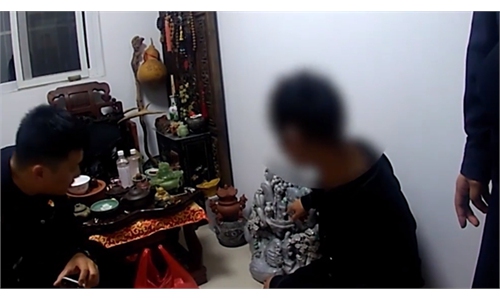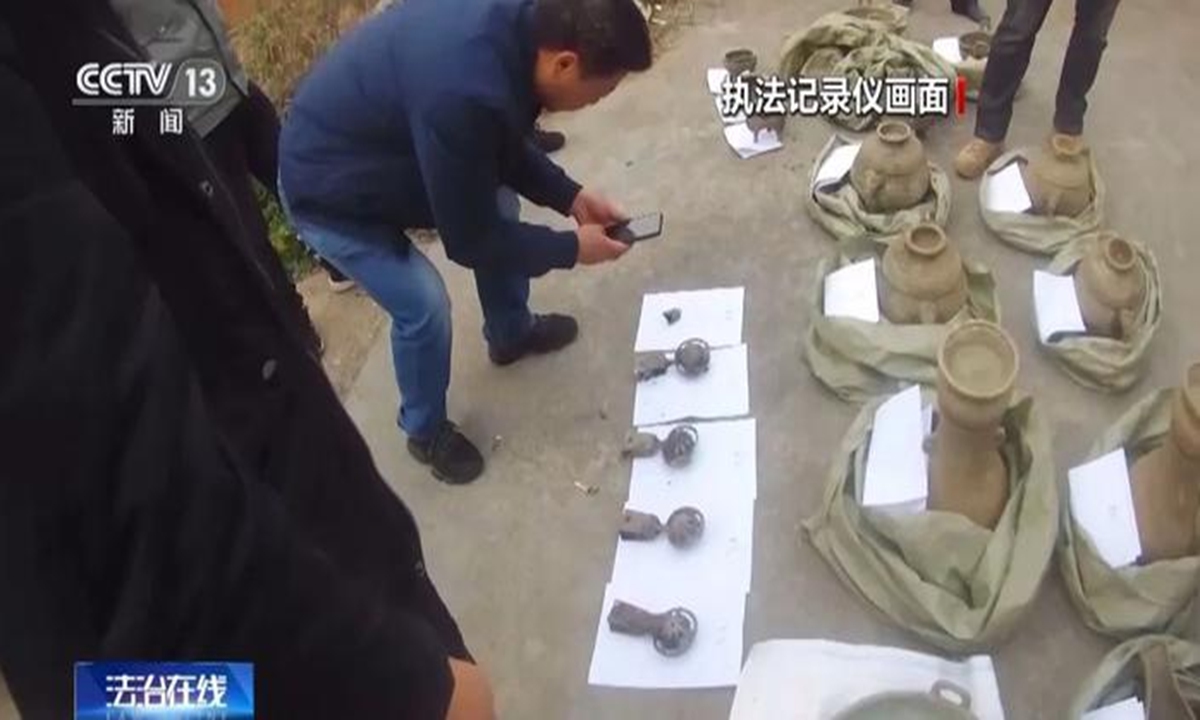
Footage from a police body camera Photo: Screenshot of the CCTV News
Chinese police arrested a gang of tomb robbers in November 2023 while they were attempting to sell 20 bronze artifacts stolen from the Guo Family Temple Tomb Cluster in Zaoyang city, Central China's Hubei Province, according to China National Radio (CNR). In July of this year, the mastermind, surnamed Yu, who claimed that his tomb-robbing idea inspired by novels, was also apprehended.
In July, the prosecutors brought charges against Yu for the crime of looting ancient tombs. Other perpetrators apprehended by police earlier had already been sentenced by local people's courts to fixed-term imprisonment ranging from three to 10 years.
He was initially captivated by the thrilling adventures in tomb-robbing novels and gradually started verifying details from the novels, which was eventually put into practice after seeing news reports about numerous artifacts excavated from this temple tomb cluster, Yu confessed.
The temple tomb cluster is the key unit of historic relic under provincial protection. The police intercepted the suspects when they attempted to sell the stolen wares, CNR reported.
As authenticated by experts, the 20 bronze wares recovered are all precious artifacts from the Spring and Autumn Period (770 - 476 BC), with nine of them bearing inscriptions, classified as national first-class cultural relics.
These inscriptions record many crucial clues, providing tangible evidence studying ancient interstate relations, experts said.
CNR citing the local authorities reported that at present, all suspects have been arrested, and the case is now under legal proceedings.
Experts emphasize that ancient tombs are non-renewable cultural heritage, and tomb raiding is by no means an adventurous exploration—it is a criminal offense. According to China's Criminal Law, the maximum penalty for tomb raiding is life imprisonment.
China National Radio
RELATED ARTICLES