China-Mongolia Expo exemplifies model of South-South cooperation
Stepping up high-tech cooperation
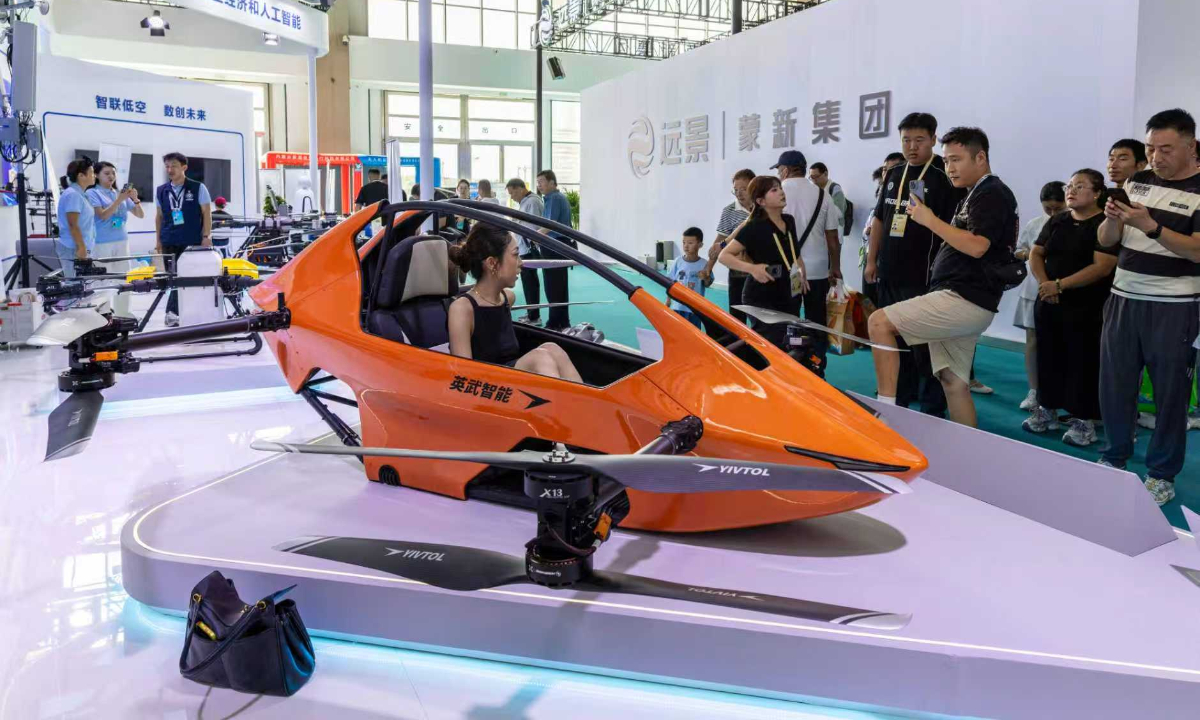
Visitors view an aircraft at the low-altitude economy and artificial intelligence pavilion of the 5th China-Mongolia Expo in Hohhot, North China’s Inner Mongolia Autonomous Region, on August 26, 2025. Photo: VCG
Mongolia, China's important northern neighbor, shares its longest land border with China, stretching approximately 4,710 kilometers, much of it across the Gobi Desert. This vast boundary not only reflects geographic proximity but also marks decades of deepening cooperation between the two nations.
Today, Mongolia is a crucial partner for China not only in border trade, but also as an important link in jointly building the Belt and Road Initiative (BRI). According to Chinese statistics, China-Mongolia trade reached $18.62 billion in 2024, up 10.1 percent year-on-year, hitting a record high. China has consistently remained Mongolia's largest trading partner, top import source, and primary export destination, according to the Ministry of Commerce (MOFCOM).
Against this backdrop, from August 25 to 31, the fifth China-Mongolia Expo (CME) is taking place in Hohhot city, North China's Inner Mongolia Autonomous Region. Established a decade ago, this institutionalized platform has become a pivotal hub for Northeast Asian cooperation. The expo extends to the wider Northeast Asia region and many BRI partner countries, playing an important role in advancing regional economic and trade collaboration.
Transforming cooperation
This year's CME has attracted about 6,000 domestic and international guests and more than 1,500 companies, including some 500 Mongolian manufacturers, exporters, organic food producers, and environmental enterprises.
In new energy and modern coal chemistry, the exhibition highlights China-Mongolia cross-border energy transmission and related technologies, featuring more than 30 industry-leading achievements. More than 20 Fortune Global 500 companies, including CATL and LONGi, presented their cutting-edge technologies, while multiple matchmaking events covering sectors such as mining and clean energy were held.
Digital empowerment of traditional industries was another highlight of the expo. Inner Mongolia is one of China's eight national computing hub nodes and hosts 10 major data center clusters, including the nation's largest cloud computing park and Asia-Pacific's largest internet data exchange center. This year's CME includes a green computing and AI exhibition area, featuring "East Data West Computing" solutions and Mongolia's new energy data center plans. The exhibits drew more than 100 large domestic and international buyers for business discussions, according to MOFCOM.
Building on traditional energy and mineral cooperation, China-Mongolia collaboration is steadily expanding into new technological fields, driving growth in bilateral trade. Emerging sectors such as information transmission, the low-altitude economy, and smart city solutions were major focal points at the expo.
Chinese tech company GEOVIS Smart Technology Co has been promoting the use of aerospace information technologies and continuously exploring innovations in smart cities, the low-altitude economy, construction, and transportation.
Bao Yilun, a company representative told Global Times that the expo offered an opportunity to expand cooperation with Mongolia and other countries in the technology sector. He noted that China-Mongolia cooperation is shifting from traditional sectors to emerging technologies.
Due to geographic proximity, many urban construction and smart management solutions applied in Inner Mongolia are well-received in Mongolia, Bao noted. For example, clients from Ulaanbaatar, capital of Mongolian and nearby cities have expressed demand for smart city initiatives, he said, noting that exchanges organized by local foreign affairs offices and consulates underscore the strong potential for bilateral tech cooperation.
Douglas de Castro, a Brazilian scholar and a professor at Lanzhou University, told Global Times that the expo shows that bilateral cooperation is now expanding beyond traditional mining into technology, agriculture, and cross-border logistics, with Inner Mongolia serving as a bridging hub. He added that opportunities lie in green energy, particularly wind and solar, alongside the digital economy and infrastructure connectivity.
The expo is a vital platform for the two countries to sign new, broader project agreements, establish business-to-business partnerships, and set up formal frameworks for long-term collaboration, with particular emphasis on people-to-people ties and culturally relevant initiatives, Castro said.
Upgrading relationship
On the opening day of CME, a development plan for the Zamyn-Uud-Erenhot Economic Cooperation Zone was released, alongside 21 key project agreements worth 65.294 billion yuan, covering cross-border service trade, mineral resource development, and new energy technology cooperation, China News Service reported.
On August 27, an economic and trade exchange meeting held by Foreign Affairs Office of Hohhot Municipal People's Government and Consulate General of Mongolia in Hohhot, which brought together more than 60 companies from the agriculture, logistics, and urban development sectors.
During the meeting, Chinese companies signed five economic and trade agreements with their Mongolian partners, while 13 others expressed intentions to cooperate in areas such as agricultural and livestock product processing, cross-border cold-chain logistics, infrastructure projects, and smart city technology, Global Times learned from the office.
In 2024, the Erenhot-Zamyn-Uud Economic Cooperation Zone was approved, becoming China's third cross-border economic cooperation zone with neighboring countries. In addition, highway links were completed at Manzhouli, Erenhot, and Ganqimaodu, AGV cross-border autonomous transport enabled intelligent customs clearance, and border inspection time was largely reduced.
On May 14, 2025, the second China-Mongolia cross-border railway- linking China's Ganqimaodu port with Mongolia's Gashuunsukhait port - was inaugurated.
Da Zhigang, director of the Institute of Northeast Asian Studies at the Heilongjiang Provincial Academy of Social Sciences, noted that within China's cooperation framework with Northeast Asian countries - Russia, Mongolia, Japan, South Korea, and North Korea - Mongolia may have a relatively small population and economy, but its geographical position and cooperation potential are significant.
"Mongolia serves as a key northern node for China, not only as a neighboring partner but also as an important participant in the BRI. The China-Mongolia-Russia Economic Corridor, one of six major BRI international economic corridors, positions Mongolia as a vital bridge linking China and Russia," Da said.
On November 28, 2022, the China and Mongolia issued a Joint Statement on Advancing Comprehensive Strategic Partnership in the New Era between China and Mongolia, agreeing to advance modernization jointly and build a community with a shared future based on peaceful coexistence, mutual support, and win-win cooperation, according to China's Foreign Ministry.
Castro said China-Mongolia cooperation should leverage complementary economies and go beyond resource processing. "This growing cooperation will strengthen regional supply chains, enhance economic integration across Asia and Latin America," he noted.
Castro also stressed that amid rising global protectionism, multilateral initiatives are of great importance. "Under the China's leadership, it demonstrates a practical model of South-South Cooperation that boosts global connectivity and development," he said.
RELATED ARTICLES