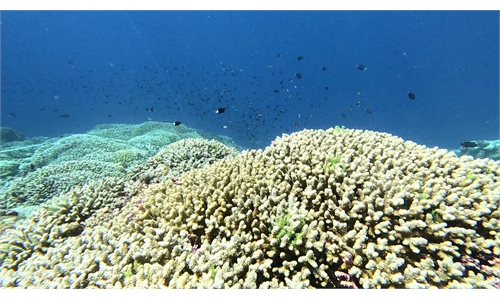
Sansha in S.China plants 100,000 coral seedlings, establishing largest artificial coral breeding base around Xisha Islands

The city of Sansha in South China's Hainan Province successfully plants 100,000 coral seedlings. Photo: screenshot from the website of Sansha city government
The city of Sansha in South China's Hainan Province has achieved significant results, successfully planting 100,000 coral seedlings, and establishing the largest artificial coral breeding base and planting demonstration area in the area of the Xisha Islands, with 143,000 coral seedlings cultivated so far, according to Sansha's marine protected areas administration, Xinhua reported.
Coral reefs are known as the "rainforests" of the sea and play a crucial role in maintaining marine biodiversity and the ecological safety of islands and reefs. In response to the coral bleaching issue caused by global warming, Sansha launched the coral planting project in 2023 in the waters of the Xuande Islands, according to the report.
The project innovatively employs "tree-type coral nursery" technology, significantly enhancing the growth rate and survival rate of corals. The annual growth rate of coral seedlings can reach 15 centimeters, and rare marine species such as sea turtles and giant clams have also noticeably increased in the coral planting area, said Li Yupei, director of the Sansha's marine protected areas administration, according to the report.
Coral reef restoration not only rebuilds marine habitats and stabilizes the food chain but also enhances the resilience of marine ecosystems and strengthens the foundation of the Sansha islands and reefs. In the next steps, Sansha will introduce new technologies such as satellite remote sensing and underwater robots to continue advancing marine ecological protection and monitoring in the South China Sea, according to the report.
Global Times
RELATED ARTICLES