IN-DEPTH / IN-DEPTH
Protectionist tariffs isolating US economically: former WTO chief economist
By and Ma Mengyang Published: Aug 31, 2025 09:06 PM

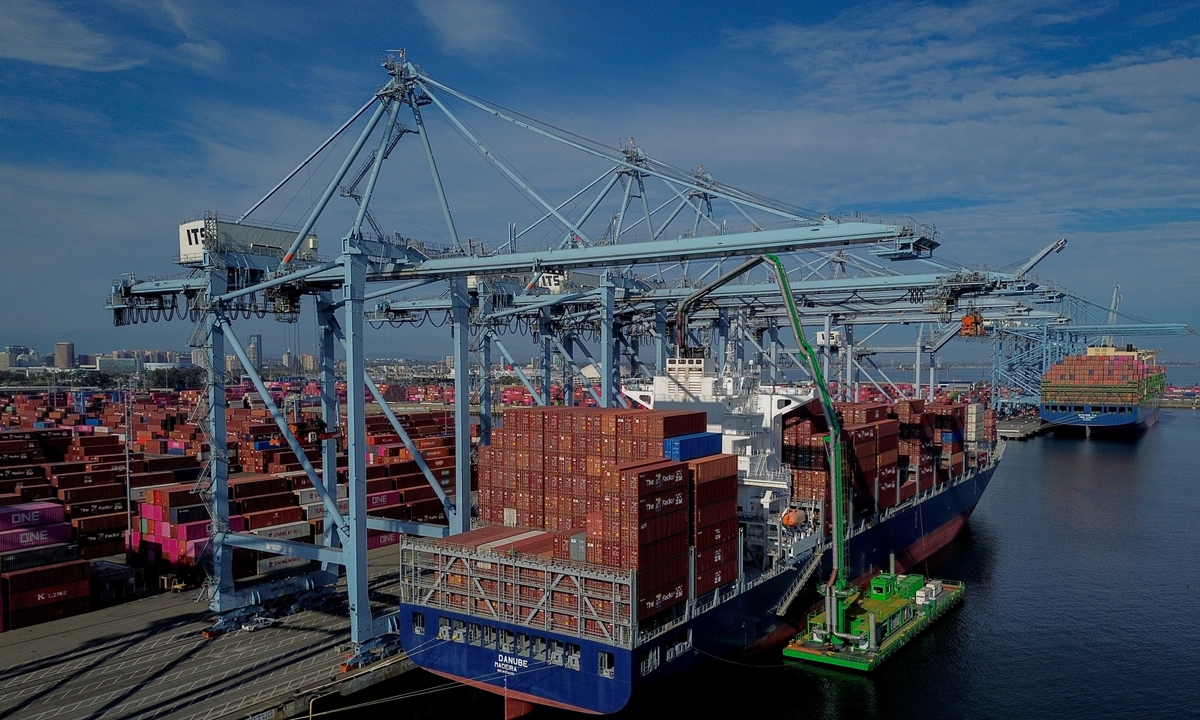
The Danube and HMM Garnet container ships dock at the Port of Long Beach in Long Beach, California, the US, on August 28, 2025. Photo: VCG
Robert Koopman, former WTO chief economist, argued that protectionism is an ineffective tool for addressing US-China trade imbalances in a recent exclusive interview with the Global Times. The expert, who has long been studying US' tariff policies and the broader commercial relationship between China and the US, criticized the current US tariff strategy as a significant departure from historical trade practices, misdiagnosing economic challenges and risking reduced growth and innovation without policies to foster competition.
On August 12, China and the US released a joint statement on the bilateral economic and trade meeting in Stockholm, which said the US will extend the tariff suspension on China for another 90 days and China likewise will continue to suspend its earlier tariff hike on US goods for another 90 days.
Koopman, also a Hurst Senior Professional Lecturer with the School of International Service of American University, observed a slowdown in the pace of US tariff policy changes, though not a complete halt. "There has been an extension in the 'pause' with China in an effort to conclude negotiations and find what the Trump Administration calls a 'deal.'" However, he cautioned that the US president's history of "reversing decisions" based on economic or political developments suggests continued unpredictability, with occasional trade and tariff policy announcements expected at a reduced frequency compared to recent months.
In Koopman's view, the current US approach significantly deviates from historical trade practices. "As US Trade Representative Jamieson Greer's recent op-ed demonstrates, the administration is deliberately attempting to reshape the global trading system to align with its preferred vision. Ironically, only the US has fully adopted this new system, with trading partners adjusting policies solely for US relations, not globally," he noted. Thus, Koopman argued, this does not constitute a new global trading system but rather a distinct US approach to bilateral trade.
Koopman believes protectionism is not the right tool to address US-China trade imbalances. He attributed US economic imbalances primarily to misguided macroeconomic and financial policies. Many US policymakers focus on manufacturing trade deficits, linking them to job losses (despite low unemployment), rising domestic inequality, or national security concerns over defense-related production. However, Koopman argued that targeting the global trading system to resolve these issues misdiagnoses the economic "illness" and applies the "wrong medicine."
Koopman acknowledged that tariffs may slightly boost the market share of US-made products. However, he emphasized that automation is the primary driver of reduced manufacturing jobs, with increased domestic production favoring automated systems. This benefits skilled engineers but limits opportunities for low-skilled workers.
Despite low unemployment and full employment in US labor and capital markets, reallocating resources to new manufacturing plants could hinder economic growth, as most analyses suggest, the economist stressed. "While Trump administration officials claim this shift would enhance productivity and innovation, empirical evidence indicates that tariff-driven reallocation, without policies promoting competition and innovation, typically reduces both."
Since Friday, the US has suspended the duty-free treatment for imported parcels valued at $800 or less. Analysts say this arrangement - originally designed to facilitate and benefit cross-border e-commerce and US consumers - has been abruptly terminated, marking a significant escalation in US tariff policy.
As US households face higher prices for both imported and competing domestic goods, dissatisfaction with the administration's trade policy implementation is growing, Koopman told the Global Times.
A US appeals court has ruled that most tariffs issued by the US administration are illegal on Friday, setting up a potential legal showdown that could upend its foreign policy agenda. The ruling affects the so-called "reciprocal" tariffs, imposed on most countries around the world, as well as other tariffs slapped on China, Mexico and Canada. The ruling will not take effect until 14 October, to give the administration time to ask the US Supreme Court to take up the case, BBC reported.
Koopman warned that if other economies adhere to WTO rules and deepen integration while the US isolates itself through tariffs, they are likely to achieve stronger growth prospects. "The US tariff policy is creating a high-cost island of production," he said. As other countries lower trade barriers among themselves, US production costs will rise relatively, further isolating the US economically.
RELATED ARTICLES