ARTS / CULTURE & LEISURE
Growing regional leagues rooting football in grassroots
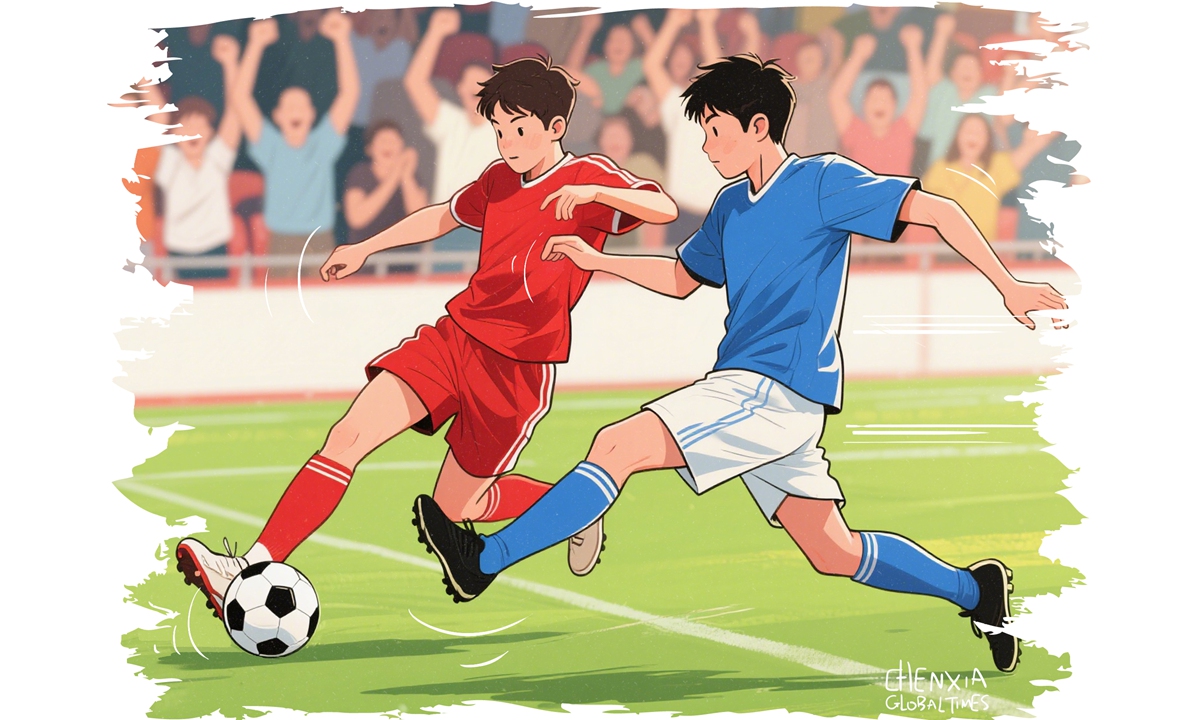
Illustration: Chen Xia/GT
A series of regional amateur football leagues is set to unfold this month now that the regional amateur Jiangsu City Football League in East China's Jiangsu Province has proven its popularity inside and even outside of the province.
Heralded by Central China's Hunan Province with their Hunan Football League, more often referred to as Xiangchao, on September 7, Southwest China's Chongqing municipality and neighboring Sichuan Province as well as East China's Shandong Province will start their editions this month.
The growing enthusiasm toward regional football leagues lie in the belief that the events could be the engines of sports popularization, social cohesion, economic and cultural vibrancy, and even lay firm building blocks for the future of Chinese football.
One of the most transformative aspects of these provincial amateur leagues is that unlike professional leagues that are restricted to registered professional players, these competitions open their doors to ordinary citizens. They could be students, teachers, workers or enterprise employees.
This kind of closeness - playing on neighborhood or district fields, seeing colleagues or classmates in kits, hearing cheers from neighbors - turns football from something that happens only on TV into a living, breathing phenomenon in daily life. The attempt to mirror Suchao makes football inclusive rather than exclusive to the elite.
For youth development, professional club academies are essential, but they cannot be the only pathway. Many young players who do not secure spots in elite youth systems often fade into inactivity due to lack of formal competition. Provincial leagues fill this gap perfectly. They offer real-match experiences for teenage talent to sharpen competitive instincts, build resilience under pressure, and gain match awareness in 11-a-side environments.
By expanding the reservoir of ready and match-tested players, these leagues serve as supplementary channels feeding into professional club systems. More importantly, they preserve the dream of football for youth beyond a single-track elite system, making it truly a type of grassroots development accessible to the broader base of aspiring players. An inspiring story is that of Miao Rundong, who plays for the Xuzhou team in the Suchao. He was summoned to the national under-18 football team last month.
Since its May 10 kickoff, Suchao has generated millions of social media impressions, while slogans have gone viral outside of what happened on the field. Some matches have drawn attendance exceeding 60,000 fans, surpassing that of many professional clubs.
Other organizers are explicitly building on Suchao lessons, elevating formats, festive culture, and community visibility, while weaving in local tourism, business sponsorship, and civic pride, creating a replicable blueprint for new regional leagues across China.
Jiao Fengbo, general manager of Chinese Super League club Zhejiang FC, said that professional leagues should be grateful to the amateur leagues as they help foster the football atmosphere. "With the improved atmosphere of the [amateur] leagues, more fans will be attracted to watch games at the stadiums, and more people will pay attention to football. In turn, more people will also pay attention to professional leagues and the national teams," Jiao was quoted as saying.
These new leagues could activate urban cultural memory, boost community bonds, and ignite the "sports-culture-tourism" combination, delivering multi-dimensional value far beyond the pitch.
Take the Jiangxi Province Football Super League in East China's Jiangxi Province as an example. Last week in Ganzhou, when the Ganzhou team hosted Ji'an, actors staged a revolutionary play to the background music "Ten Farewells to Red Army" to celebrate the revolutionary history of the region. The show was not only celebrated in Jiangxi as video clips of it also resonated across Chinese social media.
These regional leagues effectively become lightweight engines of local economic vitality, hosting events that bring spectators, stimulate dining and retail, and open avenues for football games and tourism packages. The competitive format, regional identity, and celebratory flair all blend to craft compelling experiences, turning amateur matches into community festivals with real social impact.
When viewed through a holistic lens, these provincial leagues are performing critical functions in the long-term vitality of Chinese football.
First, they expand access of football, bringing communities into active participation, not just viewership. Second, they offer realistic match environments for youth and amateur players to develop and be noticed. What's more, they ignite cultural expression, showcasing local identity through sport while weaving in tourism and economic activity, fostering local pride and communal enjoyment. In essence, these competitions are crafting the grassroots foundations that professional and national teams rely on, even if those foundations are often less visible.
This could be the real game-changing evolution. In an era where professional football worldwide is tied to capital flows and elite performance, the amateur leagues remind us that football's power lies in shared experience and identity. The regional leagues are laying down cultural bricks building not only better players but, perhaps more importantly, better supporters of the game.
The author is a reporter with the Global Times. life@globaltimes.com.cn
RELATED ARTICLES