ARTS / CULTURE & LEISURE
National intangible heritage inheritor Liu Dashan protects ‘bridges of time’
A lifetime of stone and soul
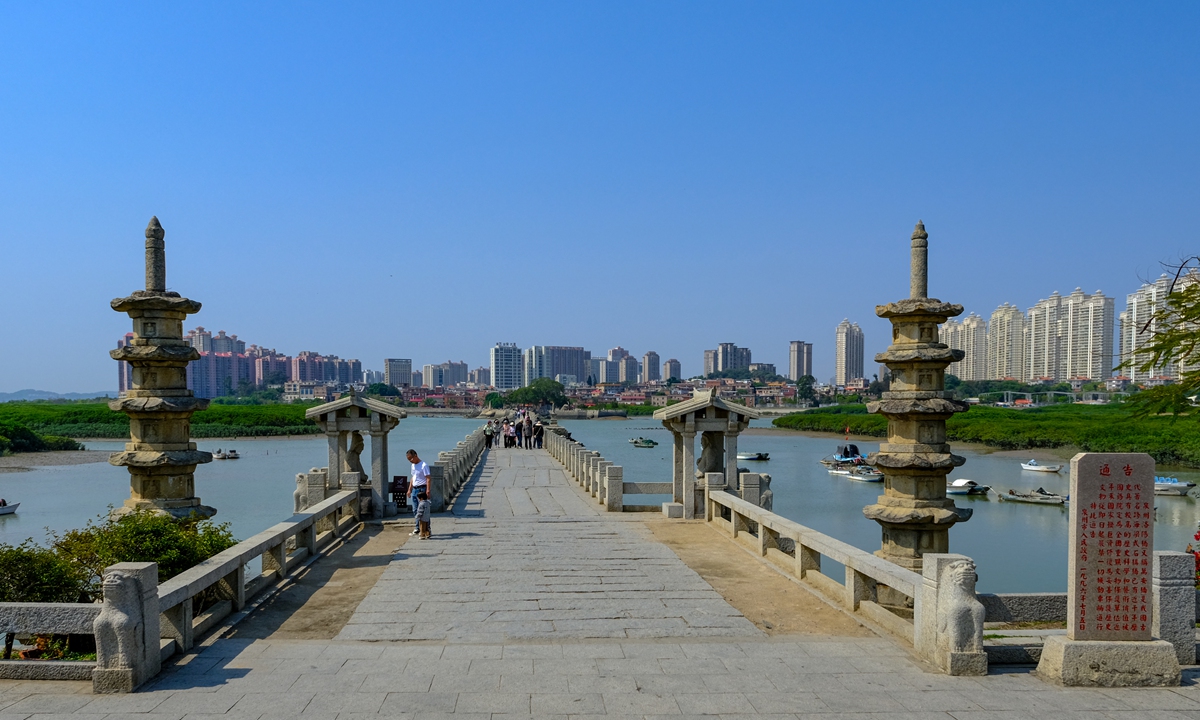
Pedestrians walk on Luoyang Bridge in Quanzhou, East China's Fujian Province, on April 7, 2025. Photo: VCG
At 72, Liu Dashan rarely lingers at home to rest. Instead, he remains a familiar dawn fixture in Quanzhou's Confucius Temple in East China's Fujian Province, quietly admiring the elegant swallow-tail ridges of the great hall.
Even colleagues at his studio say he is always at the site. "Even at his age, Liu spends most of his time at the construction grounds," a staff member surnamed Lin told the Global Times. "Sometimes, we simply can't find him."
In March 2025, Liu was officially named among the sixth batch of national-level intangible cultural heritage inheritors. Behind the honor lies nearly half a century of work: 46 years spent restoring 83 major cultural relics across China.
Proud work
He has left his mark on projects ranging from Quanzhou's Confucius Temple, which he helped repair in 2006 and again in 2014, to UNESCO-listed sites such as the Shanhaiguan section of the Great Wall. But the work he is most proud of is the restoration of Luoyang Bridge, one of China's great feats of medieval engineering.
And now, with the launch of restoration work on another Quanzhou's bridge: Anping Bridge, in August 2025, memories of Luoyang Bridge have resurfaced.
"I grew up beside Luoyang Bridge," Liu told the Global Times. "As a lifelong protector of cultural relics, my greatest dream was to take part in their restoration. To see that dream fulfilled, and now to witness Anping Bridge entering its own phase of conservation, makes me proud that ancient architecture is finally receiving the attention it deserves."
Liu's career began in 1968, when, at just 16, he started learning the craft of traditional Minnan architecture under the guidance of his father, Liu Yiyi. For the Liu men, architectural knowledge is a family legacy stretching back four generations.
In the 2014 restoration of the Fu Wen Temple's Dacheng Hall, he pioneered the use of total station positioning equipment to ensure that the roofline was preserved with millimeter-level accuracy.
By combining 3D scanning and carving technologies with centuries-old craftsmanship, he overcame the challenge of fitting irregular, damaged stone components together seamlessly. The project later won him a conservation project award.
"Every millimeter of a brick joint carries the soul of a craftsman," Liu noted. On restoration sites, his brick-cutting technique is swift and exacting. Minnan-style brick carvings, with intricate patterns such as geometric repeats, demand both artistry and precision. Each piece must be cut to fit within a 1-millimeter tolerance: Anything less risks chipped edges or uneven seams. It is a craft honed only through decades of practice.
On August 29, the National Cultural Heritage Administration issued new technical guidelines emphasizing preventive conservation under the principle of "minimal intervention." For Liu, the principle is second nature: Restoring heritage while preserving every possible trace of its history.
Luoyang Bridge, first built in the Northern Song Dynasty (960-1127), is considered the world's first large-scale stone beam bridge across the sea. Beyond its practical function as a transport artery, it stood as a vital node along the ancient Maritime Silk Road. Its survival today is owed not only to ancient ingenuity, but also to the modern guardians who continue to preserve it.
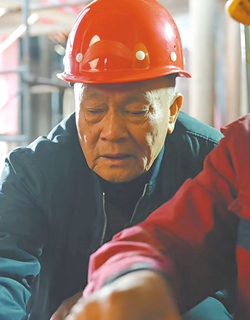
Liu Dashan restores an ancient building in Quanzhou, Fujian Province, in 2019. Photo: Courtesy of Liu Dashan
Living wisdom"To restore a bridge, you first have to read it and understand all its details," Liu explained. "Luoyang Bridge is dry-laid, with no mortar, so the builders used dovetail joints along the water-splitting piers to keep the stones in place."
These dovetail joints, shaped like butterfly bows, were once reinforced with iron inserts. During restoration, Liu discovered that while the grooves remained, the iron had corroded away. "So, we cast new pieces, precise to the original specifications, and set them back where they belonged."
This blend of tradition and innovation defines Liu's approach. His team follows the "minimal intervention" rule, retaining as much of the original fabric as possible while using modern data to support conservation decisions.
Liu scheduled work according to the tides, carrying out underwater tasks during low tide to preserve every detail. "The goal was to keep the bridge's historical value intact," he recalled.
The bridge's endurance also reflects ancient Chinese innovation. For example, its "raft foundation" was built by sinking stones from aligned fishing boats during low tide, an engineering method not adopted in Europe until centuries later, Li Guohong, a director of the Chinese Society for the History of Overseas Communication, told the Global Times.
Another technique, "oyster reef reinforcement" involved cultivating oysters on the piers to strengthen the structure naturally, marking the world's first recorded instance of using biological methods in bridge construction, according to Li.
"These are legacies of Chinese wisdom, and masters like Liu are passing it to the present," Li said.
Liu has also trained three apprentices, ensuring that the craft will continue beyond his generation.
"To protect ancient bridges and architecture, we must first understand the wisdom of the past," he said. "Only by respecting their logic can we preserve them for the future."
As Anping Bridge begins its long-awaited restoration, Liu once again finds himself at the threshold of history. For more than 900 years, the bridge has connected shores and souls, carrying not only travelers but also the enduring spirit of craftsmanship.
For him, each project is more than a job: It is a dialogue across centuries. The stones, beams, and carvings he restores are fragments of memory, bearing the weight of dynasties and the resilience of communities.
RELATED ARTICLES