Official reveals story behind selection of four choir songs for V-Day commemorations at Tian'anmen Square
By Published: Sep 03, 2025 05:10 PM Updated: Sep 03, 2025 07:30 PM

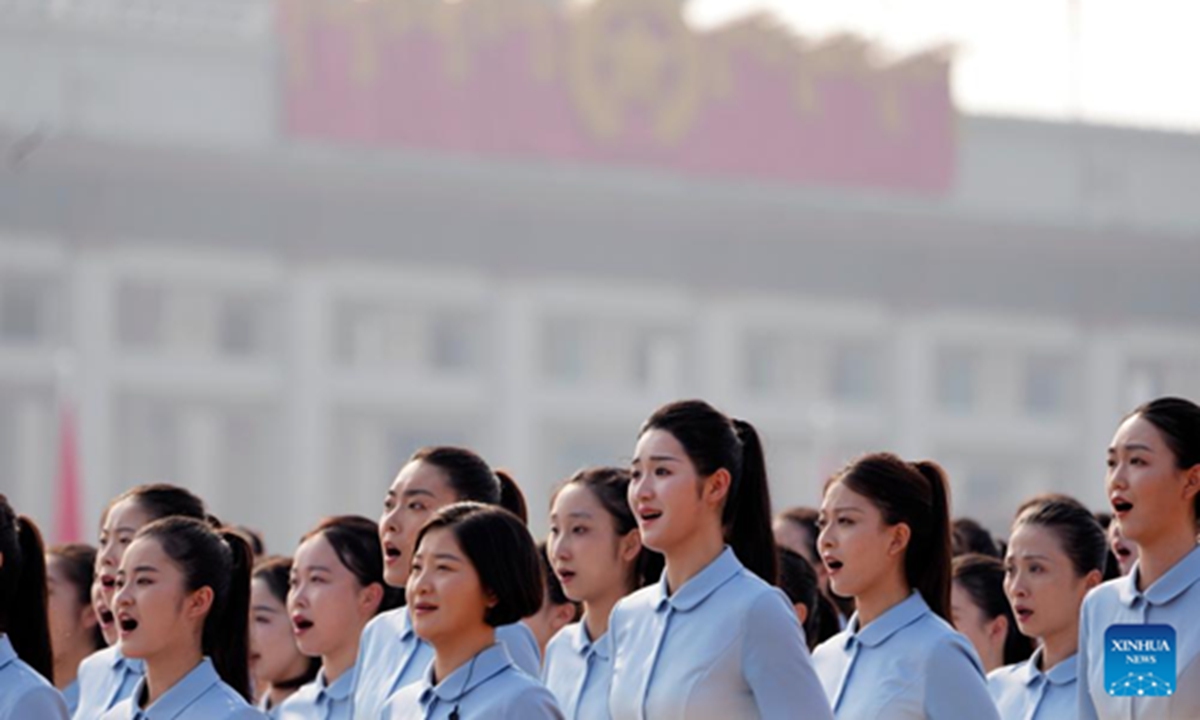
Members of a chorus perform during a grand gathering to commemorate the 80th anniversary of the victory in the Chinese People's War of Resistance against Japanese Aggression and the World Anti-Fascist War in Beijing, capital of China, on September 3, 2025. Photo: Xinhua
A choir of 3,000 college students sang four emotionally resonant songs on Wednesday morning as part of the commemorative events marking the 80th anniversary of the victory in the Chinese People's War of Resistance against Japanese Aggression and the World Anti-Fascist War.
Why were these four songs, namely On the Songhua River, On the Taihang Mountain, Defend the Yellow River, and Without the Communist Party, There Would Be No New China, selected? How were they adapted and choreographed?
Xiao Xiangrong, deputy head of the team in charge of square commemorative activities and vice president of Beijing Dance Academy, provided an in-depth interpretation in an interview with the Global Times.
"Although the segment lasted only 8 minutes, the process of selecting the songs took immense effort," said Xiao, who, in collaboration with his team, deliberated to choose the final tracks keeping in consideration of multiple dimensions: political, artistic, temporal, historical, and geographical.
The first song, On the Songhua River, represents the starting point of the Chinese People's War of Resistance Against Japanese Aggression. In 1931, when Japan invaded Northeast China, the Communist Party of China (CPC) was the first to issue a declaration against the Japanese invaders.
The second piece, On the Taihang Mountain, underscores the CPC's pivotal role in the resistance. It embodies the resolve to "make the enemy perish wherever they attack," a defining spirit of the Chinese people's fight.
The third song, Defend the Yellow River, unleashes a thunderous roar of national unity against the invaders. "Young people today, just like those 80 years ago, share the unyielding resolve to defend the Yellow River, protect northern China, and safeguard all of China," Xiao said, as reflected by this song.
The final track, Without the Communist Party, There Would Be No New China, is hailed as the "Song of Truth." "It highlights the CPC's pivotal role throughout the 14-year epic resistance war," said Xiao.
Among the selected pieces, the most ingenious and significant adaptation was that of On the Songhua River, noted Xiao. Initially, this song was not picked for the segment because it originated during the fall of Northeast China, and its overall melody was overly somber and melancholic, which did not align with the emotional tone of commemorating a victory.
"We considered many other songs, but none felt right," Xiao explained. "In the end, we had to return to the 'September 18 Incident' - the starting point of the 14-year War of Resistance. We worked repeatedly with the military band to adapt the song."
He added that On the Songhua River was not performed in its entirety; overly sorrowful sections were removed, and emphasis was placed on the indomitable spirit of the Chinese people - a crucial innovative touch.
"The Chinese nation has endured tragic moments, but it cannot be defeated," Xiao said. "After hearing the song, everyone feels galvanized."
The most distinctive feature of this year's choir performance was the incorporation of movements during the singing, according to Xiao. When the bugle call sounded in On the Songhua River, the entire choir turned toward the Monument to the People's Heroes in the square.
"This posed significant challenges for choir training, as well as live audio recording and broadcasting," Xiao noted. However, he emphasized that standing motionless would have left the performance emotionally unanchored. Thus, a tribute gesture was designed: all choir members, centered around the central axis of Tian'anmen Square, turned as a group toward the monument and then turned back.
"We sought to better showcase young people's understanding of history through these songs," Xiao added.
In previous years, doves of peace and balloons were released simultaneously at the end of the commemorations. This year, however, the release of the doves of peace was presented as a standalone agenda item. "This move embodies our responsibility to uphold peace," Xiao noted. As the doves soared into the sky, the choir sang Ode to the Motherland, their voices echoing until the conclusion of the ceremony.
RELATED ARTICLES