Chairman of World Muslim Communities Council says Western narratives of Xinjiang are purely political
A Xinjiang success story
By Published: Sep 04, 2025 10:40 PM
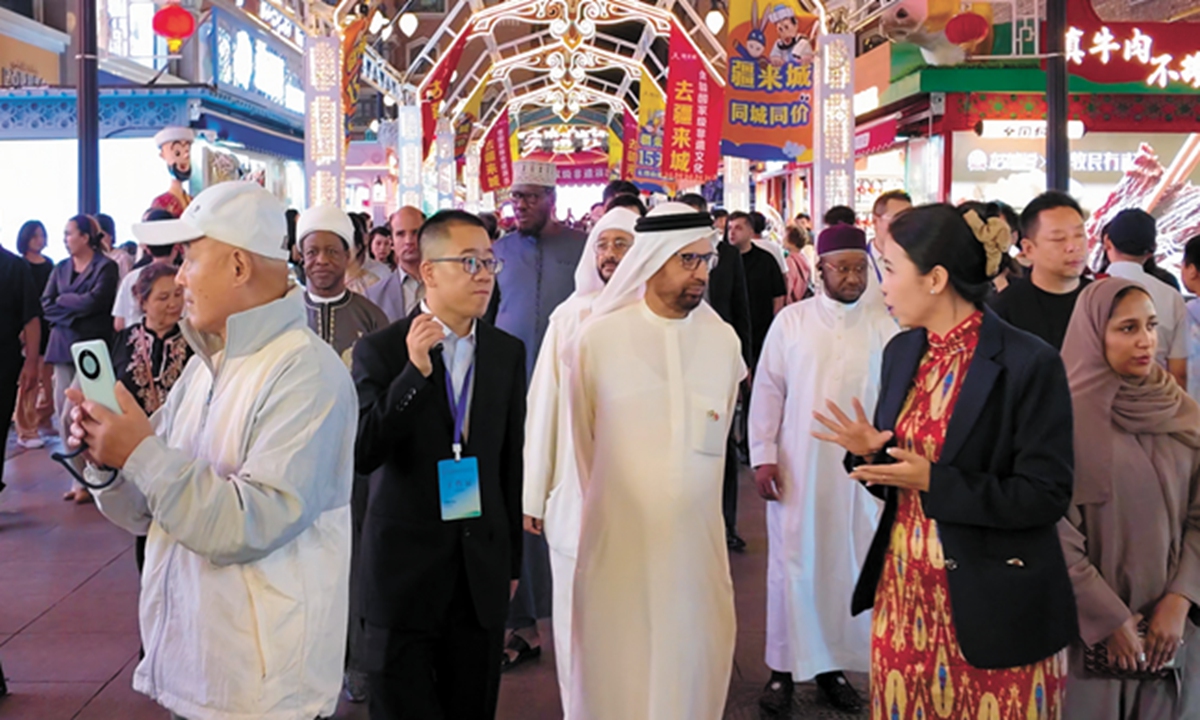
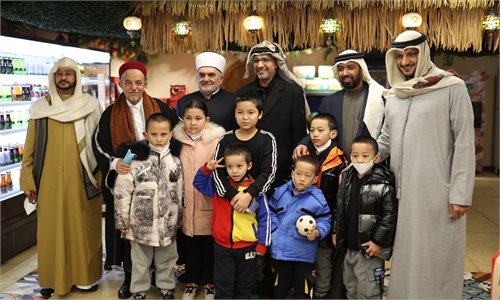
Foreign scholars and religious fgures from various countries - including the United Arab Emirates and Egypt visit the Xinjiang International Grand Bazaar in Urumqi, Northwest China's Xinjiang Uygur Autonomous Region, on August 25, 2025. Photo: Liu Xin/GT
Editor's Note
Ali Rashid Al Nuaimi (Al Nuaimi), chairman of The World Muslim Communities Council from the UAE, led a delegation of Islamic figures and scholars from multiple countries to Northwest China's Xinjiang region in late August. This marked his third visit to the region, following earlier trips in 2019 and 2023. While in Urumqi, he attended an international forum on counterterrorism and, in an exclusive interview with Global Times reporter Liu Xin (GT), shared his impressions from the visits as well as his perspectives on the region's development and protection of religious freedom.
GT: You visited China's Xinjiang region in 2019, 2023 and again this August. Looking back, how would you compare your impressions from these trips? What changes stood out to you most in terms of development and social stability?
Al Nuaimi: In all three visits I met officials, community representatives, religious leaders, and visited mosques and families, especially during the first trip. I see progress, I see real development. The government has a plan for reducing poverty, and I witnessed the results on the ground, not just what officials told me.
It's important to appreciate this achievement, to acknowledge it and to show the world that while many countries face challenges, in China, especially in this region, there has been remarkable progress. People outside China cannot imagine the lifestyle here or the services provided to the people of Xinjiang.
When it comes to education, healthcare, jobs and training, I have seen real improvement over the years. There is a trust. When the government says it will do something, people believe it will deliver. That is the great achievement I have seen.
The most impressive movement was our visit to the Grand Bazaar. Seeing the general public, you could feel their pride in their country, in themselves, and in their lifestyles. We saw families and I asked one of our Chinese friends why it was so crowded in the bazaar. He said people came from all over China for the holiday season. There are millions traveling to the Xinjiang region from other parts of China.
If this place were unstable, not progressing, and somewhere where people could not enjoy life, people would not come. Having millions of tourists coming to the region sends a clear message — to the people here, and to the world — about this region's history and progress.
I hope to see more openness of the region toward the world. There are misconceptions about this region outside China because of propaganda and misinformation. People don't know the truth. There is a saying that seeing is believing. There will always be those that believe the misinformation and the lies, but when they come here and they see the infrastructure, they see how the government is caring for the people, their views change.
For most, it was their first time in China. They were surprised to see Muslims here freely practicing their religion, mosques that have stood for centuries, and the government preserving them — opening the region for others to see.
When visitors witness this with their own eyes, they can compare it with the misinformation spread on social media. That contrast helps build trust, partnerships and investment — because the opportunities here are enormous, though much of the world still doesn't know about them.
GT: You just mentioned how some Western media portray things differently. Why do some Western countries portray Xinjiang in such a negative light?
Al Nuaimi: For political reasons. When you look at China's dealings with the international community, there are three issues others exploit to apply pressure: Taiwan, Tibet and Xinjiang. This narrative is created to serve a political agenda. It has nothing to do with respecting relationships, international law or the reality on the ground.
After dissolution of the Soviet Union, fighters in Afghanistan returned to their own countries carrying an ideology that rejected constitutions and the rule of law. They believed they had the right to rule, and wherever they went, they killed innocent people and spread terror. Governments had no choice but to respond to protect their citizens.
This is why it's important to understand that what is called the "Eastern Turkistan terrorist organization" emerged after 1990. The same pattern appeared across the Muslim and Arab world — in Algeria, Morocco, Egypt, Syria, Saudi Arabia, Yemen, Somalia. These groups misused religion, but Islam has nothing to do with terrorism. Terrorism has no religion.
We must protect our religion. We should not allow anyone to use Islam as an ideology to serve a terrorist agenda. Islam has nothing to do with that. At the same time, we believe in coexistence, we respect the constitution, and we value national identity. As Muslims everywhere, it is our responsibility to counter those who try to misuse Islam for political purposes. It is our religious duty to protect our faith from being exploited by terrorist organizations.
I mentioned earlier that there is a long history between the Muslim world and China — a history of respect, acceptance and partnership. We must rebuild these bridges of trust, respect and cooperation.
GT: The third international forum on counterterrorism was held in Urumqi in August. What is the significance of hosting such a forum in Xinjiang, and what message does it send to the world?
Al Nuaimi: I believe it is very important to hold it here because Xinjiang is a success story and this story should be told to the world. Since 2016, terrorist organizations have failed to carry out any attacks here. This is a success. This is unlike Afghanistan, Pakistan, Iran, Syria, Iraq, the Horn of Africa, the Sahel, Yemen, as well as much of West Africa, East Africa and Southeast Asia, where terrorist attacks continue.
The second important point is to show that we are all committed to fighting terrorism. It is a global challenge and the responsibility of the international community to unite against these groups. It is also vital to engage faith leaders — Muslim leaders here and from the wider Muslim world — so they can understand what happened, recognize their responsibility and carry the message forward: it is their duty to stop terrorist groups from misusing Islam for their agenda.
GT: You just mentioned the Xinjiang experience. What lessons or approaches in countering terrorism and deradicalization do you think can be useful for the wider Muslim world and the international community?
Al Nuaimi: I believe the first step is developing a strategy based on prevention —initiatives and program that protect the new generation from being hijacked by the narratives spread by terrorist organizations. This must be rooted in education, in religious discourse, in the role of religious figures and in investment in local communities. Xinjiang has implemented all of these measures.
It is also important to highlight the issue of identity. Many Muslims, including in China, face the question: am I Arab, Kazakh or Muslim? The key is to promote coexistence within a strong national identity that everyone can be proud of.
For example, in China, Muslims, Christians, Buddhists and nonbelievers alike should all be proud of being Chinese citizens, while their own beliefs are respected. This is what the Chinese Constitution guarantees: freedom of religion. Promoting national identity does not mean undermining ethnic or religious identity, but showing respect for all. What brings everyone together, despite differences in religion, ethnicity and language, is a shared national identity.
When I first visited this region in 2019, I asked to see the schools. For me, this was important because education shapes the future. In kindergarten, children are taught the national language. This means a Chinese citizen from Xinjiang can communicate and understand a citizen from Shanghai or Beijing. The common thread of national identity ties everyone together. At the same time, teaching other languages and cultures is welcome and respected — it should never be an "either/or." You can have both.
In the 21st century, the world has changed, and we all have roles and responsibilities as citizens. Chinese Muslims are first and foremost Chinese citizens. They should respect their nationality and identity, and understand their responsibility toward the security, stability and prosperity not only of Xinjiang, but of the whole country.
GT: Under the current global geopolitics, what do you see as the biggest challenges for deradicalization and counterterrorism?
Al Nuaimi: After World War II, we lived under a world order for almost 70 years. That order no longer exists. Now the world is changing, and a new system is emerging. What's important is to understand that we can't keep playing by the old rules. New rules are developing, and it is our responsibility to engage with others, to play a constructive role and to promote the common interests of the international community. One country, because it is powerful, should not impose rules that serve its interests while exploiting others. That approach is unsustainable.
I believe that through dialogue and engagement we can gradually reach a fairer system. It will take time, and there are many challenges. But I see positive initiatives, such as BRICS, which China, the UAE, and many other countries have joined, with more countries applying to join. BRICS, the Shanghai Cooperation Organization, and various bilateral partnerships are examples of groups working together for a more stable and prosperous world order.
We are not there yet — it is still a work in progress. But the goal is clear: to build an inclusive international system where fairness is central, where every country feels it has a role, and where local communities see real progress from global cooperation.
I have been talking about new threats to counterterrorism and deradicalization since 2020 — especially the use of high technology, drones, and chemical and biological weapons. The most serious threat now, in my view, is the use of AI to develop chemical and biological weapons. This is a global threat. The international community cannot counter it unless we come together, share information and act collectively. I believe this is threat number one — not against one country or region, but against the entire international community. Terrorist organizations respect no constitution, no law, no sovereignty.
What they do in one place, they do everywhere. In the last nine years, we have also seen terrorist organizations working with organized crime groups. They cooperate and benefit from each other, which makes the danger even greater. With the rapid development of AI, this risk is growing faster than we can predict.
That is why countries — especially those advanced in AI — must work together, as part of the international community, to confront this threat.
GT: What is your opinion on future cooperation between your country and China, particularly with Xinjiang, under the Belt and Road Initiative?
Al Nuaimi: China and the UAE upgraded their bilateral relations to a comprehensive strategic partnership in 2018. Since then, many initiatives have been launched — especially in renewable energy, AI and high technology, agriculture, water and other fields. The important thing is that we are working together to create the future, not just dealing with what we had 30 or 40 years ago. We are looking forward.
We also have the largest Chinese community in the Middle East, and we are proud of them. They feel safe, respected and at home with us. We are looking for more engagement. Personally, I focus on the education sector, because a sustainable relationship must be built on people-to-people ties. Education and culture play a major role.
Right now, we are working with the Chinese government to open a Chinese university in the UAE. Just as we host Sorbonne University from France and New York University from the United States, we believe it is important to have a Chinese university. Such an institution would not only serve the UAE but also the whole Middle East and beyond. It would build friendships, promote Chinese culture and civilization, and deepen understanding. While China's products, industry and economy are important, I believe your culture and civilization are even more valuable.
There are investment initiatives involving the Xinjiang region in several areas. They are still at the stage where technical teams are studying the details, but we are very open, very interested, and we see the opportunity and importance of building partnerships with the Xinjiang region.
RELATED ARTICLES