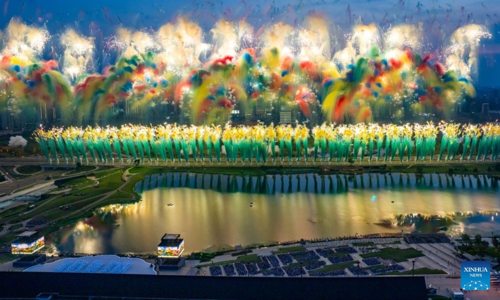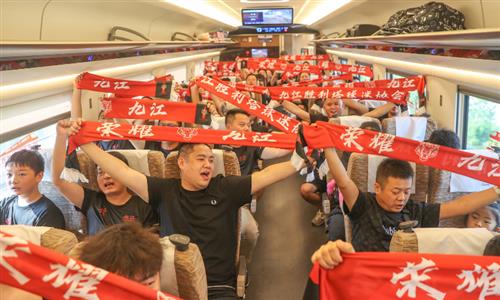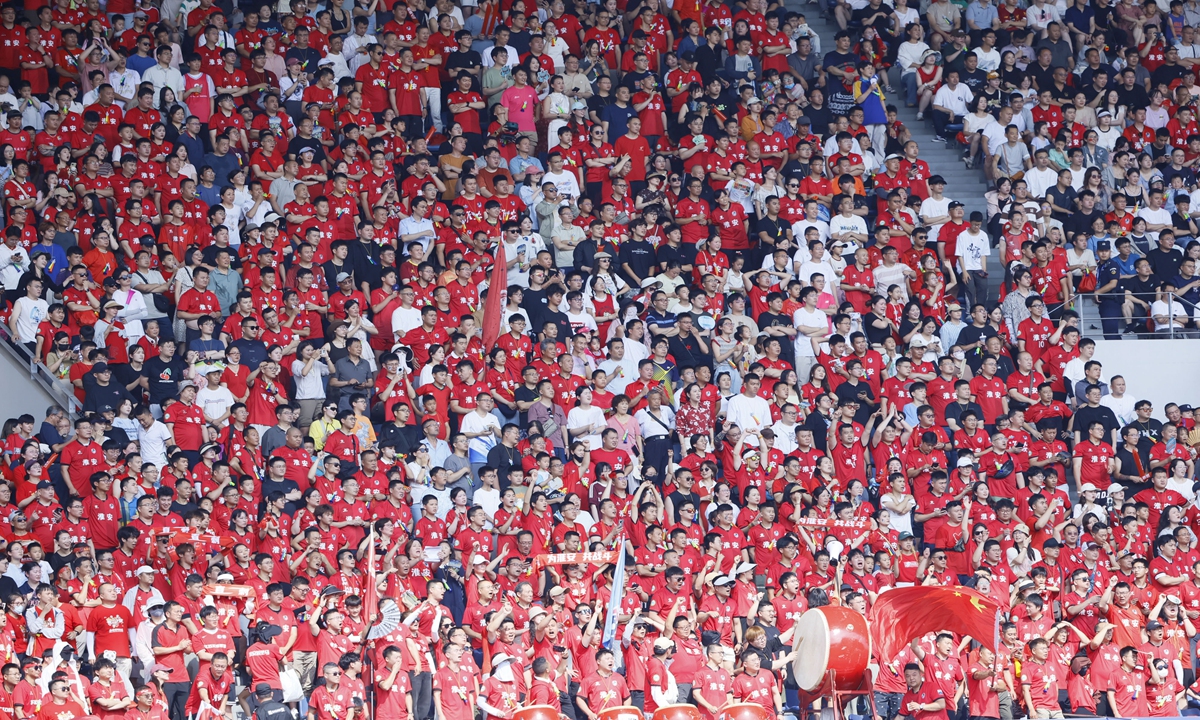
The fourth round of Suchao - Huai'an vs. Nanjing sets a new attendance record on June 14, 2025. During the fourth round of the tournaments over the weekend, there were more than 25,000 spectators per match, according to the Xinhua News Agency. Photo: VCG
China aims to cultivate a number of sports enterprises and events with global influence, and the country's sports industry is projected to exceed 7 trillion yuan ($980 billion) by 2030, according to guidelines released by the Chinese authorities on Thursday. This target is part of broader efforts to promote sports as a key sector for economic growth and social development, according to an industry expert.
The General Office of the State Council, China's cabinet, issued the new guidelines aimed at stimulating sports consumption and driving the high-quality development of the sports industry.
The guidelines outline comprehensive measures aimed at expanding sports product supply, stimulating consumer demand, strengthening sports business entities, and enhancing industry support, so as to cultivate new growth points in the sports industry, according to an official document released on Thursday.
China will accelerate the construction of the modern market system for the sports industry, continuously boost sports consumption, and enhance the overall strength and competitiveness of the sports industry, said the document.
The guidelines emphasize the need to enrich sports events and activities by introducing specialized policies for the event economy's development. This includes creating a multi-level event system, cultivating professional sports events with independent intellectual property rights and international influence, and supporting emerging sports projects.
Successive policy support will be introduced to boost the ice-and-snow economy and promote the outdoor sports industry, according to the guidelines. For example, leveraging the unique natural resources of different regions, authorities will promote the development of a diverse range of outdoor sports projects such as mountaineering, water sports, automobiles, motorcycles, and aviation, and promote the construction of high-quality outdoor sports destinations.
Notably, on the basis of ensuring safety, the conduct of activities such as low-altitude flying sports, aviation model sports, and simulated flight will be encouraged to enhance low-altitude sports consumption, said the guidelines.
To engage 300 million people in winter sports, China will continue to roll out people-oriented policies: advocate for the inclusion of appropriate ice-and-snow equipment in the large-scale equipment update support framework and vigorously implement the strategy of "South exhibition, West Expansion and East advancement" for ice-and-snow sports, per the guidelines.
Meanwhile, to boost consumer demand, the guidelines propose expanding sports consumption scenarios by utilizing urban spaces and integrating sports facilities into commercial and residential areas. They also encourage the creation of immersive sports consumption experiences and the extension of operating hours for sports venues to promote nighttime sports consumption.
Financial incentives, including sports consumption coupons and digital red packets, are proposed to encourage broader participation, according to the document.
"Inspired by the country's robust policy guidance, sports events are fostering integrated development across multiple sectors, and injecting strong momentum into the sustained growth of domestic consumption," Jiang Yiyi, a tourism and sports expert at Beijing Sport University, told the Global Times on Thursday.
The new guidelines reflect China's commitment to leveraging the sports industry as a driver of economic growth, Jiang said, adding that by focusing on expanding product supply and stimulating consumption through industry support, it will create a vibrant and sustainable sports ecosystem that benefits both businesses and consumers.
As an example of the sport industry's boom, grassroots sports events such as the Jiangsu Football City League (also known as Suchao) and the Zhejiang Provincial City Basketball League (ZheBA), have been dedicated to sports-driven consumption and have injected new economic momentum into the local consumer market.
According to the Zhejiang Sports Bureau, the first phase of ZheBA showcased an impressive array of achievements, including 250 preliminary matches that attracted a cumulative audience of 778,800 spectators. This phase generated a remarkable 603 million yuan in cultural, tourism, business, and sports-related consumption, along with ticket revenues amounting to 5.76 million yuan, the Xinhua News Agency reported on August 17.
Yet the huge potential of the sports industry remains untapped, said Jiang. "The total scale of China's sports industry has grown at an average annual rate of more than 10 percent in the past five years," said Yang Xuedong, economic director at China's General Administration of Sport, adding that China's ice-and-snow industry has grown from 381.1 billion yuan in 2020 to 970 billion yuan in 2024, Xinhua reported.
Global Times
RELATED ARTICLES